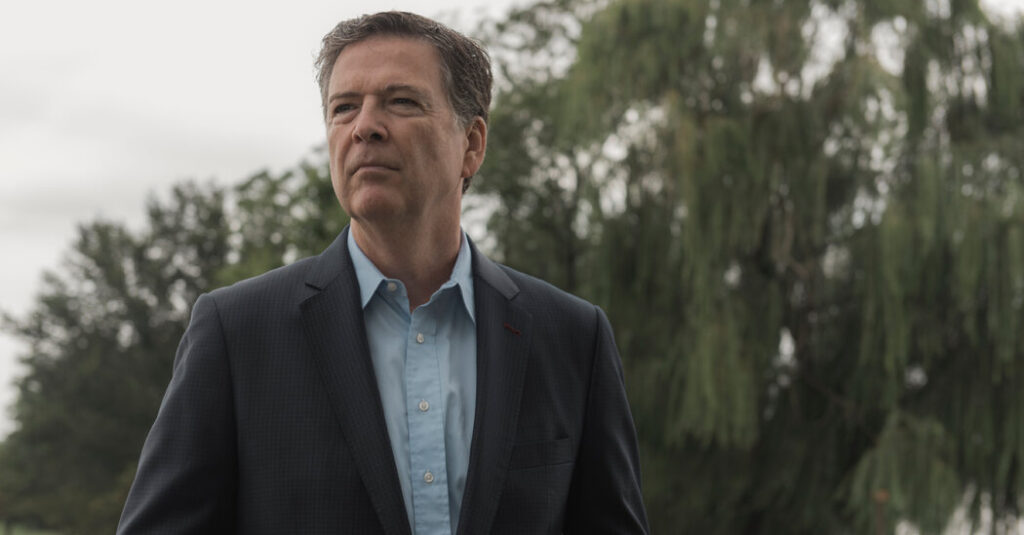
Federal prosecutors have issued a grand jury subpoena demanding testimony from Daniel C. Richman, a close confidant of James B. Comey, the former F.B.I. director and one of President Trump’s most reviled political adversaries, according to a person familiar with the matter.
The subpoena, issued by prosecutors in the U.S. attorney’s office for the Southern District of Florida, appears to be connected to the so-called grand conspiracy case that has sought to implicate Mr. Comey and other federal officials who have investigated Mr. Trump in an overarching plot to deprive him of his rights. It was a small but significant escalation of the Florida case and the latest move in a persistent campaign to go after Mr. Comey in particular who has already been indicted twice in separate cases in Virginia and North Carolina.
It remained unclear what sort of testimony the prosecutors in Florida want from Mr. Richman, a law professor at Columbia University who once served as an adviser to Mr. Comey at the F.B.I. But he has found himself caught up in two previous investigations of his friend and former boss.
One of the inquiries — which ended without charges — sought to determine whether Mr. Comey had used Mr. Richman as a conduit to leak information to the news media about sensitive investigations conducted when he ran the F.B.I. The other resulted in an indictment last September accusing Mr. Comey of lying to Congress about some of the same matters covered in the leak investigation.
The Justice Department did not respond to an email seeking comment on the subpoena.
The inquiry in Florida is the third time Mr. Richman has been called to provide information about Mr. Comey. The investigation is being led by Joseph diGenova, a Trump loyalist who has convened a grand jury in the Federal District Court in Fort Pierce overseen by one of the president’s friendliest appointees to the bench, Judge Aileen M. Cannon. It has targeted other former officials who have triggered the president’s ire — chief among them, John O. Brennan, a onetime C.I.A. director.
The grand conspiracy case is arguably the most far-fetched of the Justice Department’s serial efforts to pursue Mr. Trump’s political opponents. Under Mr. diGenova’s leadership, prosecutors have tried for months to connect disparate inquiries into Mr. Trump — including the investigation into ties between Russia and his 2016 presidential campaign and the later inquiry into his mishandling of classified documents — as a single, long-running scheme to damage his political prospects.
Mr. Comey first ran afoul of the president when he oversaw the early stages of the Russia investigation and was ultimately fired by Mr. Trump in May 2017. That move led to the appointment of a special counsel, Robert S. Mueller III, who continued the inquiry but eventually determined that charges could not be brought against a sitting president.
When prosecutors in Virginia filed their first indictment against Mr. Comey, they relied heavily on a trove of text messages and emails between him and Mr. Richman. Those communications, they claimed, proved that Mr. Richman had served as an intermediary funneling information to journalists on behalf of Mr. Comey.
That first case was dismissed in its entirety in November after a federal judge determined that the inexperienced prosecutor ordered by Mr. Trump to bring the charges had been improperly appointed to her post. Mr. Richman quickly complicated the Justice Department’s efforts to bring a new indictment involving similar accusations by persuading a federal judge that investigators, in a glaring misstep, had improperly obtained his communications with Mr. Comey in the first place.
Five months after the initial charges were dismissed, the Justice Department brought a second indictment against Mr. Comey, accusing him of threatening to kill Mr. Trump by posting a photograph of seashells arranged on a beach in North Carolina spelling out a message reading, “86 47.”
Prosecutors claim that “86” is a mafia term meaning to kill someone and that “47” was a reference to Mr. Trump’s role as the nation’s 47th president. But lawyers for Mr. Comey have scoffed at the idea that the photo was a real threat against the president, adding that prosecutors have been unable to come up with any evidence that Mr. Comey meant to harm Mr. Trump.
The post Justice Dept. Issues Grand Jury Subpoena to Comey Confidant appeared first on New York Times.