Stevie Nicks wasn’t done yet. Her poignant, twirl-happy duet of “Landslide” with the 23-year-old pop star Olivia Rodrigo had just closed out the inaugural Daisy Chain Fields, a sold-out, one-day festival in Irvine, Calif., created by Rodrigo to raise money for women-oriented charities and to spotlight female artists like the pop supernova Chappell Roan, the hip-hop firebrand Doechii and the pioneering punk band Bikini Kill.
But just after the stage lights went out, Nicks used the witchcraft of her charisma to command them back on, because she had something else to say. “I’m somewhat awe-struck that she could do all this, because it’s so hard,” Nicks told the crowd of around 45,000, gesturing to a beaming Rodrigo. “You have no idea, putting something together with all these people.”
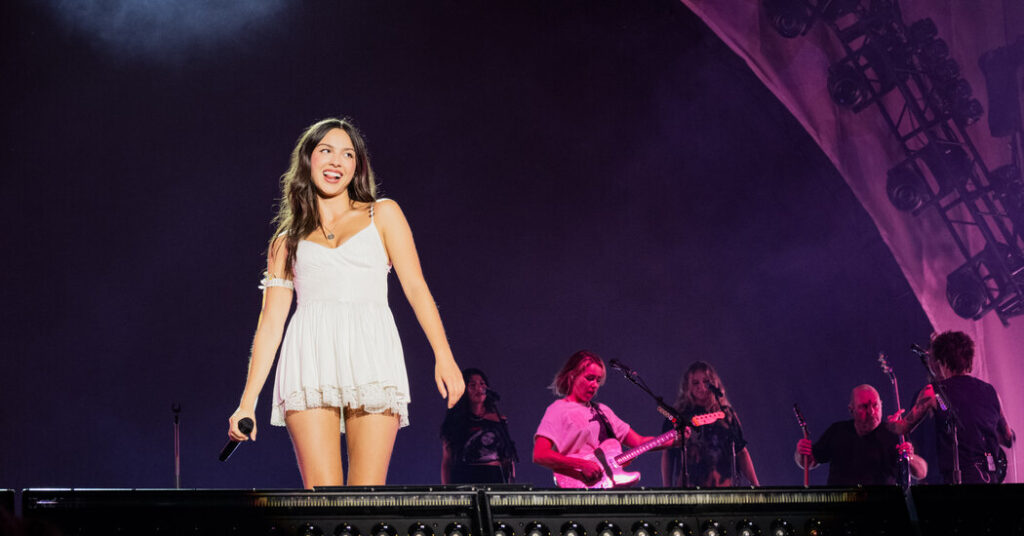
Nicks was one of several fairy godmothers who descended upon Rodrigo’s triumphant, 80-minute headlining set, during which she performed material from her new album “You Seem Pretty Sad for a Girl So in Love” and in turn helped crystallize the image of this event she had just pulled off with a stage presence that oscillated between a politician’s poise and a rock star’s sense of abandon.
The set’s opening benediction was given by the philanthropist Melinda French Gates, who had just pledged to match every dollar that the festival had raised for 10 different nonprofits including Planned Parenthood, the Center for Reproductive Rights and the Black Mamas Matter Alliance, bringing the grand total up to $20 million. The Canadian folk-rock star Sarah McLachlan, in fine voice, also joined Rodrigo to sing two songs, including her weepy ballad “Angel,” which a teary-eyed McLachlan dedicated to “the biggest philanthropist in the history of country music, Dolly Parton.” (In 1997, McLachlan created Lilith Fair, the short-lived but wildly successful tour that Rodrigo said inspired Daisy Chain Fields.)
Toward the end of her set, Rodrigo also brought out another surprise guest: Alanis Morissette, a fellow female rocker who once rose to youthful, overnight fame on the strength of her feelings-forward, jagged-edged hits. Together, their eyes locked and, glowing with mutual appreciation, they sang “Ironic,” a 1996 smash that Morissette wrote just before her 20th birthday.
In its first iteration (Rodrigo hinted from the stage that it would return next year), Daisy Chain Fields was not without its own Morissetian ironies. Attending was both spiritually inspiring and physically grueling, as temperatures crept into the mid-90s and the location in Irvine’s Great Park offered scant relief from the scorching August sun. The festival persistently megaphoned messages of equality, but it still offered the best views of the stage to those who had paid $1,250 for special “pit access” tickets.
Nonprofits and feminist art installations from the likes of Jenny Holzer and Yoko Ono were centered in the festival’s highly photogenic visual branding, but so, perhaps inevitably, were corporate sponsors like Taco Bell, which offered plenty of flowery photo ops for fans who endured the long lines to sip Rodrigo’s cheekily named custom soda brew, You Seem Pretty Pink for a Baja Blast.
My shoulders by then seemed pretty pink for someone who had reapplied her sunscreen. At the peak of the afternoon heat and in a line for food that lasted as long as indie-pop singer-songwriter Mitski’s entire set, I chatted with a mother of two who felt like she and her children had spent the entire day waiting in a succession of lines: two hours to enter the Etsy Creative Village tent, another hour to buy merch — even in the supposedly less populous V.I.P. area where tickets had gone for $500 a pop.
Can a mainstream music festival ever be a truly utopian space? Probably not, and these are some of the same complaints plenty of people might have about Coachella or Governors Ball. But I air these grievances in keeping with the beliefs that Rodrigo encouraged throughout Daisy Chain — that improvement is always possible, that learning is a vital part of change, and that, even in a space as rife with noxious misogyny as the music industry, the status quo can indeed be radically reimagined, preferably with a sprinkle of Stevie Nicks’s gold dust.
Though there was a sizable contingent of hip parents sweating it out alongside their excitable tweens and teens, a majority of Daisy Chain attendees looked to be groups of friends in their early 20s. The most common sartorial trends were floral accessories (duh), band merch and feminist-minded message T-shirts, one of which supported a particularly 21st-century cause: “BAN MALE PODCASTS.”
McLachlan’s presence during Rodrigo’s set invited an opportunity to reflect on the ways in which Daisy Chain had improved on an earlier model. In the late-’90s cultural imagination, “the Lilith Fair sound” was enough of a thing to be easily identifiable and, at times, mercilessly lampooned. (On “Saturday Night Live,” Ana Gasteyer played a fictitious Lilith Fair performer named Cinder Calhoun, who described herself as “a funny wordsmith folkist who came out of the singer-songwriter tradition.”) It is probably a mark of progress, then, that Daisy Chain featured such a wide, multitudinous array of genres and personalities that it would be impossible to reduce to a single aesthetic.
The hard-rock quartet Die Spitz played a satisfyingly pummeling set — inspiring some seemingly harmonious mixed-gender mosh pits — right after the sugary electro-pop artist Devon Again. The kinetic rapper Doechii commanded the main stage (she and her dancers sported head-to-toe pink body paint that made them look like aliens from Planet Matriarchy) before the secondary stage shifted into the crunchy alt-rock sounds of Garbage. Much of the crowd that gathered to watch the beloved riot grrrl band Bikini Kill sang along to every word of Chappell Roan’s wrenching situationiship ballad “Casual,” which played over the P.A. system while the band’s gear was being set up, and which Roan herself would later play on the main stage during an electric, fan-favorite set.
Rodrigo has by now become known for her earnest attempts to bridge such generation gaps and for trying to convince her younger fans that it’s cool to circumvent the passivity of the algorithm with educational deep dives into alternative rock’s past. Daisy Chain effectively embodied that ethos, and it offered a rare opportunity for conversation on both sides of that exchange.
During Bikini Kill’s gloriously galvanizing set, the vocalist Kathleen Hanna addressed the crowd with her typical off-the-cuff, heart-on-sleeve candor. A younger generation of fans who embraced nonbinary gender identities prompted her to rethink the phrasing of the band’s slogan “girls to the front,” because, 57-year-old Hanna said, “you can’t tell who’s a girl just by looking at them, and we don’t want to reinforce that [expletive].” She added, “I just want to say to all the people younger than me, keep teaching people who are older than you, even if they are being hesitant and weird and [expletive] up about it.”
From the stage, Hanna also recalled days when she and her female bandmates were pelted with sexist slurs and constant objectification. The male gaze was less of a direct threat these days, she suggested. But a more modern reality loomed over the entire festival, for better or worse: The constant presence of the digital gaze, that omniscient pressure to always look camera-ready in the most Instagrammable festival ‘fit, to find the best backdrop and angle, and thus to look like one is having a FOMO-inducing amount of fun at all times.
Despite how rosy it might have looked online, Daisy Chain Fields wasn’t always perfect IRL: The weather was punishing, the lines stretched interminably and the journey out of the parking lot was like a modern-day remake of “The Odyssey.” But still, at a macro level, Rodrigo pulled it off, driven by what Nicks described from the stage as “this grace and crazy, crazy energy she has.”
The power of that energy was on display when Rodrigo performed “Expectations,” a vampy new-wave number ostensibly about setting higher standards for romantic partners — “I won’t settle for a guy with a fake job,” Rodrigo proclaims on the chorus. At Daisy Chain, she used a call-and-response breakdown to make the song expand into something even greater. She asked all the girls in the crowd to sing the bridge as loud as they could, and the unity of tens of thousands of voices made it sound like a mantra: “I’ve got big expectations,” they sang at the tops of their lungs. “I’ve got real big expectations.” Who knows what sort of seeds were planted in that moment, what sort of wild things they might bloom into?
The post Olivia Rodrigo Reinvents the Feminist Music Festival appeared first on New York Times.