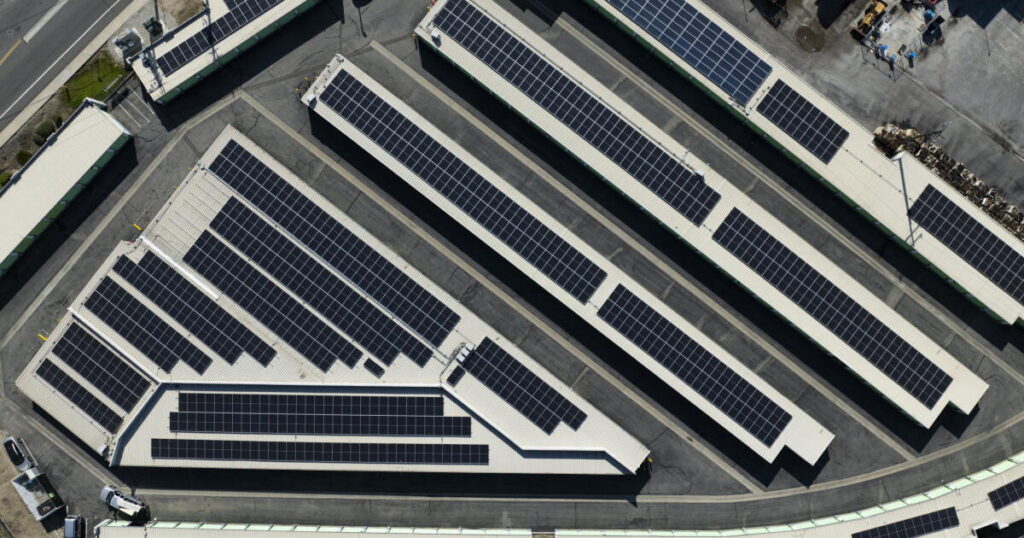
The California Legislature just passed two bills that advocates say will greatly improve access to small-scale solar for renters, people in condos and others who don’t have access to their roofs or can’t afford a full rooftop array.
On Sunday night, lawmakers approved Assembly Bill 1813, a third-time effort to force the California Public Utilities Commission to develop a more robust community solar program, in which residents sign up to participate in a small solar array built nearby and pay monthly at a discount on their electrical bills.
Last week, with Senate Bill 868, California’s Legislature also became the latest to legalize plug-in solar. Also known as “balcony solar,” these systems allow anyone — renter or owner — to set small panels on their patios or fences and plug them directly into wall outlets to lower bills without having to navigate utility permissions.
“It’s an idea whose time has come,” said bill author Sen. Scott Wiener (D-San Francisco), who noted the devices can bring down bills by hundreds of dollars a year. “It’ll be very beneficial for people who are looking to lower their cost of living.”
The votes come after some difficult years for rooftop solar in California thanks to strong pushback from utility companies. The state had been a leader nationally on solar energy in the 2000s. But installation rates plummeted in 2022 after Gov. Gavin Newsom’s Public Utilities Commission sharply cut back incentives for customers.
Utilities that lobbied for the change argued that compensating rooftop solar at a higher rate meant that people without solar panels were disproportionately paying the costs of maintaining the overhead lines that everyone uses.
This year, utilities made similar arguments against both the community solar and balcony solar bills.
Pacific Gas & Electric was successful in inserting an end date for Wiener’s SB 868 balcony solar bill, so, if it is signed into law, the Legislature will have to reauthorize it before 2030.
“While the bill establishes additional guardrails, it also creates a period through 2030 during which plug-in solar devices not meeting key safety and certification requirements could be purchased and used in California,” PG&E spokeswoman Lynsey Paulo said. “We believe customers and emergency personnel deserve the protections that come from clear safety standards and established interconnection processes from the outset.”
Both bills now go to the governor’s desk.
If signed, the balcony solar bill will go into effect once systems have been certified as safe for use in the U.S. by a nationally recognized testing laboratory like UL Solutions. Balcony panels are already certified in Germany, where plug-in solar is popular. Advocates say U.S. certifications will come through soon.
Community solar reform could have a harder time clearing Newsom’s desk, as the Public Utilities Commission, appointed by the governor, has previously opposed this type of program.
All the state’s big investor-owned utilities lobbied against the community solar bill, AB 1813, which would require them to compensate community solar developers and customers at higher rates than those established under the Public Utilities Commission’s current program.
That program, finalized this year, relies on canceled federal funding and incentives that developers say are too low for them to launch new projects.
“We remain opposed to AB 1813 because it would shift significant costs to customers who do not participate in the program,” PG&E’s Paulo said. “This legislation is about profits for solar companies, not customer affordability.”
The Public Advocates Office, the independent consumer advocate at the Public Utilities Commission, said recent amendments to the bill did not address its concerns about shifting costs from one group of ratepayers to another.
“We support expanding community solar so renters and other Californians who cannot install rooftop solar can benefit from clean energy. But the savings for participants should not be financed by raising bills for everyone else,” said Mary Flannelly, a spokesperson for the Public Advocates Office. “Our analysis of AB 1813 estimates that it could shift about $1.5 billion a year onto customers who cannot participate — roughly $12 more per month on average — a sizeable cost.”
Southern California Edison also has opposed the bill. SCE spokesperson David Eisenhauer said it would “expose customers to higher rates and unreasonable costs compared to more cost-effective clean energy sources.”
Assemblymember Chris Ward (D-San Diego), who authored AB 1813, and a coalition of environmental groups, solar developers and the Utility Reform Network, a ratepayer advocacy group, have tried for years to get the commission to adopt their vision for a community solar program that would serve people who don’t own or don’t have access to their roofs. Several other states have them.
The bill would compensate community solar developers and customers at a rate that advocates say more accurately accounts for the savings solar brings to the grid, especially on hot days when the system is stressed.
Ward said low-income residents affected by high electricity bills are exactly the type of customers his legislation is intended to support.
Wiener said both bills are important for helping individuals and communities “to not be trapped in the monopoly utility model that is so expensive.”
“We should empower people to generate their own electricity and to lower their electric bills,” he said.
Times staff writer Ian James contributed to this report.
The post Solar power for renters would get easier with two bills now on the governor’s desk appeared first on Los Angeles Times.