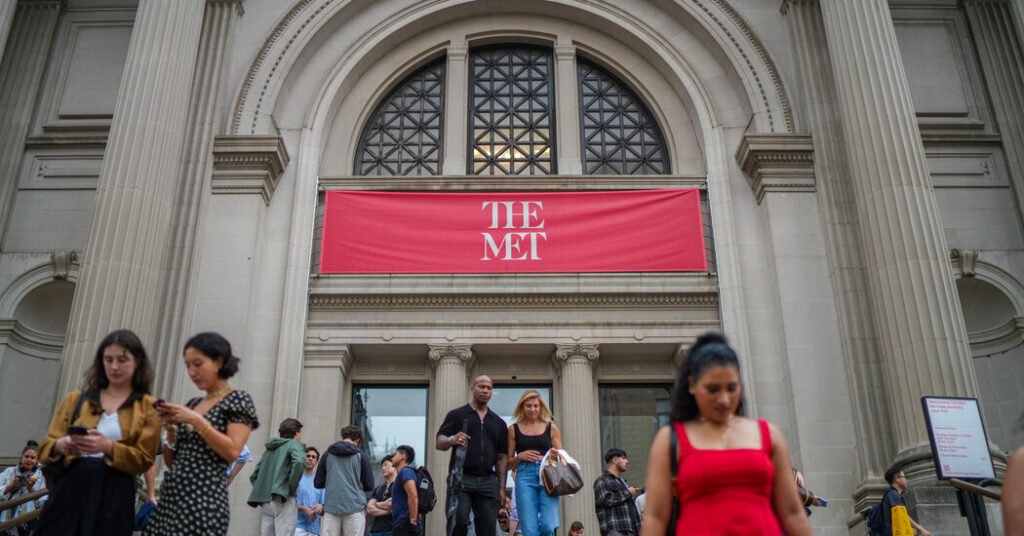
Facing an intense backlash, the influential fashion designer John Galliano has taken the unprecedented step of withdrawing from a planned exhibition in his honor at the Metropolitan Museum of Art.
“After much reflection and discussion with all those involved, I have decided, with great sadness, that it is best for the exhibition not to take place at this time,” Galliano wrote in a statement posted to his Instagram page.
He also expressed “profound and enduring” gratitude to the museum’s leadership, and acknowledged the pain his past words had caused.
“I do not want the debate surrounding me to place the Met in a difficult position or distract from the remarkable work of the Costume Institute,” he wrote. “I also recognize and respect that an exhibition honoring my work would be painful for some.”
In a statement on Monday, Max Hollein, the director of the Met, said, “Following thoughtful discussions with John Galliano, we have together decided not to proceed with the exhibition.”
The cancellation came at a time when a number of donors and political leaders were coming forward to express their opposition to the nine-month exhibition, which had been scheduled to begin with next year’s Met Gala.
In recent days, a furor mounted over the museum’s choice to honor Galliano, who was convicted of an antisemitic hate crime by a French court in 2011. He would have been only the third living designer to receive a solo exhibition at the Costume Institute, the Met’s fashion wing.
Given that the Met Gala has traditionally served as the opening night for the Costume Institute’s spring exhibition, the plan risked placing the museum in the position of seeming to sanctify Galliano during an event that has become the Super Bowl of glamour.
Galliano’s departure became known on Monday, just as key members of the Met’s board of trustees were scheduled to gather for a morning meeting to discuss the fate of the exhibition. Museum leadership had also called a Zoom meeting of the board for Monday at 4 p.m. to “focus on a discussion of the Costume Institute,” according to an email invitation that was shared with The New York Times.
On Friday, The Times quoted Jewish leaders who spoke out against the planned exhibition. They included Arne Glimcher, an art world titan who threatened to cut the museum out of his will; Julie Menin, the speaker of the City Council; and Elisha Wiesel, the chairman of the Elie Wiesel Foundation.
The Met is one of the 39 arts institutions operating on city-owned property, and it receives millions of dollars of annual support from the New York City Department of Cultural Affairs. Its ties to the city made its decision to honor Galliano a political issue.
Menin, the speaker of the City Council, sent a letter to Met leadership late last week, becoming the first local politician to oppose the planned Galliano exhibition. In an interview on Sunday, Menin, a Democrat, called the since-canceled show “a gut punch to the Jewish community in our city, who are already reeling.”
In 2011, a French tribunal ruled that Galliano had made hateful remarks about Jews and Asians in two incidents at a bar near his home in Paris. At roughly the same time, a video circulated showing Galliano saying “I love Hitler” and telling appalled patrons that “your mothers, your forefathers” would all be “gassed.”
He was fired from his job as the creative director of Dior, a post he had held for 15 years, when the video surfaced. In 2014, after Galliano had gone through a stint in rehab and discussed Judaism and its history with rabbis and the former head of the Anti-Defamation League, he became the creative director of Maison Margiela and was re-embraced by the fashion world.
Brad Lander, a Democratic congressional candidate from Brooklyn, was among the politicians who came forward in recent days to criticize the Met’s plan to honor Galliano, calling it “a bad mistake.”
“This seems very straightforward to me,” Lander, said on Sunday. “They should cancel the show and change the Met Gala honoree.”
Those critics were joined by Alice Tisch, a prominent donor to the museum. On Friday, as the backlash mounted, Tisch sent an email to Hollein, the museum’s director.
“This exhibit bespeaks a failure of governance,” Tisch wrote.
She went on to call the planned exhibition a “whitewash,” adding that “it is not in the museum’s interest to have this perception out there, and it flies in the face of your rich curatorial history and ongoing fiscal and moral leadership.”
Tisch forwarded her email to some people close to her, and it made its way across New York society over the weekend and was viewed by The Times.
Her words carry weight with the museum. Through a foundation, she and her husband, Thomas Tisch, gave hundreds of thousands of dollars to the Met between 2020 and 2024, tax filings show. (Thomas’s sister-in-law, Merryl, is a Met board member whose daughter, Jessica Tisch, is the New York City police commissioner.)
On the watch of Anna Wintour, the chief content officer of Condé Nast and a museum trustee, the Met Gala has become a star-studded benefit, with celebrities seated among billionaires at tables costing hundreds of thousands of dollars.
As Wintour’s presence at the museum has grown, so has that of Condé Nast, a regular sponsor of the Costume Institute exhibitions. Last year, the 11,500-square-foot space off the Great Hall got a new name: the Condé M. Nast Galleries. That is where the Galliano exhibition had been scheduled to take place.
The Met was aware that a show in honor of the designer, a longtime Wintour favorite, might cause a backlash. Before committing to the exhibition, Galliano met with Jewish leaders in gatherings arranged in part by Wintour and Andrew Bolton, the curator of the Costume Institute.
Most of the Jewish leaders came away satisfied that Galliano was sufficiently repentant for the hateful remarks he had made. When news of the exhibition became public, Wintour told The Times, “There is no one more deserving of an exhibition of this scale than John Galliano.” She added: “His career isn’t defined by a single moment.”
But others questioned why the museum had decided to honor him at a time of rising antisemitism. Angela W. Buchdahl, the senior rabbi of Central Synagogue, a reform synagogue in Manhattan, was even invited to be on the host committee of the gala by Wintour, but declined.
Micah Lasher, a New York assemblyman who represents the Upper West Side and recently won the Democratic primary for the 12th Congressional District, which includes the museum site, joined the chorus of criticism in an interview on Sunday.
“This is not a freedom of expression issue,” he said. “This is a judgment issue, and I am baffled that anyone saw this as anything other than a terrible idea that would amount to the normalization of antisemitism.”
Sam Raskin, a spokesman for Mayor Zohran Mamdani, delivered a statement on Sunday: “John Galliano’s repeated use of antisemitic language is vile. The Mamdani administration recognizes that the Met’s decision to honor him has caused pain and anger among many Jewish New Yorkers. The Met is an independent institution and its decisions — and how it responds to the many Jewish New Yorkers appalled by this choice — are ultimately its own. But independence does not mean insulation from criticism.”
On Monday, the Met issued a statement: “Information on a new spring Costume Institute exhibition and the 2027 Met Gala will be announced at a later date.”
The Met Gala, which takes place on the first Monday in May, raises tens of millions of dollars each year for the Costume Institute. The benefit has been run by Wintour, the global editorial director of Vogue, since 1999. The guests are the first to see the Costume Institute exhibition. As crowds stand outside the museum among the paparazzi, the A-listers funnel through the show between the cocktail party in the Great Hall and the dinner at the Temple of Dendur.
The connection between the annual gala and the exhibition became even closer this year, when the Costume Institute galleries were moved near the Great Hall and named the Condé M. Nast Galleries. As a result, the Costume Institute show is one of the first things any visitor to the museum will see. That is where a Galliano exhibition would have taken place.
The post John Galliano Withdraws From Met Museum Show After Backlash appeared first on New York Times.