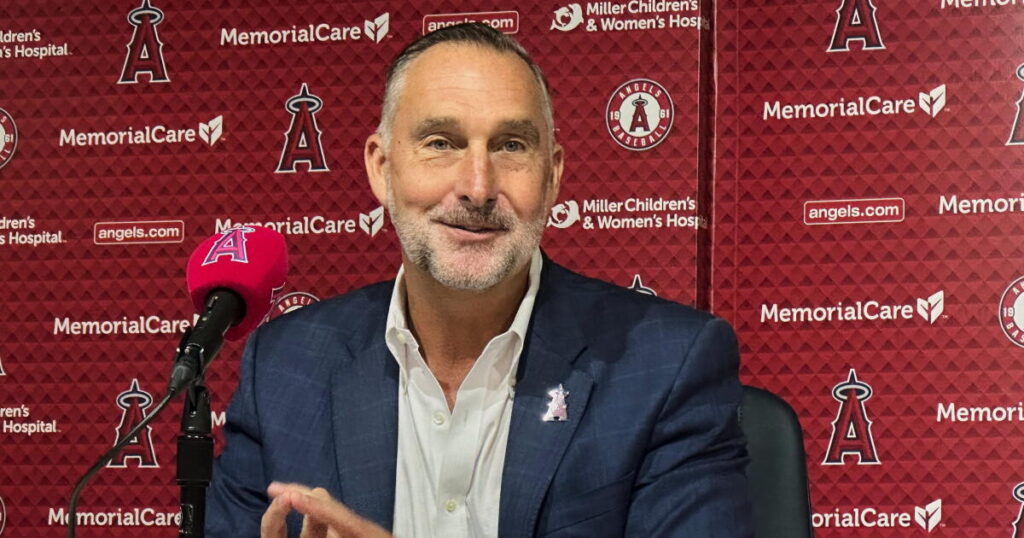
In two months as the Angels’ interim general manager, John Mozeliak has reoriented the team’s draft selection priority from “closest to the majors” to “best available,” traded one-third of the major league roster to seed a barren minor league system, fired three coaches and completed a restructuring of the front office.
On Monday, he has scheduled the first meeting of the new leadership group in baseball operations.
We’ll get to that restructuring, but none of the decisions so far resolve two of the most compelling questions in Anaheim: Who is going to be running the Angels next year? And, with this year’s Angels flirting with the first 100-loss season in franchise history, are the Angels going to be much better next year?
To the latter question: Probably not.
“With the starting pitching we have, if we have the ability to be more consistent with our offense, you can definitely squint and see a better club out there,” Mozeliak told me. “But it’s going to take a few pieces to do that.”
Uh oh. That sounds discouragingly like the Angels of the past decade: We’re undermanned, but we want to be competitive, so we’ll sign a few lower-tier free agents and hope we can sneak into the playoffs with an 83-win season. In the real world, the Angels clinched their 11th consecutive losing season before the calendar turned to September.
Mozeliak has said he did not believe that the Angels need to rebuild, that the resources available to a team in the second-largest market in the majors should preclude outright tanking. In theory, that should mean that Mozeliak could trade José Soriano for shortstop Arjun Nimmala, 20, now the Angels’ top prospect, comfortable that owner Arte Moreno could buy a quality free agent to replace Soriano in the starting rotation.
In reality, Mozeliak cannot rightly tell Moreno that the Angels are one or two free agents from winning. And, as Mozeliak said, “It’s not the most robust free-agent class of all time.”
The Angels rank 26th among the 30 major league teams in runs scored, so Mozeliak might well focus on offensive upgrades. Standout names among free agent hitters this fall: Luis Arraez, Gleyber Torres, Jake Bauers … Taylor Ward, anyone?
With the infusion of talent from the draft and the trade deadline, analyst ratings for the Angels’ minor league system have risen from among the worst in baseball to middle of the pack. It’s a start. If next season is about building, why not just play the kids?
Rookie Denzer Guzman is batting .218, with a .263 on-base percentage and a .341 slugging percentage.
“We’re starting a 22-year-old at third base,” Mozeliak said. “Most 22-year-olds are finishing their senior year in college. He’s competing. There’s a lot of upside in him, but that requires a little patience.”
Of the 12 prospects Mozeliak acquired at the trade deadline, he said he anticipated two — designated hitter/catcher Moises Ballesteros and infielder Nacho Alvarez Jr. — would have a chance to make next year’s team. The Angels also would prefer not to replace Soriano from a blossoming corps of young arms.
“We don’t want to start reaching down to the minors to try to push someone that might not be ready,” Mozeliak said. “I think we’ve seen that here before.”
As Mozeliak restructures the roster, he is doing the same in the front office. He said he is elevating Matt Swanson – removed as scouting director by former general manager Perry Minasian — to oversee all of the Angels’ scouting operations: amateur, professional and international.
The rest of the leadership core, all from within the organization: Joey Prebynski to oversee player development, including a separate minor league director to be hired; Michael Lord to head research and development; and assistant general manager David Haynes, who will focus on major league personnel. Mozeliak said he will ask those leaders to evaluate their departments and make personnel recommendations.
“I think that exercise is going to happen over the next four weeks,” Mozeliak said.
That timeline could mean that the Angels do not hire a general manager by the end of the season, as the team originally outlined. Mozeliak said he has neither interviewed any candidates nor set up any interviews.
Within the industry, former major league pitcher and current St. Louis Cardinals assistant general manager Randy Flores is considered the favorite, with Mozeliak remaining either as a president of baseball operations or a senior adviser.
Mozeliak insists he has not decided what he wants to do beyond the season, and he said his long working relationship with Flores in St. Louis will not preclude a round of interviews.
“I certainly understand that Molly [Jolly, the Angels’ team president] and Arte would want a very exhausting search,” Mozeliak said, “and one that isn’t just two degrees connected to Mo.”
If the Angels get to the end of the season without a general manager, who would make the call on whether to retain manager Kurt Suzuki and the coaches?
“Based on the timeline today, it would feel like it would be our group now,” Mozeliak said, “but time will tell.”
If the Angels dismiss Suzuki, that would allow a new general manager to hire a new manager. If Mozeliak decides to retain Suzuki, that could set up the awkward prospect of a new general manager inheriting a manager he did not choose, as Minasian did with Joe Maddon. In Minasian’s six seasons as general manager, the Angels had five managers.
The Angels could use a little more time. In 2027, they just might get it, and perhaps no organization could benefit more from it.
If owners lock out major league players for all or part of the season, in a year Mozeliak suggests might be best remembered for the development of minor league players, that might be no great loss for the Angels. Better than 100 losses, certainly.
The post What’s next as John Mozeliak revamps the Angels? The interim GM discusses his plans appeared first on Los Angeles Times.