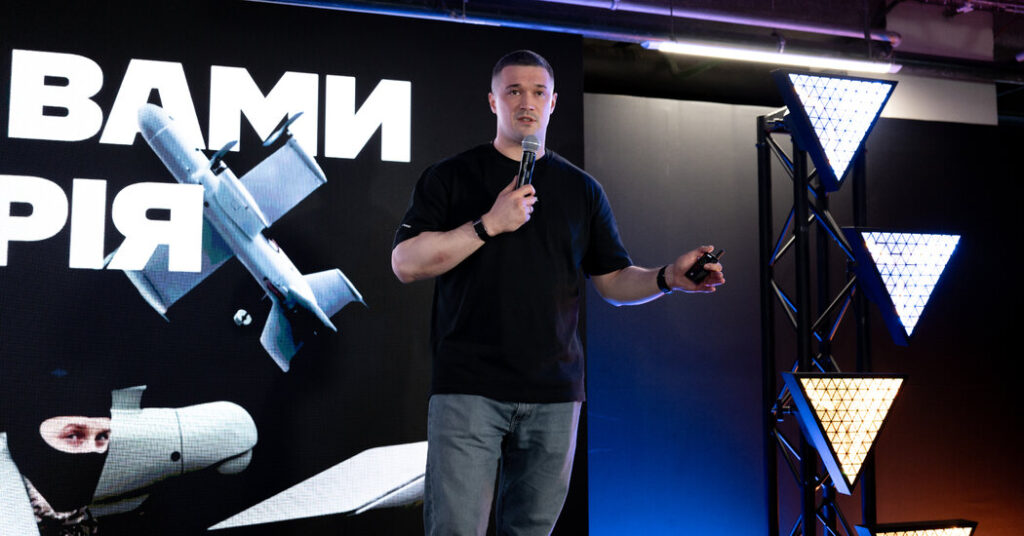
Ukraine’s former defense minister and a mastermind of its drone warfare, Mykhailo Fedorov, has been enlisted to advise the Italian defense minister on modern military strategy, weeks after he was fired from his position in the Ukrainian government.
Mr. Fedorov’s appointment highlighted how Russia’s war in Ukraine has fundamentally altered the conduct of 21st-century warfare, and countries around the world are racing to adapt their militaries to the emerging technologies developed on Ukrainian battlefields.
Guido Crosetto, the Italian defense minister, announced Mr. Fedorov’s appointment on Friday, saying in a statement that, “In a landscape characterized by sudden and unprecedented transformations, in which change amounts to a constant, it is essential to seek opportunities for dialogue and the sharing of experiences.”
Mr. Fedorov said in a separate social media post that he was offering his expertise to Italy “in adopting modern warfare technologies, enhancing its defense sector, and adapting to emerging global security challenges.”
The agreement between Mr. Crosetto and Mr. Fedorov is directly between the two individuals, rather than a formal agreement between the governments of Italy and Ukraine. Mr. Crosetto has appointed other outside experts on issues including industrial policy and artificial intelligence. Mr. Federov, who is Mr. Crosetto’s first non-Italian adviser, will not be paid for his consulting services, according to Italy’s defense ministry.
The office of Italy’s prime minister, Giorgia Meloni, declined to comment.
Mr. Fedorov, 35, is a popular figure in Ukraine who became a symbol of Ukraine’s post-independence generation when he helped modernize the country’s defense sector, first as minister of digital transformation.
After taking over as defense minister in January, Mr. Fedorov often clashed with older military leaders, especially the country’s top general, Oleksandr Syrskyi, who resisted Mr. Fedorov’s push to deploy machines instead of humans and overhaul contentious conscription efforts.
President Volodymyr Zelensky fired Mr. Fedorov in July in order to resolve that dispute, Mr. Zelensky said. The decision was also widely viewed as an attempt to sideline an official whose growing popularity could be perceived as a future political threat.
Mr. Fedorov’s firing triggered rare wartime protests in Kyiv, spurring Mr. Zelensky to also replace General Syrskyi with a new commander in chief. The replacement, Maj. Gen. Mykhailo Drapatyi, represents a younger generation of Ukrainian military officers and had also pushed for major changes to Ukrainian military strategy.
But Mr. Zelensky did not restore Mr. Fedorov to his position.
Despite his new advisory position in Italy, Mr. Fedorov will continue to live in Ukraine and maintain focus on “helping Ukraine stop the enemy,” Mr. Fedorov’s office wrote in a group chat with journalists on Saturday.
She defended Mr. Fedorov’s decision to work with a foreign power, noting that several foreign former officials have also been recruited to advise the Ukrainian government.
“This role does not involve the disclosure of state secrets or the transfer of specialized information required for the development, production, or use of military products,” she wrote.
The appointment drew a mixed response in Italy, where politicians on both the left and the right have criticized the continuation of financial support for Ukraine.
Roberto Vannacci, a far-right leader and former general, implicitly criticized Mr. Fedorov’s appointment in a social media post, saying that while the government focused on Ukraine, including by appointing Mr. Fedorov, “for us ITALY AND THE ITALIAN PEOPLE REMAIN AT THE TOP.”
Marco Travaglio, editor of Il Fatto Quotidiano, an anti-establishment newspaper, wrote in an editorial on Sunday that Mr. Crosetto had chosen an adviser from “one of the most failed, poorly governed, and corrupt countries in Europe.”
But writing in La Stampa, a centrist newspaper, Jacopo Iacoboni described Mr. Fedorov as “one of the big shots on the global stage,” adding that his appointment was “certainly a success.”
Italian defense experts said Mr. Fedorov’s experience could prove invaluable as the government tries to modernize its military. Ukraine has been a “a tragic laboratory of innovation,” said Alessandro Marrone, a defense expert at the Institute of International Affairs, a think tank in Rome.
Italy would benefit, he added, “by having a person with a firsthand experience of how the armed forces have profoundly and rapidly changed in a few years in Ukraine.”
Lt. Gen. Pietro Serino, a former chief of staff of the Italian Army, said he hoped Mr. Fedorov could help the defense ministry to accelerate its procurement of military equipment. Currently, he said, authorizing the military use of a drone takes too long — “between nine and 18 months.”
With elections looming next year, it is unclear whether Italy’s defense minister will have time to implement any of Mr. Fedorov’s advice. And some experts wondered whether the Ukrainian would be able to share much detailed technological or strategic information.
The question, said Gregory Alegi, a historian at Luiss Guido Carli University in Rome, is whether “Mr. Fedorov is at liberty to share actual technology, or just broad philosophical insights.”
Josephine de La Bruyère contributed reporting from Rome.
The post Ukrainian Drone Mastermind, Fired by Kyiv, Will Advise Italy’s Defense Chief appeared first on New York Times.