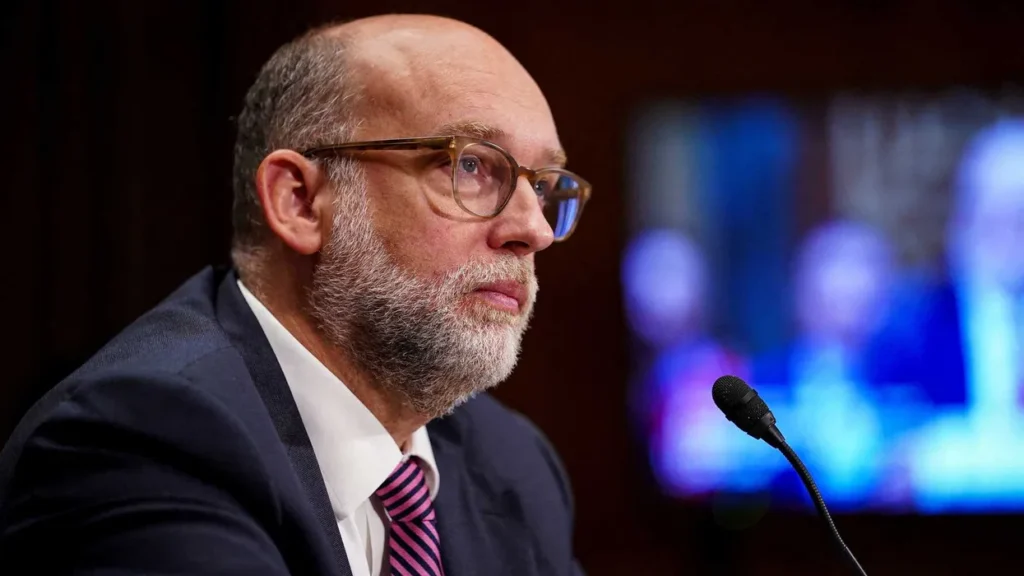
In mid-July testimony before Congress, Russell Vought boasted that, as the acting head of the Consumer Financial Protection Bureau, he’d refashioned the agency’s approach to pursuing banks and other financial companies accused of exploiting Americans — the role Congress had created for the agency after the 2008 economic crash.
Vought had spent the first 18 months of the new Trump administration trying to dismantle the bureau, much as he and other appointees had done with the U.S. Agency for International Development. At CFPB, he’d ordered mass layoffs, tried to choke off the bureau’s funding and ended the lease on its headquarters, attempting to make good on his vow to put civil servants “in trauma.” But federal courts blocked Vought’s efforts to close the CFPB, with a judge at one point saying the administration had acted with “complete disregard” for Congress.
So Vought, who is one of President Donald Trump’s top advisers, switched tactics: If there had to be a watchdog, theirs would be more of a golden retriever, friendlier to industry and less aggressive. Vought had accused the bureau of “thuggery” in the past, and said the “new” CFPB would focus on deregulation, embrace “humility” and adopt a “collaborative approach” to its dealings with companies that harm consumers.
As evidence of the success of this new approach, Vought singled out one company by name in his testimony, a buzzy startup called Bilt. The company, which offers credit cards used to make rent and mortgage payments, had fumbled a critical transition, leading to confusion and financial stress for its customers. In the past, the CFPB might’ve deployed examiners to ensure that every consumer harmed got relief, investigated Bilt’s technology platforms for potential flaws, questioned its third-party contractors or issued subpoenas — with the goal of finding the root causes of whatever went wrong and preventing it from happening again.
The Trump-era CFPB took a different tack. “We reached out to the company,” Vought told Congress, “and before it got to the adversarial part of the process, they were able to fix their issues.” The CFPB even posted a feel-good statement on its website, touting its new approach and telling consumers that information provided by Bilt “appears to show” the firm was “back on track.”
Yet two weeks after Vought’s testimony, Bilt failed customers again. This time, Bilt cardholders received mistaken debt collection notices and saw their credit scores go down as a result, sparking more embarrassing news stories and angry complaints. It was Bilt’s second fiasco in six months, and as its customers scrambled to understand what had gone wrong, the CFPB was nowhere to be found.
The Bilt controversy offered an early test of CFPB’s new approach, and the results suggest that an ask-nicely strategy to consumer protection isn’t likely to protect consumers. What’s more, current and former CFPB officials say the bureau could’ve caught the issues that caused the second of Bilt’s two screw-ups had the previous playbook still been in use.
ProPublica sent the CFPB a detailed set of questions about its handling of the Bilt complaints and what actions it took to protect consumers and prevent future problems. The bureau did not respond to any questions or requests for comment.
The whole episode drives at a bigger question, according to consumer advocates and current and former CFPB employees: If the Trump administration can’t eliminate the CFPB, what will become of it in the hands of Trump officials, such as Vought, who have long believed the agency is unnecessary? (Vought termed out as acting director in early August but remains a senior adviser. The administration’s nominee for full-time director, Brian Johnson, is an executive at Capital One bank and a former CFPB appointee. At his confirmation hearing, Johnson said he could not think of a single decision that he disagreed with made by Vought at the CFPB.)
“What we saw Vought do with Bilt is innovative — and I don’t mean that as a compliment,” said Mike Pierce, a former CFPB official who runs the consumer advocacy group Protect Borrowers, which has criticized Vought’s tenure at the bureau.
A Rocky Transition
Bilt’s business rests on a simple premise: Consumers should build credit and earn rewards for what’s typically their single biggest expense — their rent or mortgage payment. “Prior to Bilt, that payment didn’t build anyone’s credit history, which is crazy,” Bilt co-founder Ankur Jain said in March. Jain added that it was “silly that you can earn rewards buying a round of drinks at a bar, but not paying your rent every month.”
Founded in 2021, Bilt is one of the hottest startups in the personal finance industry. Bilt says it has 7 million customers and has raised nearly $1 billion in venture capital investments, at a $10.75 billion valuation. Investors include private equity giant Blackstone, the Ontario Teachers’ Pension Plan and a venture capital fund chaired by former American Express CEO Kenneth Chenault.
Forbes estimates Jain’s wealth at $3.4 billion. People magazine published exclusive photos of Jain’s 2024 wedding to Erika Hammond, a former WWE wrestler and cast member on the upcoming season of “The Real Housewives of New York City.” The event took place near the Great Pyramid of Giza; one photo shows the couple kissing at sunset with the Sphinx and pyramids in the background.
Earlier this year, Bilt suffered a serious crisis. The startup had signed a seven-year partnership with Wells Fargo to offer Bilt-branded credit cards that could be used to pay rent. Under its deal with Bilt, Wells Fargo agreed to absorb processing fees associated with rent transactions and make payments to Bilt because it saw the partnership as a way to attract new customers who might one day seek a mortgage from Wells Fargo, according to The Wall Street Journal.
But revenue fell short of Wells Fargo’s projections, and the bank was losing so much money — as much as $10 million a month, the Journal reported — that it ended its partnership with Bilt four years early. (A Bilt spokesperson said at the time that the Journal’s reporting was “an inaccurate representation” of the Wells Fargo partnership.)
In February, Bilt relaunched its credit cards with new financial partners. But the rollout of “Bilt 2.0,” as the company called it, was a debacle.
Customers said their rent payments were paid late, double-charged or not paid at all. Credit limits had been lowered from one card to the next. Their cards were inexplicably frozen. “This unexpected double charge has caused significant inconvenience and financial distress,” one Bilt customer wrote to the CFPB in February after Bilt paid her rent twice in the same month. (A Bilt spokesperson said, “As soon as we were made aware of this issue, we resolved it and made the member whole.”)
Bilt’s customer support department struggled to keep up as tens of thousands of messages poured in. Customers fumed that they were unable to bypass chatbots and reach a human being for help. They also bombarded the CFPB’s website with complaints, which included accounts of how Bilt’s AI support system gave information that was “completely wrong” and “demonstrably … false.” (In a statement at the time, Bilt said its new card had “attracted unexpectedly high demand, and some of our members experienced gaps in service that are simply unacceptable to us.” The company told ProPublica it resolved all problems related to the new cards “months ago.”)
In March, the consumer group Protect Borrowers sent a letter to the CFPB, demanding that the bureau’s supervision or enforcement divisions take “immediate action.” Sen. Elizabeth Warren, D-Mass., wrote to Bilt, pointing out a 1,300% increase in complaints about the company submitted to the CFPB in February and seeking answers about the Bilt 2.0 transition. Warren also said that Bilt’s practice of immediately debiting rent payments may have run afoul of the 2009 Credit Card Accountability Responsibility and Disclosure Act’s disclosure requirements for credit cards. A Bilt spokesperson said Warren’s assertions were “incorrect.”
It’s common for lawmakers and advocacy groups to fire off outraged letters about a company’s alleged wrongdoing.
The strange part is what the CFPB, then led by Vought, chose to do about it.
“Air Cover for the Company”
The law that established the CFPB, the Dodd-Frank Act of 2010, envisioned two tracks for the bureau’s work.
On the supervision track, CFPB employees would periodically visit banks and other financial institutions to monitor their business practices and ensure compliance with the law. Supervision would be confidential, giving companies the ability to adjust their operations without public scrutiny. Contrary to Vought’s accusations, current and former CFPB staffers say the traditional supervision process has long been collaborative and nonpublic. Congress designed it that way when it wrote the law.
Supervision could examine the past or look in real time. In one notable instance, when two federal student loan servicers exited the industry in 2021, the bureau’s supervision division chose to proactively monitor the transition of more than 9 million borrowers’ accounts to new servicers. Bureau staffers caught problems mid-transfer, from inaccurate due dates to botched repayment schedules, and directed the companies to fix them. It later published a recap of what the CFPB did as well as a set of tips so that the rest of the industry could avoid the same mistakes.
On the enforcement track, CFPB lawyers would file lawsuits against or pursue consent decrees — binding settlements that courts can enforce — with companies that allegedly broke the law. By their nature, lawsuits and settlements are public, but the enforcement division didn’t speak publicly about its actions apart from its filings.
The Trump-era CFPB took neither of these tracks in response to Bilt’s first incident. A senior political appointee and Vought aide, Victoria Dorfman, took the lead in contacting Bilt and asking for information about the consumer complaints, according to a person familiar with the interactions who requested anonymity to share confidential communications. Dorfman was joined by Elie Greenbaum, another Vought adviser, and Deborah Morris, the deputy enforcement director. Having political appointees lead this process, instead of nonpartisan career executives and subject-matter experts, was “abnormal” for the CFPB “but is becoming normal” under the Trump administration, a current CFPB staffer told ProPublica.
Dorfman, Greenbaum and Morris met with Bilt’s executives, who explained how they were fixing the problems and supplied data to the bureau about the company’s customer communications and efforts to resolve problems. When Bilt assured the bureau it had fixed the issues, CFPB officials appear to have taken those assurances at face value, issuing a celebratory press release on the bureau’s website.
But it was what the press release said, or didn’t, that alarmed some current and former CFPB officials. Nowhere does it mention whether the bureau dispatched examiners to help locate the root of Bilt’s problems, as it would have done in the past, or whether it conducted its own audit of Bilt data to ensure every harmed consumer got relief.
Indeed, the CFPB’s statement stressed that the bureau did not open an investigation. Nor did it craft a consent decree or enforceable pledge to ensure compliance. Documentation provided by Bilt, the bureau said, “appears to show” that the company had fixed its problems and that its systems were “back on track.”
Austin Hinkle, a former supervision lawyer and section chief at the CFPB, said it’s easy for a company to identify a population of customers who were harmed, issue an apology and get them relief, as Bilt did.
Understanding what caused the issue is more complicated — and arguably just as important. In a situation like Bilt’s, Hinkle said, CFPB examiners would normally conduct a root-cause analysis, asking, for instance, which system led to the late or double-charged rent payments and why had it failed. Financial technology companies often rely on third-party processors and banks, Hinkle said, so the bureau’s investigators would also scrutinize what outside firms Bilt uses and what the communications have been with those firms.
There’s none of that depth in the CFPB’s statement, Hinkle said. “The press release just looks like they’re providing air cover for the company without directing real fixes or systematic changes.”
The lighter touch appears, so far, to be a hallmark of the Vought-era bureau. It has brought just one enforcement action since Trump took office, which ended with a consent decree and a civil penalty of $1, while dismissing or resolving dozens of cases brought during previous administrations. A CFPB supervisor warned her subordinates that they would face “most unpleasant” consequences if they were too aggressive in their work, Reuters reported. Recently, the bureau announced it would no longer include narratives in consumer complaints that appear in the CFPB’s public database.
Meanwhile, a current CFPB staffer told ProPublica that the number of policy attorneys, who help direct supervision work and identify violations of law, had shrunk from typically between 40 and 50 lawyers down to five. The staffer said that examiners were no longer allowed to access the primary source level data and could only “check the checker now,” meaning they must rely on a company’s own findings. They also faced pressure to finish examinations as fast as possible, given only three weeks to complete their work when they used to have eight weeks.
The staffer added that, as far as they knew, the first time that front-line staffers on the supervision and enforcement tracks heard of CFPB’s handling of the Bilt case was either the public statement or when Vought mentioned Bilt in his Capitol Hill testimony.
Pierce, the Protect Borrowers director, said he viewed CFPB’s treatment of Bilt as an indication that the bureau had embraced a mindset similar to what Ronald Reagan’s presidency was known for: a wholesale deregulatory approach meant to strip away regulations and oversight of companies large and small.
“It’s taking the government’s supervision and enforcement tools and figuring out how you can use them the way the Reaganites used them,” Pierce said.
“Sent Me Into a Panic”
Roughly two weeks after Vought’s testimony, Bilt customer Jordan Carey, a 30-year-old who works in the hospitality industry, received an alert from Credit Karma, the credit-monitoring service. His credit score had dropped 50 points in a single day. The news “sent me into a panic,” Carey said. He had stellar credit and paid off his Bilt credit card the day charges were posted. “I was thinking there is no way this is real,” he said.
Carey dug deeper and saw that the hit to his score had happened after a debt collector, Tate and Kirlin, reported a supposed long-overdue payment. And when he looked at the collections notice, he saw it listed Bilt as the cause of the error.
When he alerted Bilt’s customer service to the problem, he said, “they were not aware of the issue [and] I’m pretty sure I was one of the very first people to report it.” A Bilt customer service agent initially laid the blame with Wells Fargo and told Carey to contact the bank for help. But when he posted on Reddit about his experience, he got a different response from Bilt about the source of the problem, blaming a different banking partner. He also heard from almost a dozen other people who said they had the same issue.
Nearly 1,900 of Bilt’s customers received mistaken notices from a debt collector that said they owed hundreds or even thousands of dollars in unpaid credit card balances. On Reddit, people wrote about receiving one or multiple false collections notices, including, in one case, as the cardholder was closing on a new house.
Hinkle, the former CFPB section chief, said the more recent Bilt problem was the kind of situation the CFPB’s previous oversight model could’ve prevented or identified more quickly, instead of customers discovering the problem and self-reporting it. “The fact that there’s a seemingly related problem popping up now suggests to me that the normal supervisory process didn’t work here,” he said.
The CFPB has not made a public statement since Bilt’s second breakdown.
Bilt, for its part, said the issue had to do with an earlier iteration of its credit cards that had stopped accepting customers. The company said it alerted the collection agency in question as well as the credit bureaus to the mistake. It also awarded customers an extra 2,500 points for their trouble, worth between $25 and $50. “We held the agency accountable, made things right for every customer involved, ensured each was notified directly and provided direct customer support along with courtesy Bilt Points,” a spokesman said.
Carey said his credit score had been restored within a few days but was unimpressed by the free points; 10,000, or about $100 to $200, would have felt more appropriate. “This is a multibillion-dollar company,” he said. “They can afford it.”
The post Trump watchdog accused of providing ‘air cover’ for company that burned customers appeared first on Raw Story.