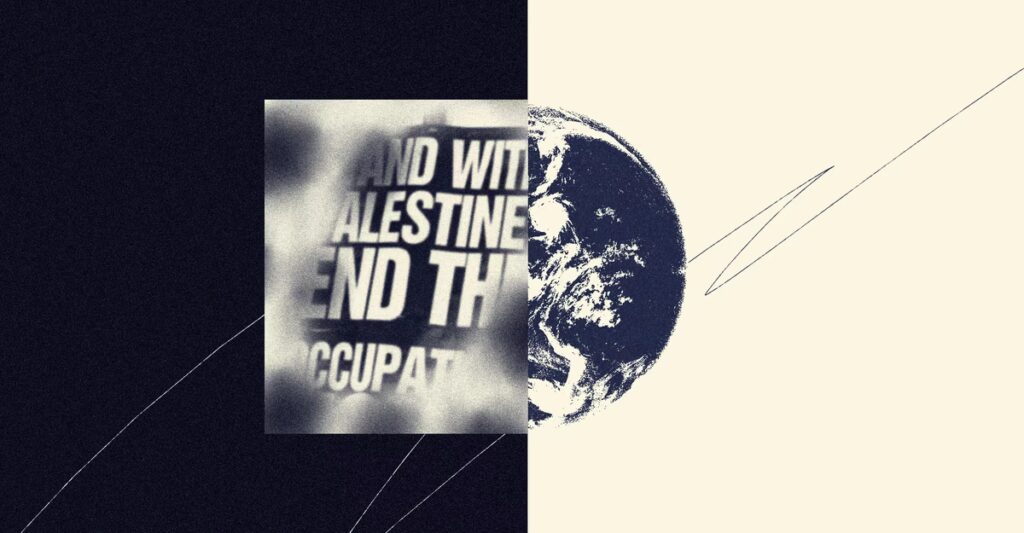
Greta Thunberg was detained last month in Germany, during a sit-in at a munitions factory that sells weapons to Israel. She was wearing a Yalla Intifada T-shirt. Perhaps you thought Thunberg was a climate activist. She used to be. Thunberg gained fame by warning that greenhouse-gas emissions posed a threat to human life so urgent and existential that the world must put aside trifling concerns to solve it immediately. “I want you to panic. I want you to feel the fear I feel every day. And then I want you to act. I want you to act as you would in a crisis. I want you to act as if the house was on fire. Because it is,” she told the World Economic Forum in 2019. But someone else will have to put out the fire, because these days, Thunberg is possibly the planet’s most famous anti-Israel protester.
Much of the climate movement—particularly its most radical elements—has pivoted to Palestine. The Climate Justice Alliance, Extinction Rebellion, and Climate Defiance, among other green organizations, participate regularly in Free Palestine demonstrations. Most of the campus groups that were previously organized around demanding that their universities divest from fossil-fuel companies now demand that they divest from companies that do business with Israel. The same holds true across swaths of the left. Activists who previously treated racial justice, public health, or trans rights as the cause of a lifetime have determined that Gaza is now the cause of their lifetime.
Some of the pre-Gaza activism yielded tangible successes. Climate activists, for example, built a movement that persuaded Democrats to make their cause the party’s highest legislative priority, which is why the Biden administration expended so much effort passing green-energy subsidies. These gains were temporary: Donald Trump proceeded to repeal most of those policies. But instead of continuing to try to put out the blaze, many activists have simply moved on.
The draining of energy away from issues that once seemed so urgent has been slightly disorienting, even humorous. Alexandria Ocasio-Cortez recently repeated a catchphrase that has circulated on the left, “Woke 1 was crazy,” which simultaneously laughs off the excesses of the social-justice left while implicitly assuming that a Woke 2 is just around the corner. The reality, however, is that Woke 2 is already here, and Gaza is its current preoccupation.
[Idrees Kahloon: The Democrats can’t just laugh off ‘Woke 1’]
Woke 2 exhibits nearly all of the same behaviors as its predecessor—the fervent demands that society concentrate all of its attention on an apocalyptic crisis, the importation of academic jargon, and the reshaping of the social relationships and everyday decisions of its adherents.
To see these characteristics reappear in a completely different context from their original incarnation casts the woke phenomenon in sharp relief. Wokeness is not concern about a particular issue or issues, or even an ideology. It is, instead, a political style, a form of apocalyptic obsession that is serially fixated on different issues, waxing and waning in intensity. It offers the comfort of Manichaean morality—telling adherents that they alone can see the world in its true horror. But what it doesn’t offer, by design, is any practical resolution.
Unlike what the historian Richard Hofstadter once called “the paranoid style in American politics,” which dwelled on imaginary plots, the woke apocalyptic style concerns itself with actual social crises. Greenhouse-gas emissions really do pose a threat to posterity. Israel really has killed thousands of Palestinian civilians. Racism and police brutality, and the coronavirus pandemic—two other causes that inspired apocalyptic forms of activism—were likewise anything but a figment of the left’s imagination.
So what distinguishes the woke apocalyptic style from the understandable urgency one would expect activists to feel about any important social problem? The mindset has three defining traits.
First, its adherents gravitate toward the purest version of whatever position they select. They are facing down not just climate change, police bias, or a pandemic, but human extinction, racism, eugenics, and other existential perils. Only questions that can be reduced to a pure conflict between good and evil interest them. They generally reject any nuanced view of these issues as an effort to distract from the question at hand and drain the necessary moral fervor (though they prefer to call it “moral clarity.”) Beliefs they themselves held until very recently can become not just wrong but so abhorrent that anybody still endorsing them must be shunned.
A 2024 New York profile of the former Atlantic writer Ta-Nehisi Coates, a seminal figure in both Woke 1 and Woke 2, explained his newfound focus on Palestine as a product of the revelation that the issue was actually quite simple. The profile frames this aspect of his thinking about the Israeli-Palestinian conflict in vivid terms: “That it was complicated, he now understood, was ‘horseshit.’ ‘Complicated’ was how people had described slavery and then segregation. ‘It’s complicated,’ he said, ‘when you want to take something from somebody.’”
Second, as a way of counterbalancing its tendency toward serial fixations, woke apocalypticism frequently asserts that every worthy cause is linked. During the 2014 protests against police abuse, Free Palestine activists persuaded racial-justice activists that their causes were the same. When COVID-19 seized the attention of the protest community, these same activists emphasized the racial-injustice aspect of the pandemic. “Palestinian Liberation is a disability justice issue,” the “People’s CDC,” a left-wing public-health group, has proclaimed. In the green activist community, the slogan “There is no climate justice without Palestinian liberation” has become almost a ritual incantation.
In June, trans-rights activists chased California State Senator Scott Wiener from a trans-rights rally, screaming, “You do not belong here,” because they deemed his position on Israel unacceptably Zionist. (Weiner has accused Israel of “genocide” and called for cutting off U.S. aid for offensive weapons, but continues to support Israel’s right to exist.) All political coalitions try to emphasize links among single-issue activists, but it is nearly impossible to imagine, say, a Republican legislator being ejected from an anti-abortion rally because he supported a gun-control law.
The substantive basis for linking every cause together ranges from tenuous (the pandemic did harm minorities somewhat disproportionately) to nonexistent (Palestinian liberation has no bearing on climate change whatsoever). Yet insisting on a relationship upholds the bonds of solidarity among single-issue organizations, giving them permission to operate outside their domain and pursue whatever cause is presently animating their supporters. And it reinforces a sense of omnicrisis, that their project is not a series of discrete policy changes but the healing of a broken world.
The third characteristic of this activism is that its demands are irresolvable. The crisis is perceived as literally existential, a form of damnation that a response as small as legislation cannot dispel. Many racial-justice activists have directed their energy into tarring the United States as the sinful product of colonialism and slavery—a diagnosis that, while containing elements of truth, offers little practical redress. Unlike Marxism’s postrevolutionary paradise, woke politics has no end point beyond despair.
The Biden administration tried to address racial justice and climate change, two causes that preoccupied left-wing activists at the time of the 2020 election. Yet the impressive array of legislative and executive steps designed to advance both causes did nothing to placate activists, who by 2024 had decided that Gaza was all that mattered. They were not wrong to care deeply about the suffering in Gaza, but the amnesiac way in which they dropped causes that they had very recently proclaimed to be matters of literal life and death suggests that their stated motives cannot be taken purely at face value.
What seems to propel these activists is not the specific issue that at any given moment is causing them to feel—as Thunberg once demanded in response to the climate crisis—panic and fear, but instead the need to experience these sensations constantly.
Woke 1 was a tidal wave that crashed over blue America. Nearly anybody who resided in a deep-blue space—academia, publishing, Hollywood, the arts, news media, nonprofits—experienced an onslaught of new terminology and rituals. Some of this (land acknowledgments, for example) has survived as a sort of residue. Other elements (Robin DiAngelo) have receded into embarrassing memory.
Woke 2, so far, is more of a ripple. Opposition to Israel has long held a place in the firmament of left-wing causes, but it reached preeminence only after October 7, 2023. A network of pro-Palestinian student activist groups sprang into action immediately after the attack, which they characterized as an act of liberatory defiance. The key dynamic that enabled their cause to expand beyond committed anti-Zionists was the intensity and duration of Israel’s response to October 7, which played directly into the attackers’ goal of creating a humanitarian crisis that would turn Israel into a pariah, elevating opposition to its very existence into a social cause.
[Jonathan Chait: The crisis for Democrats in Michigan]
The cultural manifestation of this movement is most evident in progressive capitals such as San Francisco and New York City. In June, a Brooklyn coffee shop announced on social media that Dan Goldman, a Democratic member of Congress, was a “genocide enabler” and no longer welcome there. The most recent cover story of New York putatively celebrates the coolness of the Southwest Asian and North African (SWANA) community, but defines it in ideological, not ethnic, terms. “To be in SWANA community,” it states, “meant embracing a set of shared beliefs: that Palestinians deserve human rights. That what happened in Gaza in the aftermath of October 7 constitutes a genocide. That social justice and social welfare override capitalist concerns.”
A companion article describes how this dynamic has seeped into the dining scene. “In the three years since October 7, awareness of Israel’s genocide of Palestinians and the wars that keep proliferating have turned eating out into just one more way people are expressing their views on Israel, on Gaza, on Lebanon, on Iran.” It reports that one Middle Eastern restaurateur’s “decision not to speak or post about the war publicly has left many fans of his restaurants Miss Ada and Theodora confused about where he stands,” as if café owners, like presidential candidates, should be expected to articulate a foreign policy.
In political terms, Woke 1 had a profound effect on the Democratic Party. Demands by activists and staffers pushed candidates to adopt left-wing positions on crime, immigration, trans rights, and climate change that placed them out of step with the majority of the electorate. Woke 2 has had a similar effect, providing left-wing activists with a tool to discredit mainstream Democrats.
The movement’s insistence on calling Israel’s mistreatment of Palestinians a “genocide” is its most important demand. Scholars do not agree on what this term means or whether it applies to Israel’s conduct, and resolving the question is unnecessary to establish a consensus that Israel’s response to October 7 was excessively punitive, or even that its military has violated the laws of warfare. But the tactic of demanding that Democrats label the conflict a genocide, and treating anybody who refuses as complicit in the murder of children, is not aimed at exposing supporters of Israel’s policy. It instead targets liberals who have traditionally viewed the Israeli-Palestinian conflict as a cycle of violence for which both sides bear responsibility. Describing the conflict as a genocide frames the problem not as a matter of shared guilt and shared responsibility to compromise, but as the straightforward oppression of an innocent people by a guilty one.
The term brings together the perspective of Palestinian nationalists, who see Israel as a source of unique evil in the world, with the apocalyptic left’s orientation toward generalized despair. The left-wing writer Noah Berlatsky recently argued not only that the case that Israel had committed genocide was “open and shut,” but also that genocide is a routine occurrence. Other examples include British treatment of trans people (“The UK is moving towards, or already in process of committing, a genocide against trans and intersex people”) and Elon Musk’s cuts to USAID.
Leftists have discovered that requiring the term is a useful way to discredit Democrats who oppose them on other issues. “This is a moral Rorschach test,” the Democratic U.S. Senate candidate Abdul El-Sayed said during his primary campaign in Michigan. “If you can’t identify the systematic murder of tens of thousands of kids as a genocide, and then you want to say that you’re a fighter for human rights and dignity, that’s just hypocrisy.”
Democrats who refuse to embrace the movement’s preferred term are, by and large, those who hold more nuanced positions on other issues. The demand to use the term genocide has broad application as an ideological sorting device. David Purucker, a sociology graduate student at the University of Oregon and a Democratic Socialists of America activist, recently illuminated the dynamic on a podcast from the centrist Niskanen Center. “And then just on the Palestine question, even though it’s not super salient to the broad Democratic electorate, it is, I think, is a really powerful signal of who is willing to take on the most sort of powerful parts of the establishment and really fight for the economic issues that are your priority,” he said. “I guess the sort of mental process would be like, Okay, if this person isn’t willing to call it a genocide in Gaza, how can I trust them really to stand up to the health-insurance lobby, for example?”
The Nation’s president, Bhaskar Sunkara, also a DSA member, likewise told Ross Douthat on a New York Times podcast that Gaza is “being used to separate Democrats who are committed to an old political establishment, including the foreign-policy establishment, and Democrats who are better.”
The Palestinian-nationalist movement has long sought to place Israel in a special category of evil. The woke apocalyptic left has assimilated many concepts and terms from that struggle, but its interest in the subject is slightly different. It uses the issue to affirm the pervasive horror of the modern world. Berlatsky’s Substack is titled, fittingly, Everything Is Horrible.
Despite the effort by some leftists to shrug off the craziness of the Woke 1 era, several left-wing candidates who have benefited from the energy of Woke 2 have found themselves haunted by their Woke 1 messaging. El-Sayed, the former candidate for Wisconsin governor Francesca Hong, and Democratic House candidates Darializa Chevalier of New York and William Lawrence of Michigan have all had to explain away or apologize for social-media posts using the left-wing academic jargon that was in vogue half a decade ago, some of them endorsing abolition of the police, Thanksgiving, or other well-liked institutions.
Any movement built on anti-Zionism as an organizing principle will tend to attract anti-Semites.When the British Labour Party under Jeremy Corbyn elevated a left-wing faction that was similarly motivated by intense anti-Zionism, it resulted in “a culture within the Party which, at best, did not do enough to prevent antisemitism and, at worst, could be seen to accept it,” a report by the Equality and Human Rights Commission found. The Democratic Party might be facing an equally grim future, in which what happened to Weiner and Goldman—experiences that Jewish liberals have had with increasing frequency since October 7—grows routine.
[James Loeffler: The hatred that broke American politics]
But there is also reason to expect, or at least hope for, a more constructive outcome. Woke 2 has generated fewer cancellations, firings, and acts of terrified self-censorship. There is no 2026 Harper’s letter defending the right of intellectuals to openly debate Israel, because such a letter is not necessary.
Perhaps this is because progressives have learned from their past censoriousness. Perhaps even they find it too implausible to claim that exposure to contrary beliefs about a conflict on the other side of the globe is a form of harm from which they require protection. Or maybe progressive institutions are simply too split over the morality of the Israeli-Palestinian conflict for woke activists to easily impose a new consensus and ostracize all dissenters. Whatever the explanation, Woke 2, with a handful of exceptions, has taken the form not of a silencing campaign but of a debate—angry and frequently stupid, but engaged energetically.
In an atmosphere that permits deliberation, rage may give way to reason. Liberal supporters of Israel may concede to the Free Palestine movement that Israel’s current government has no strategy other than endless use of force, that it has willingly enabled settlers to terrorize Palestinians in the West Bank, and that American policy has done too little to alter these choices. The Palestine activists might be made to acknowledge that the carnage in Gaza would not have occurred but for Hamas’s desire to murder as many Israeli Jews as possible, and that the group deliberately maximizes deaths among Palestinian civilians by embedding their fighters in schools and hospitals.
In other words, the Middle East is complicated. Bringing the moralistic fervor of Western progressives entirely onto one side of a generations-long conflict between warring religious sects claiming mutually exclusive historical and divinely granted rights to control a sliver of land is unlikely to result in peaceful coexistence.
Pro-Palestinian activists are correct to argue that American support has enabled Israel to pursue a one-state solution and to rely on military force in place of diplomacy. What they have yet to grasp is that the Western left’s inability to repudiate Hamas has had a pernicious effect on the conflict: reinforcing a co-belligerent in a cycle of violence. The American civil-rights movement is not, in fact, the proper moral lens with which to understand a terrorist group that murders not only Jewish civilians but also dissident Palestinians, and whose objective is not the right to vote and sit at lunch counters but to impose sectarian theocracy. An effective and humane Western form of activism would recognize that disregard for Palestinian well-being is a trait shared by Hamas and Israel, and would challenge both accordingly.
The American influence on this intractable conflict can be exercised more constructively. What Middle East policy cannot accomplish—what no reforms in any policy domain can accomplish—is resolving the existential angst caused by a political style that cannot tolerate moral ambiguity.
The post The Apocalyptic Style in Woke Thinking appeared first on The Atlantic.