Compared with Donald Trump’s chaotic, divided, and violent America, China is a bastion of steady progress and serene order. This, at least, is the story that Beijing’s propagandists have been eager to spread. The Global Times, a Communist Party–run news outlet, proclaimed earlier this year that “the world’s peace and development increasingly rely on China’s stability.” The state news agency Xinhua chimed in that “in today’s uncertain world, China’s stability and predictability provide a rare and valuable anchor, which is set to benefit other countries.”
This message appears to be resonating around the world. A Pew Research Center survey of three dozen countries recently found that China is now seen more positively than the United States. Respondents expressed more confidence in Chinese President Xi Jinping to “do the right thing” in world affairs than Trump.
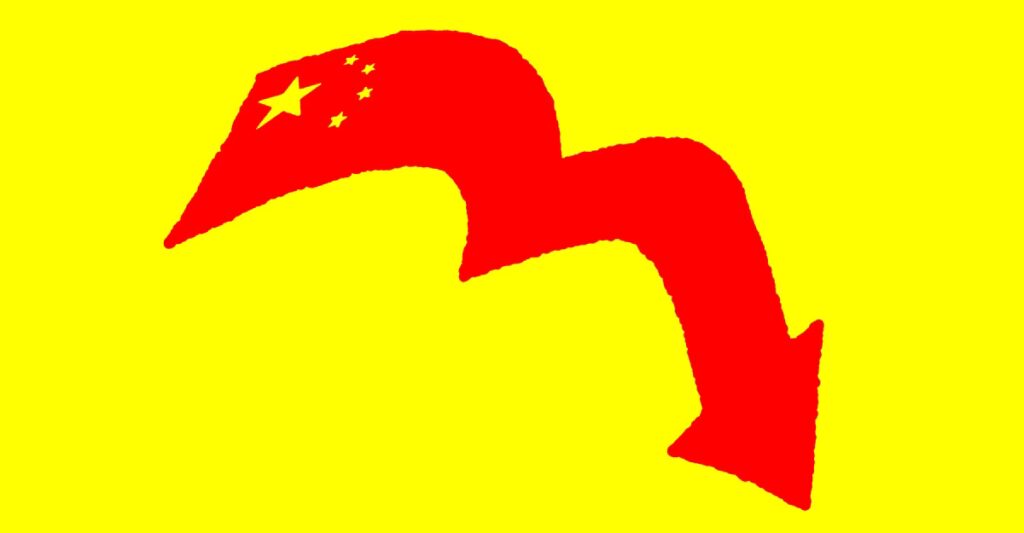
China’s stability may appear desirable to a world in turmoil. But inside China, this “stability” looks a lot like policy paralysis, economic stagnation, and intensified political repression. What all the handwringing over China’s growing influence and surging exports fails to recognize is that the country is flatlining politically and economically. The evidence is in plain sight.
Policy makers around the world are understandably fixating on China’s abundant and cheap electric cars and competitive AI models, which present a serious threat to national industries. But these advances are one small part of a broader economy with pernicious and deep-rooted problems. The country’s property-market downturn, triggered by the 2021 meltdown of the real-estate developer Evergrande, has not hit bottom. Home prices continue to fall, eating away at the wealth of many middle-class households.
Trump’s war with Iran has pushed up oil prices, raising the cost of production for Chinese companies and ending three years of deflation. But the underlying problems of oversupply and weak demand remain entrenched. Youth unemployment, which emerged as a major social issue in 2023, has become chronic. The jobless rate among workers aged 16 to 24 stood at 18 percent last month.
[Matteo Wong: What really happens if China wins the AI race?]
These pressures have left Chinese consumers reluctant to spend. Retail sales grew a paltry 0.6 percent in July. Domestic sales of EVs have been falling. China’s economic problems have become so dire that some economists suspect that the official government statistics are overstating the country’s true performance. Although China’s economy has been growing a respectable 5 percent annually for the past three years, the research firm Rhodium Group estimates that China’s actual growth rate was probably near 2 percent in 2023 and closer to 3 percent over the past two years.
Any hope that China’s leaders will tackle these problems is almost certainly misplaced. Xi has stubbornly resisted the difficult and politically sensitive reforms necessary to fix the country’s economic model during his nearly 14 years in charge, and he is unlikely to change his approach anytime soon. He remains as myopically focused as ever on state-led programs to advance Chinese technology and industry, and particularly AI, and is apparently convinced that they will boost the entire economy. Perhaps this strategy will one day pay off, but the signs aren’t good. China’s debt has exploded on Xi’s watch—at three times the size of the economy, it surpasses even America’s debt burden. Growth in the second quarter of 2026 was the slowest since 2022, when China was still battling the coronavirus pandemic.
The Communist Party could theoretically change its leadership team at a major congress next year, but in the absence of any clear alternatives or successors, Xi is likely to secure yet another five-year term as general secretary. Xi’s ruthlessness in office has been marked by regular purges of possible rivals, generals, and members of other party factions. His latest victim appears to be Fang Xinghai, a former top securities regulator well-respected by international business leaders, against whom the party recently launched an investigation for unnamed disciplinary violations. With Fang’s fall, the government is sidelining yet another economic reformer with valuable expertise who might have helped fix the economy’s woes but whose market-oriented philosophy has fallen out of favor with a regime that prefers a top-down approach to national development.
Xi maintains social order through this never-ending malaise by controlling information and repressing alternative views. A sweeping new law took effect last month that mandates Mandarin as the primary language in education and orders parents to guide children to “love the Chinese Communist Party.” In prizing national unity over ethnic autonomy, this policy seems designed to force the country’s various ethnic minorities, including Uyghurs, Tibetans, and Mongolians, to assimilate into the majority Han Chinese culture. Even humor must follow the party line. Local authorities are reportedly investigating Guo Degang, a popular comedian who made the mistake of altering the lyrics of a patriotic song cherished by Communist cadres during a performance in the city of Wuhan last month.
[Vivian Salama and Jack Rodriquez-Vars: The danger of Trump’s anti-communist rhetoric]
Despite global surveys that report a growing fondness for China, the country’s “stability” comes at a steep cost to other countries. China may not be dropping bombs, but Beijing is arguably helping other countries drop theirs. By economically supporting Iran and Russia, Xi is essentially fighting proxy wars in both Europe and the Middle East.
In the absence of domestic demand, China’s subsidized and bloated manufacturing industries are exporting their problems and threatening the survival of competitors around the world. Given weak sales at home, Chinese automakers are shipping twice as much of their production overseas as they had a year ago. European Union officials are seeking greater powers and enhanced cooperation among its members to protect the continent’s industries from an onslaught of cheap Chinese imports, which have not only cost the region jobs but have run up a trade deficit with China topping $1 billion a day.
As Trump’s unpredictable and self-obsessed decision making saps America’s economic competitiveness and military might, China’s rise on the world stage is destined to continue, if only by default. But Xi’s insistence on preserving stability instead of addressing China’s serious structural problems threatens this ascent. Perhaps, then, the competition between China and the U.S. is less a contest for supremacy than a race to see which country hits bottom first.
The post The World Is Telling the Wrong Story About China appeared first on The Atlantic.