THE CASTLE: Adventures in a World of Unraveling Men, by Jon Ronson
In “The Stepford Wives,” the 1975 movie based on Ira Levin’s novel, former women’s libbers glide vacantly through supermarket aisles after being transformed by their husbands into robots. In the journalist Jon Ronson’s new book, “The Castle,” those shoppers are men, and all too human.
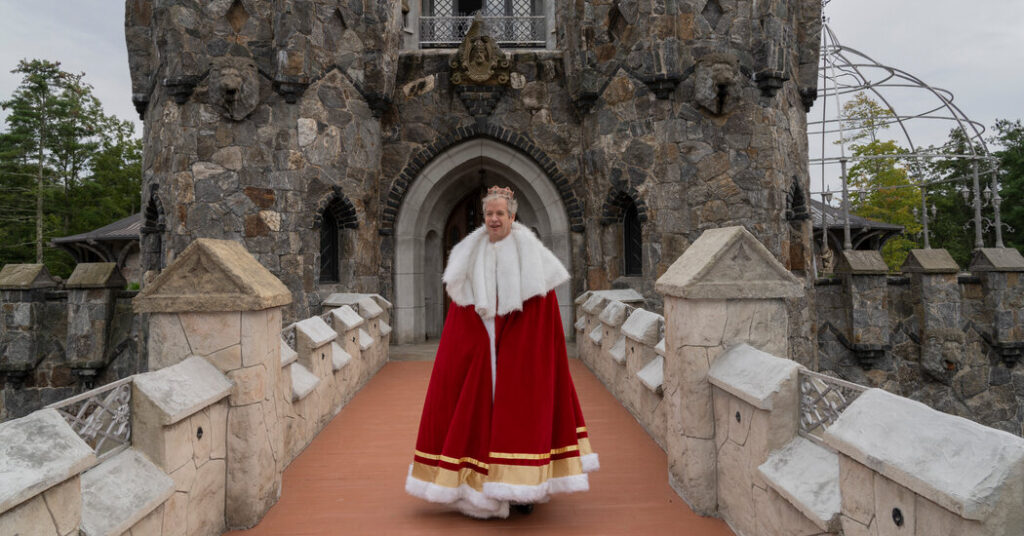
Ronson’s title refers to an extraordinarily baronial piece of private property in Woodstock, Conn., owned by one Chris Mark, the scion of a Gilded Age steel tycoon, whom the author decided to investigate after his son was invited to a party there that got weird fast. (Princess costumes were involved.)
The title also echoes the old expression, originating in English law, that “a man’s home is his castle,” which seems ever less true in 21st-century America. The pandemic, #MeToo and artificial intelligence have rattled the old patriarchal order; Donald Trump’s ballooning ballroom is the backlash. A man’s home, if he’s lucky enough to have one, is now his remote work space, his playroom, his refuge, his dungeon perhaps — but his castle? A fresh pair of soft pants, your majesty?
Starting with Mark and fanning out to various YouTube influencers and culture warriors, Ronson is interested in fellows who’ve gone off the rails in some way, “unmoored” by the erosion of office and factory life.
Once we had the Marlboro Man; now, “these are boom times for men who can play doofuses in ads,” Ronson notes, interviewing an actor frequently cast as one. (In fairness, this has been true since the Ira Levin-Alka Seltzer-“I can’t believe I ate that whole thing” era.)
Ronson is also interrogating his own manhood. The author of half a dozen lively previous books about topics including public shaming, psychopathy and conspiracy theorists, as well as a podcaster and documentarian, he admits that when he’s not working he feels like an abject failure. He’ll occasionally sit on a public bench to think of story ideas, see other guys there staring into space and think despairingly, “I’m just a man sitting on a bench.”
But to invert Napoleon’s quip, a bench is just a throne without velvet — which brings us back to Mark, who among other sus activities has lured women to his castle, “his great temple to Hefner-style virility,” under the pretext of filming a reality show destined for Netflix. “I’m the lord,” was how he explained the concept to Ronson’s son. “I’m looking for my queen and I’ve got 101 princesses to choose from.”
Researching Mark’s background takes Ronson most fruitfully to Marktown, a former planned utopian community for steelworkers and designed after an English country village, in East Chicago, Ind. The town suffered a refinery explosion, pollution, gangs and the economic downturn of automation and now resembles “a mouth filled with tooth decay.” Recovering from hip replacement surgery, the town historian gives Ronson — himself recovering from diverticulitis surgery — what he says will be his final walking tour. They make a darkly hilarious pair, with a whiff of “Withnail and I.”
Elsewhere in the book, we get to know Greg Chism, a former lawn care YouTuber and single father whose lucrative experiment making gross-out videos with his two young daughters ended badly after content farms began plagiarizing them into obscene cartoons. (The girls now appear to be thriving teenagers, who will have a hell of a college-essay topic if A.I. doesn’t eliminate that as well.)
Ronson considers disinhibition, in the form of Dan Bilzerian, the social media playboy who went from trying to create heroic content at the 2017 Las Vegas gun massacre to anti-Jewish rants on “Piers Morgan Uncensored.” (“I wondered if antisemitism was just Bilzerian’s way of keeping things fresh,” Ronson writes.) And hedonism, with a visit to Armie Hammer, the actor whose career was derailed after screenshots of his text messages suggested cannibalistic leanings. “White men have been the problem for a long time, and obviously I recognize my privilege in a lot of ways,” he tells the author. “But,” he went on, “I don’t feel powerful. I feel [bleeping] scared and lost all the time.”
Ronson has a fantastic dry wit and tiptoe-through-the-tulips style that reminded me of Roald Dahl, minus Dahl’s own antisemitism. (How gratifying to discover that both men were born in Cardiff, Wales.) Outlining a plan with his then-fiancée to build on his castle grounds an orphanage called Ark of Light, Chris Mark rings faint chimes of Dahl’s fictional protagonist Henry Sugar.
But this is real life, and we learn fairly early on that Mark has bipolar disorder requiring medication, making him perhaps a shaky symbol of our national masculinity crisis. Ronson mentions serious allegations against him but then steers away, like a court jester gingerly circling the moat on a hydrocycle. Still, the attitude of gentle, dogged bemusement in “The Castle” seems preferable to many of the more strident positions struck by his … subjects.
THE CASTLE: Adventures in a World of Unraveling Men | By Jon Ronson | Riverhead | 322 pp. | $32
The post A Connecticut Castle, a Cosplay King and a Nation of Men in Crisis appeared first on New York Times.