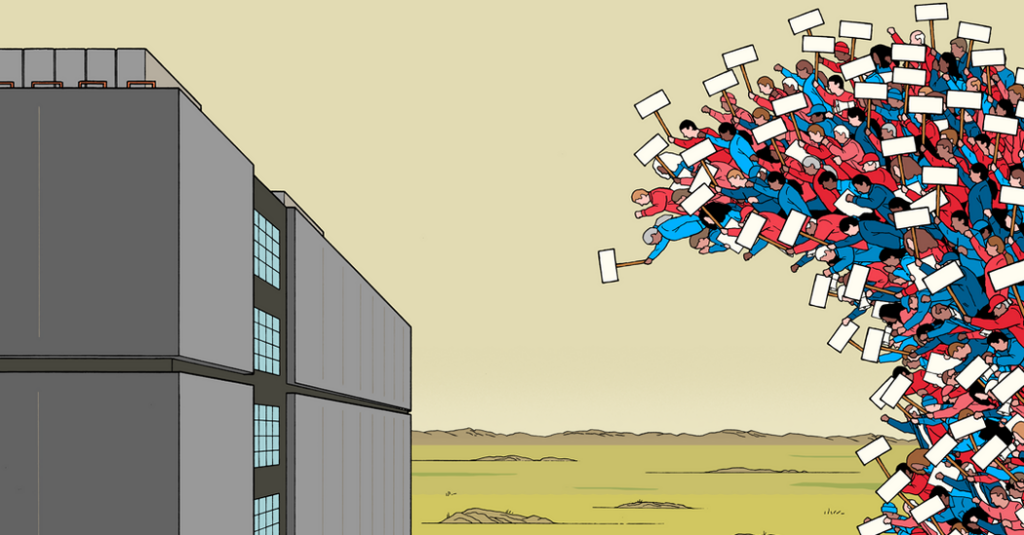
The data center backlash is still, like a tidal wave, growing. And to really understand what’s happening, you have to start not with the constituent parts of the resistance but with the sheer scale of what’s become an extraordinarily broad consensus.
Three in four Americans said they’d oppose the construction of a data center in their communities, according to a recent poll from Heatmap Pro and Embold Research. Local data centers were opposed by two-thirds of Republicans, whose party is warning that recent support for such projects could destroy its chances in key Senate races. And though political causes rarely transcend partisanship, this one appears to: Nearly 80 percent of independents opposed local data center projects, along with 83 percent of Democrats.
Slice the population any which way you want — by age, by gender, by income, along the urban-rural divide — and the pattern is the same. As are the trends. Last August the American public was almost evenly split when Heatmap Pro asked about local projects. Then net approval swung 62 percentage points. Opposition this year was higher than 70 percent in every region in the country; more than half of Americans supported a national moratorium.
In an earlier era, it might have taken a while for politics to catch up to grass-roots rage. But our political institutions, though normally unresponsive, are weaker than they used to be, and entrepreneurial politicians are now more eager to capitalize on anti-establishment frustration. $130 billion in projects were delayed or canceled just in the first quarter of this year. According to The Information, 500 jurisdictions have passed bans or moratoriums, including 150 local bans passed in July alone. In places like Maryland, next door to the data center capital, Virginia, local data center laws have grown to cover three-quarters of the state’s population. In July, New York passed the first true state-level pause.
This is happening not just in Democratic strongholds. In Texas, celebrated in recent years as America’s ultimate laboratory of hands-off construction, Gov. Greg Abbott effectively issued a data center moratorium, pausing approvals until an audit of all data centers seeking to connect to the state’s electric grid was completed. “Our top priority is to protect Texans’ safety and quality of life,” he declared, sounding less like a business-friendly libertarian than someone at the mic of a town hall winning applause from people wearing Pride pins and Infowars-branded “Don’t tread on me” shirts. As recently as November, he bragged that Texas was an artificial intelligence hot spot; by August, he was declaring, “Texans must come first.”
Until recently, Gov. Josh Shapiro of Pennsylvania spent much of his time boasting of all the ways he streamlined processes to rapidly rebuild a collapsed bridge and promoting new data center projects in his state. Then this month he issued an executive order imposing new guardrails on data center projects, calling the companies building them “predatory” and promising not to be “bullied” or “bulldozed” into submission.
The backlash may prove a fleeting fever — or even, ultimately, immaterial, given how much has already been wagered on the A.I. boom and its infrastructure. The politics are still evolving, little more than a year since data center fights began showing up in local races, and it is worth keeping in mind that as recently as 2020, 67 percent of the public professed support for Black Lives Matter and that, according to a Pew Research poll from March, 60 percent of the country said the federal government was not doing enough to stop global warming (a sentiment that is probably driving at least a bit of the backlash).
But the breadth of data center opposition alone suggests that the fight no longer centers simplistically on environmental concerns or NIMBYism, the forces of oligarchy or the prospect of an A.I. future — though each of these plays a role.
You can see in the survey data a mutually reinforcing list of complaints that are anchored in environmental concerns about energy and water use and spread to worries about pollution and noise and scale and effects on local electricity prices and from there to broad distaste for or distrust of A.I. There are also old-school NIMBYs, unapologetic Luddites, onetime MAHA activists and, yes, a few outright conspiracists. It’s a pretty big tent. That’s one thing it means to have three-quarters of the country on your side: You have to draw together different constituencies, from climate activists to MAHA moms and plenty of normies, with their own concerns, in between.
Breaking the coalition down into silos risks missing the big-picture phenomenon — and reducing a generational mass movement to the size of your pet gripe.
If you call it simple environmentalism, you have to reckon with the fact that coal plants are less unpopular. If you call it NIMBYism, you need to reckon with the fact that just three years ago, Americans said they supported the construction of solar farms in their communities by three to one and nearly the same for wind farms. If you call it anti-corporate backlash, you need to reckon with the fact that support for nearby Amazon distribution centers was higher and that generic factories, semiconductor plants and even nuclear power plants all polled better than data centers, too.
If you call it a turn against Silicon Valley or delayed payback for a decade or two of its broken promises, you have to account for the fact that Americans not only obsessively use tech products but also tend to view many of the big tech companies favorably. If you call it know-nothing tech derangement, you have to make sense of the relative popularity of computer chip fabrication plants. If you call it the paranoid style of American politics in the social media era, you have to explain how it could be that more than three-quarters of Americans got Covid shots in 2021 and how data center opposition is much larger than movements against earnest causes like fracking and fringier ones like opposition to 5G. If you call it the thinly felt politics of TikTok vibes and predict they’ll probably evaporate, you may be somewhat right. You still have to explain why no other recent cause has generated as tall a mountain of negative vibes.
Like any mass populist movement, this one features echoes — and veterans — of others. But with data centers, something different, bigger and perhaps irreducible appears to be happening. Perhaps the better analogy is not with any movement of the social media era but with the long crusade against nuclear power, which managed to pull many threads of opposition together because nuclear plants’ iconic towers triggered, beyond political objections, apocalyptic ones, as well.
On the ground, the fight over data centers looks like a conflict over the nature of progress, the shape of the future, and who gets to determine the terms by which citizens submit to the visions of technologists and their financiers. To many who believe in the promise of A.I., it looks like a degrowth cul-de-sac — and a test case for whether dreams of frictionless technological progress can survive democratic blowback.
But one of these groups is simply much larger than the other. Only nine percent of Americans surveyed by Pew Research in June said they were more excited than concerned about A.I., perhaps because opponents had heard more about the risks it poses than the concrete gains it might deliver. You can’t reduce data center resistance to just fear any more than you can call it simply the influence of short-form video. Yet one way of reading the backlash is as a many-headed protest against inevitability — about not just the technology itself but also the whole package of breakneck build-out, social disruption and insane wealth creation it has come wrapped in. Is this really the only future on offer?
Still, the data center build-out continues. There are more than 1,500 such projects underway across the country and perhaps thousands more in the planning stage. In spite of the breadth and depth of the opposition, only a small fraction have been canceled or delayed thus far. And even statewide pauses may prove less effective than imagined, at least insofar as the goal is to slow down A.I. development. The Princeton professor Arvind Narayanan — an author of “A.I. Snake Oil” and “A.I. as Normal Technology,” two touchstone works of nuanced skepticism — recently calculated that the average one-year state-level moratorium would slow increases in A.I. capabilities by only a matter of hours.
This is not exactly a classic bubble, like the railroad boom or the original dot-com frenzy, in which speculative construction and investment outrace demand. Even though corporate America is pulling back on its token budgets, demand for A.I. still looks larger than supply. That’s why frontier labs have been periodically forced to ration what they’re selling. Seeing the opportunity, developers are scrambling to build capacity wherever they can. And while politicians are increasingly echoing activists, policies range pretty widely. Some are aggressive, designed to stop new data centers and slow A.I., and others are meant to buy time for negotiated compromise and further construction.
All this momentum is one reason the fight against data centers can seem quixotic. Frankly, I expected much more fatalism about what looked like a world-historical combination of technology, huge spending and investment and the basic deferential weakness of our current political economy toward the richest companies the world has ever known. What we’ve gotten is not acquiescence at all but, along each of these fronts, a remarkable fight.
One way of taking stock of the intensity of opposition is to look at the data center sales pitch.
In Loudoun County, Va., a data center hub, taxes from more than 250 such projects are expected to account for 40 percent of the county’s tax revenue next year. Already the windfall has allowed the county to lower the tax rate paid by residents by about 30 percent.
In rural Quincy, Wash. — a town of just 8,500 people where data centers carry more than half of its property tax burden — around 30 data centers have helped pay for a $120 million high school, Nathaniel Meyersohn recently reported for CNN, not to mention a $15 million aquatic center and a 143,000-square-foot indoor sports complex. The hospital, library and police and fire stations have been improved, too, as have sidewalks and sewage systems.
In Richland Parish, La., where generous tax incentives helped draw a Meta data center project, an annual payment from the company and the extra sales tax revenue generated by workers who came to town to build the thing meant that, my colleague Jacey Fortin recently reported, many local teachers got a bonus of $51,000 — more than most of them make in salary each year. “It really feels like something that happens to people in movies,” one first-grade teacher said.
These are cherry-picked stories, highlighting a charm offensive by A.I. companies and hyperscalers and eliding quite a lot of what ignites the opposition. (You can read all about the secret negotiations that brought Meta to Louisiana, and Georgia recently calculated that it would lose $2.5 billion on data center sales tax exemptions this fiscal year alone.)
But on the surface, the sales pitch seems to offer a golden-ticket appeal to almost anyone’s idea of the median American: better-funded social services plus tax cuts, without any fiscal hangover. Maybe you’re not enamored with the promise of an A.I. future; few Americans outside Silicon Valley and Wall Street really are, with more of us anxious about the technology than citizens in almost any other country. But as a matter of local politics, these benefits should sit in an absolute political sweet spot. To a mayor or town councilor facing a budget crunch or a demanding constituency or both, a data center project might well look like deus ex machina. Which is why it is so striking that to the public at large, the sales pitch doesn’t seem to be working. Almost at all.
Why?
One hypothesis is that the positive case for A.I. build-out hasn’t really been made properly to the public. Instead, what Americans have heard from founders and boosters sounds both abstract and scary — that it might bring about mass unemployment while intensifying wealth inequality, that it could produce pandemics or even bring about human extinction. To the extent the average American has encountered a positive vision, it’s a broader argument on behalf of possible benefits of the technology that most people have yet to encounter. My colleague Ezra Klein recently called this a problem of offering to trade “a concentrated cost for a diffuse benefit.”
But when I look at Loudoun County or Quincy or Richland Parish, I see the possibility of some pretty significant and pretty concentrated benefits, too — even as someone who’s somewhere between agnostic and softly skeptical about A.I., who tends to see the tools as more of a normal technology than a profoundly transformative one, who is concerned about the concentrations of wealth and power in Silicon Valley and who is broadly sympathetic to the data center backlash as a form of the resistance to the future imagined by A.I. founders.
A lot gets left off the balance sheet when you point to booming tax revenue as an argument for building a data center — the size of tax breaks handed to many developers to attract projects, the large carbon footprint of many data centers, the local pollution produced by some of them, the disruption of construction, the lack of enduring jobs and the many projects required to generate the kinds of tax benefits you might get in Northern Virginia.
But put all those problems aside — or imagine a way of controlling them — and the size of those benefits looks potentially quite big. They look bigger still in places in economic decline, like West Virginia, which is moving to embrace data center construction as the rest of the country retreats from it. These arguments also don’t require you to persuade your constituents that A.I. will cure cancer, only to promise that a few construction projects will help fund local public schools.
Another explanation is that the local upside hasn’t penetrated a fog of anxiety — about water use, about electricity rates, about surveillance — that circulates particularly on social media. On some level, the argument is undeniable. The most viral claims about water use have largely been debunked, even though the effects are certainly not zero.
The impact on electricity rates differs from location to location, but some recent studies suggest that data centers have actually driven down the price of power. And some experts have suggested the build-out offers a rare opportunity to modernize and decarbonize the electricity grid. The carbon impact of a huge surge in power demand is nothing to brush past, particularly for those of us anxious about bringing global warming under control, but A.I. is just one constituent piece of the emission puzzle, and while concern about climate remains higher than many appreciate and is probably playing an important role in this backlash, it’s not as though three-quarters of the country is rushing out to protest pipelines these days.
Two other elements help explain why data centers are so unpopular and why the natural arguments for them have fallen on so many deaf ears. The first is that few people really believe those making the pitch, having grown so distrustful of A.I. companies and hyperscalers and their friends in local government that they won’t credit any promise of forthcoming local benefits, no matter how appealing they may sound.
The country as a whole has a pretty complex relationship to Silicon Valley, viewing its flagship companies relatively favorably while loathing its executives and lamenting the rise of Big Tech, even as we grow increasingly dependent on it. But many data center projects are not being spearheaded by recognizable companies. Often, they are the work of opportunistic developers, and activists, when they aren’t worrying about the possibility of the bubble popping, distrust the whole pitch deck. You might hear an appealing promise about future tax revenues but won’t hear about the fact that several states — including Virginia — are losing at least a billion dollars a year when you factor in data center tax breaks.
The second is that, to the extent those contemplating possible local projects believe there might be some benefits, they don’t really care. That’s how fiercely opposed they are to data centers on other grounds. This is the most straightforward reading of polls showing that Americans tended to believe that data centers would bring economic benefits and tax relief to local communities but at the cost of other impacts they apparently consider nonstarters.
It also helps explain why Northern Virginians swung 69 points against data centers in recent years, despite all of that additional tax revenue. Yes, a data center in rural Louisiana may bring $50,000 bonuses for local teachers, said the activist Saul Levin, who runs a podcast chronicling the backlash called “The Hum.” But those upsides are not universal, he says — far from it, in fact. And even the shiniest promises look a lot less alluring to people when balanced against concerns like more pollution, higher electricity costs and the possibility that what’s inside those giant buildings will be used to enable surveillance powers or warp the minds of your children and the shape of their lives.
“Data centers are a physical manifestation of so many things that people are upset about in our day-to-day lives,” Levin continued. “It’s not a fight about technology,” he said. “This is a fight about control. This is about who controls the future.”
If this really is a fight for the future, it does raise the question: What comes next? After a pause for reckoning, planning and deal making, is a kind of grand bargain possible?
For me, it’s not that hard to imagine the substantive contours of such a deal: guaranteed local tax benefits in place of tax breaks like those that have been so often used to draw new projects; policy reform to ensure not only that electricity rates won’t go up for local homeowners and businesses but also that the data centers will pay for upgrades to the grid to benefit everyone; more transparency about and monitoring of local environmental effects, with binding standards; perhaps renewable-power requirements that builders and operators can be held accountable for; and some process by which local citizens can be made to feel empowered rather than discounted in debating projects that literally loom over their landscapes. Certainly, more transparency and fewer nondisclosure agreements.
But while concessions like these may pull local leaders back onto the side of development, it has gotten a lot harder for me to believe that they would meaningfully move the needle on public opinion — at least very quickly. And it’s gotten a lot easier to picture a future in which the build-out continues around obstacles and objections while the country as a whole remains suspicious, if not outright hostile. Supermajorities don’t come around very often, and they tend not to collapse overnight. And when people are boiling with rage, they generally don’t appreciate being told to shut up or stand aside — as the E.P.A. basically did recently, moving to limit public input on data centers by eliminating a federal requirement that states announce their plans and solicit local feedback. As Matthew Yglesias put it, “This is like they straight-up want to lose the midterms.”
And beyond that horizon? What does the data center backlash tell us about the country’s attitude toward growth and progress and change in other domains? The answer isn’t exactly clear, since so much of our economy and future has been wagered on this one bet that it has begun to look less like a novel technology than a new social and economic model, imposed from above.
It’s been almost two decades since the financial crisis, but before A.I., no obvious paradigm had really emerged to succeed the one that gets loosely called neoliberalism. There have been a few bursts of new industrial policy, including successive rounds of trade and tariff wars and some small-scale reshoring, of which the data center build-out is a symbolically significant part. There were promises of a Green New Deal and a care economy — and perhaps more than promises, given that nine-tenths of new energy infrastructure in the United States is clean and that health care and social assistance accounted for so much American employment growth in recent years.
We’ve flirted with a crypto future, the metaverse, legalized sports gambling and futures markets and wallpapered the rest of our lives with advertisements for them and their kind. We’ve heard sermons about abundance, deliverism and popularism and come to understand that there may not be an end to this age of broad discontent without meaningful progress on the affordability crisis so many Americans feel — even the pretty well-to-do among us. We’ve been told, “It’s time to build,” then watched as the most avid advocates of a new American dynamism have refused to acknowledge any check on their imperious projects as legitimate.
In all this time, full of so much political turmoil and economic frustration, nothing else has loomed as large as A.I., which now seems to many Americans to occupy almost the whole horizon of possibility. This is the biggest reason that data centers have attained such totemic significance for so many Americans and why technologists have tended to see the backlash as an uncompromising war against progress. But 75 percent of Americans aren’t against progress. That’s absurd. They just resent it being imposed on them, unilaterally and unconditionally.
David Wallace-Wells, a writer for Opinion and a columnist for The New York Times Magazine, is the author of “The Uninhabitable Earth.”
The Times is committed to publishing a diversity of letters to the editor. We’d like to hear what you think about this or any of our articles. Here are some tips. And here’s our email: [email protected].
Follow the New York Times Opinion section on Facebook, Instagram, TikTok, Bluesky, WhatsApp and Threads.
The post Americans Agree on Almost Nothing. Except Data Centers. appeared first on New York Times.