‘Lanterns’ Season 1, Episode 3: ‘Outkast’
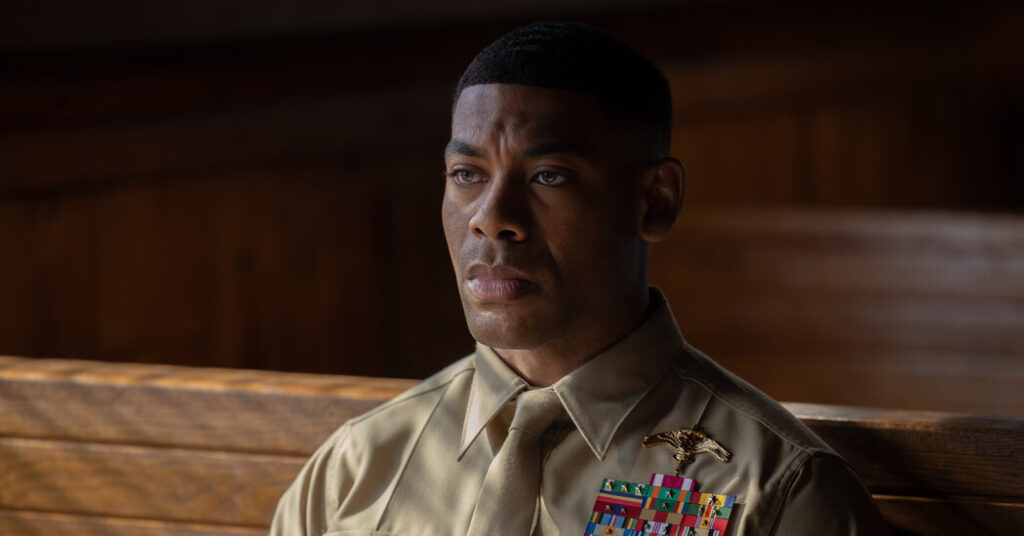
Through the first two “Lanterns” episodes, we have gotten a few stray biographical tidbits about Hal Jordan’s ostensible “trainee,” John Stewart. We know his parents went to extremes to make him fearless so that one day he might become a Green Lantern. We know he was a special forces Marine sniper. And … well, actually, that is pretty much it.
This week’s episode leaves the action in Rushville behind to go deeper into John, digging into how he was raised and why he is the way he is: so cool, so curt, so strangely enamored of birds. It’s the kind of episode you might expect from a show cocreated by Damon Lindelof. It’s a stand-alone story, similar to the kind that peppered “The Leftovers.” It jumps around in time, following multiple subplots in parallel, just as Lindelof used to do each week on “Lost.” And like “Watchmen,” the episode drives home a larger point about systemic and unconscious racism.
Much of this week’s episode is framed as job interview. In the opening scene, John mysteriously drops through a hole in the ceiling of an abandoned shopping mall, where he makes his way to an office occupied by an unnamed woman (played by Laura Linney). After she makes him wait overnight to test how serious he is, she reveals herself to be one of the 12 Guardians of the Universe. One of their number has recently died, which has led to some rethinking of how they run the Green Lantern Corps — and to the opportunity for which John has been waiting his entire life.
We hear that Sinestro, the villain Hal met with at the end of last week’s episode, is responsible for the dead Guardian. The remaining Guardians also seem unsure about whether they trust Hal, who was trained by Sinestro. The big takeaway from John’s job interview is this: He is not actually being groomed to be a backup. The Guardians want him — maybe need him — to replace Hal.
But while that is the major plot point of this episode, the story isn’t really about that. The credited screenwriter, Vanessa Baden Kelly, and the “Lanterns” creative team use this hour to snap together a mosaic of John Stewart, one tile at a time. Some of the pieces depict his highly unconventional childhood. Some follow him through one particularly gnarly Marines mission. Some cover his post-military detour through art school, when he might have been at his happiest.
The approach mostly works, although some of these pieces are more revealing — and more fun to watch — than others. The sequences from John’s boyhood become sourly repetitive. (Although to be fair, that does also seem to be an accurate depiction of his youth.) We get too many scenes of John’s mother, Bernadette (Jasmine Cephas Jones), snapping at him whenever he acts too much like a normal kid. Bernadette also lies to John repeatedly about the Guardians, saying they have been watching him through the eyes of little birds, and that they are “not seeing results.” After a while, it becomes exhausting seeing a young man be psychologically manipulated.
In one of the grimmest moments, John’s parents drop him off in the middle of a rough neighborhood and tell him to find his way back home — which he accomplishes with no trouble, although he does later break down crying. Like a lot of what Bernadette and John Sr. ask of him, this lesson is about giving John Jr. the confidence to go anywhere, from a crime-ridden city block to a corporate office. According to Bernadette, the only reason Hal Jordan is a Green Lantern is because, like a lot of self-assured white men, he’s privileged enough to know no fear. “We’re giving you that same gift,” she insists.
Bernadette’s fervor stems from the original sin of the Stewart family. One night, when John Jr. was a baby, his father was visited by a glowing green light, which lifted him out of bed and asked if he was afraid — to which he shouted: “Yes! Yes!” Ever since, the Stewarts have been convinced Hal got the job meant for John Sr.
All Bernadette wants is a second chance. She even has a long talk with one of the Guardians — the same one who later interviews John Jr. — and makes the case that you can’t ask a Black man in America if he’s afraid without waiting around for some clarification. (“By Black you mean … brown-skinned?” the Guardian asks. “Even in space y’all don’t consider us,” Bernadette sighs.)
The best scenes in this episode, though, are the ones with John as an adult. The Marine sniper mission — which has John parachuting into the wilderness to take out an elusive terrorist money launderer code-named Gray Wolf — is a darkly hilarious shaggy dog story, with a potent punchline. John stays put in the woods for nine months, dressing his own wounds and surviving on bugs and berries. Then, before John can get his shot off, Hal Jordan flies in and captures the Gray Wolf, as a favor to some Department of Defense bureaucrat he met in a strip club.
In a sublime bit of irony, John ends up being dishonorably discharged because of Hal’s bungling. The good news is, Bernadette finally relents and lets her son stop working so hard toward becoming the next Green Lantern, instead encouraging him to follow his clear passion for drawing and design. Funny enough, this is what ends up winning over the Guardians, who are impressed with John’s ability to draft elaborately detailed buildings and objects from memory.
The loop on this episode closes when a Guardians recruiter visits John’s college and tells him to jump into a void through a hole in the floor — which he does without hesitation because he knows better than to show any fear. That hole drops him into the mall where we found him at the start.
This episode’s fragmented narrative structure is clever, but this isn’t just a case of TV writers showing off. (Not that there would be anything wrong with razzle-dazzle for razzle-dazzle’s sake. Television is supposed to be entertaining, after all.) The point is to illustrate all that John carries with him, why he is unlike other humans and why those qualities might appeal to the Guardians after decades of dealing with Hal.
The Guardians clearly find humanity confusing. The one we meet knows enough to present herself as someone who looks like Laura Linney, rather than in her (or his?) natural blue-skinned, spindly form. But nothing John tells her about his parents — and about why he loves them despite their grueling Green Lantern obsession — makes sense to her. When John tries to explain that humans are raised, not programmed, the Guardian does not see a distinction.
Yet in John’s own human interactions, he too seems like an alien. He is stiffly formal in conversation, often coming across as disengaged. John is assertive. (His mother made sure of that, reminding him, “Sometimes a Black man has to raise his own hand.”) But he is a loner by nature — or perhaps nurture. In that way, he may be more like Hal than the Guardians realize.
Hal does not fully appear in this episode until the end. Even when John sees him during the Gray Wolf mission, it is from far away — as if witnessing a shooting star. But Hal’s presence looms large, such that when he shows up in the Stewarts’ kitchen at the end, unctuously calling them “the Midwest Huxtables,” the effect is jarring. He is not a legend here, or some standard to live up to. He’s just a guy: a motor-mouthed, self-absorbed, petty guy.
But how else to end an episode about John Stewart? In a perverse way, everything John has become is in reaction to Hal. Even though he was raised to be his own man, it was in Hal’s shadow. Now his goal is in sight, depending on how much he is or is not like Hal. Such is the way of this world.
Somewhere I hear Bernadette, ruefully tsk-tsking.
No evil shall escape …
-
The title of this episode, “Outkast,” comes from the Rock ’n’ Roll Hall of Fame hip-hop act Outkast, in particular their song “ATLiens,” which John’s brothers dare him to rap with in front of their parents. It’s an apt title, speaking to the John’s nature, as someone raised to be outside this world.
The post ‘Lanterns’ Season 1, Episode 3 Recap: Parents and Guardians appeared first on New York Times.