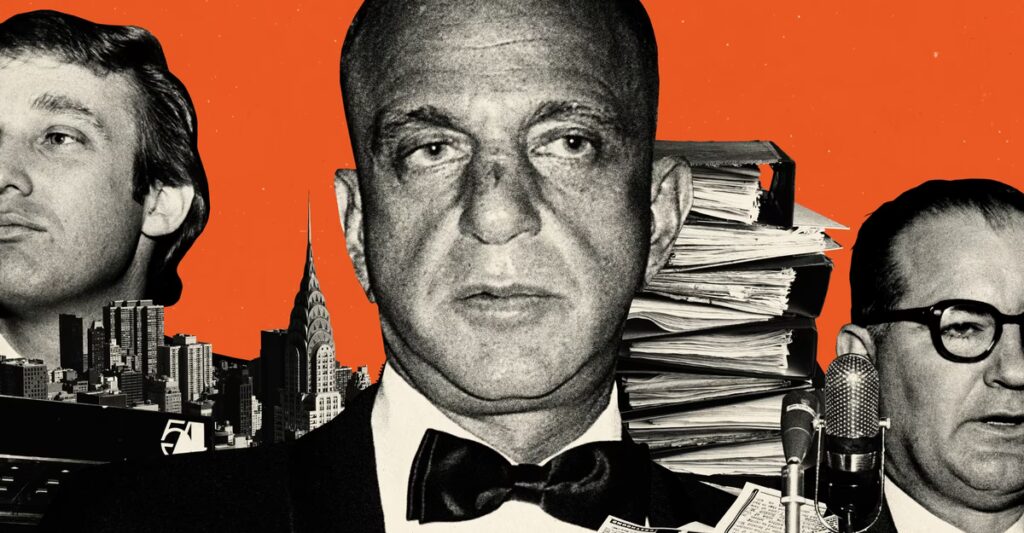
The day after Donald Trump won the 2016 election, the conservative political operative Roger Stone was among the lucky few to get through to him on the telephone. The president-elect reminisced about the long-dead friend who had introduced him to Stone: “Wouldn’t Roy love to see this moment? Boy, do we miss him.”
“Roy” was Roy Cohn, who became notorious in the early 1950s as chief counsel to Senator Joseph McCarthy and then built a career as a lawyer and fixer for New York City’s rich and powerful. His roster of clients, many of whom doubled as his friends, included Cardinal Francis Spellman, George Steinbrenner, the media mogul Si Newhouse, and a host of famous mafiosi, including “Fat Tony” Salerno and John Gotti. Trump met Cohn in 1973, when the young developer sought advice about a federal lawsuit alleging racial discrimination by his family’s real-estate company. Cohn proposed countersuing the feds for defamation—even though the company had been marking the applications of prospective Black tenants with a large C, for “colored,” and then telling them no apartments were available. The countersuit, for $100 million, failed as a legal tactic—the company settled with the Justice Department, without admitting wrongdoing, after two years of litigation—but it made headlines, which was the real point. Trump and Cohn had the same attitude toward the law: It was not a system of rules, but a way of getting what you wanted.
For a generation of liberal Manhattanites, the mere mention of Cohn’s name produced a visceral loathing. They saw him as a self-serving and unprincipled social climber whose crusade against communism had ruined lives. In documentaries, profiles, and the play Angels in America, he has been portrayed as a villain in the vein of Shakespeare’s Richard III, whose monstrousness can be traced back to his own sense of social exclusion. When Cohn contracted AIDS, he kept his illness and his sexuality secret to the end. He died in 1986 insisting that he had liver cancer, even while enrolled in a clinical trial to receive AZT, an early AIDS medication.
In American Scoundrel: Roy Cohn’s Dark Journey From Joe McCarthy to Donald Trump, Kai Bird—writing with his wife, Susan Goldmark, whom he credits with contributing significant research—aims to bring Cohn into focus as a progenitor of Trump. Bird’s previous work as a biographer has focused on distinguished statesmen and scientists of the mid-20th century, most notably the left-leaning nuclear physicist J. Robert Oppenheimer, whom he and Martin J. Sherwin wrote about in American Prometheus, the book adapted by Christopher Nolan for the movie Oppenheimer.
Cohn, like Trump, had nothing but contempt for the norms and ethos of that mid-century elite. But Bird argues that this hatred was driven less by a coherent politics than by “dishonesty, narcissism, careless cruelty, and vengefulness.” Both men were avatars of the glitzy New York of the ’70s and ’80s, sharing an obsession with sex, a love of celebrity, and a hatred for expertise. Bird quotes the New York Times reporter Sam Roberts on the lessons Trump learned from Cohn: “1. Never settle, never surrender. 2. Counterattack, counter-sue immediately. 3. No matter what happens, no matter how deeply into the muck you get, claim victory and never admit defeat.” (Bird also implies that Cohn may have had a crush on Trump, blond and blue-eyed men being his ideal type.)
In Bird’s telling, the parallels between Cohn and Trump begin with their childhoods. Both grew up in New York’s outer boroughs, in families that were prosperous but resentful of those in the real inner circle. Cohn, born in 1927, lived in the Bronx as a young boy, the only child of a loveless marriage. His maternal grandfather, a wealthy banker, founded the Bank of United States, whose clients were primarily Jewish immigrants. Cohn’s father, active in the Bronx Democratic machine, agreed to marry his mother in return for being made a judge, which her father could promise thanks to his political connections. But the family was plagued by a scandal: The bank collapsed in the early years of the Depression, and Cohn’s maternal uncle, who had taken over as its president, was convicted of fraud and sent to prison at Sing Sing.
Cohn grew up without many friends; one of his cousins said that he was the kind of kid who would have enjoyed keeping a snake as a pet and feeding it live mice. His social life didn’t improve when the family moved to the Upper East Side in 1935. Few Jews lived in the area then, but the collapse of real-estate prices in the Depression made it possible for the Cohns to get a place on Park Avenue. Cohn was educated at elite private institutions: the Ethical Culture School and then the more traditional and uptight Horace Mann School, followed by Columbia for college and law school.
Thanks to his father’s influence, Cohn quickly got a job in the U.S. Attorney’s Office. He was soon working on high-profile cases against alleged Communists, including the writer Dashiell Hammett and the State Department official Alger Hiss. In 1951, Cohn was a key member of the team that prosecuted Julius and Ethel Rosenberg for conspiring to pass atomic secrets to the U.S.S.R. He intimidated Ethel’s brother David Greenglass, who’d worked on the Manhattan Project, into testifying against her. After the Rosenbergs were convicted, Cohn helped press Judge Irving Kaufman to give both of them the death penalty, hoping that Ethel would feel forced to talk. She did not, and the Rosenbergs’ two children were orphaned.
[From the August 2026 issue: Amy Weiss-Meyer on the Rosenberg boys]
Cohn’s ferocious investment in anti-communism, Bird argues, reflected the fears of New York’s “Park Avenue Jews,” who worried that Jewish Americans would be suspected of disloyalty because of Lower East Side radicals like the Rosenbergs. It also made him a natural choice when McCarthy, then at the height of his anti-communist campaign, needed a new chief counsel. Cohn was hired at age 25, beating out Robert F. Kennedy for the job. He advised McCarthy as the senator oversaw more than 110 closed-door hearings and subpoenaed hundreds of people, many of whom lost their job or faced public humiliation.
Cohn was especially nasty toward gay men. Hundreds of federal employees were fired not for being Communists but because they were suspected of being gay. Not that the two were entirely separate in his view; Cohn, like many others, believed that homosexuals were prime “prey” for spies. At the same time, he was the target of homophobic rumors himself, especially about his relationship with David Schine, a wealthy, Harvard-educated young man whom Cohn persuaded McCarthy to hire as an unpaid consultant. When Schine was drafted into the Army as the Korean War was ending, Cohn tried to get him excused from basic training. After these efforts were rebuffed, Cohn called the Army’s general counsel and threatened to “teach the Army what it means to go over my head.” A month later, Army representatives were called before McCarthy’s congressional committee for the first time, setting up a confrontation that would eventually lead to McCarthy’s downfall. Bird argues that Cohn’s willingness to say and do anything to get what he wanted—no matter who might suffer along the way—provided a model for Trump’s approach to political life.
[George Packer: The Mafia style in American politics]
Cohn may have entered American political history because of his role in the Red Scare, but American Scoundrel emphasizes the career he went on to build in New York, where he showed an amazing capacity to escape legal repercussions for his misdeeds. Over the course of the 1960s, the liberal U.S. Attorney Robert Morgenthau unsuccessfully brought charges against Cohn for perjury, obstruction of justice, mail and wire fraud, conspiracy to bribe a city official, extortion, and blackmail. Cohn claimed that he was being targeted by Attorney General Robert F. Kennedy, his old rival: “A few people are out to get me,” he declared. During Cohn’s second trial, his attorney suffered a heart attack. Instead of getting a new lawyer, Cohn gave the summation of the case on his own behalf, and when he was acquitted of all charges, he told the press: “Thank God we put juries between the type of tyranny that Morgenthau perpetrates on his enemies!”
Cohn could be charismatic. Ayn Rand fawned over him when they met at a party: “You’ve always fascinated me so much and I believe in so much of what you stand for.” Still, he comes off in this book as smarmy and unappealing, a cheat from start to finish. Bird gives us a litany of Cohn’s pettier sins. In the summer of 1968, he invited Cardinal Spellman and the Democratic politician Carmine De Sapio onto his yacht (named Defiance) to discuss judicial nominations, then wrote it off as a business expense. He and Barbara Walters were good friends and he hinted to gossip columnists that they were romantically involved, using her to hide his sexuality. Cohn had a lifelong habit of eating off the plates of his dining companions without asking their permission. He regularly stiffed his creditors. When one hapless small-business man sent him a memo reminding him of a $10,000 debt, Cohn scrawled a characteristic response: “Dear Louie: Fuck you. Roy.”
For Cohn, being gay was a private matter—his business, nobody else’s. Drawing on an unpublished memoir by Cohn’s cousin, Bird details sex parties at Cohn’s townhouse on East 68th Street; apparently the house was also used as the set for a pornographic film (Cohn owned two X-rated-movie theaters in New Jersey). He went out regularly to gay establishments, and the gossip columnist Liz Smith wrote that he “owned a number of successful gay bars around Manhattan.”
But Cohn remained intensely homophobic in public, telling people that he believed “gays shouldn’t be schoolteachers.” He lobbied against gay-civil-rights legislation for New York City in the 1970s and early ’80s. In 1978, he told an interviewer that anyone “who knows the way my mind works or knows the way I function in active life, would have an awfully hard time reconciling that with any kind of homosexuality.” The playwright Tony Kushner drew on this idea for the famous monologue that his version of Cohn delivers in Angels in America: “Homosexuals are not men who sleep with other men. Homosexuals are men who in fifteen years of trying cannot get a pissant antidiscrimination bill through City Council. Homosexuals are men who know nobody and who nobody knows. Who have zero clout. Does that sound like me?” the Cohn character asks. “No. I have clout. A lot of it.”
American Scoundrel offers an effective portrait of Cohn’s role in New York society in an era when sleaze and respectability were not clearly delineated. There is a great deal of salacious gossip; readers will learn far more than they ever wanted to know about Cohn’s sexual habits. Yet despite the extent of Bird and Goldmark’s research, the portrayal of Cohn as an unbounded narcissist misses some of what his life might tell us about the right-wing politics of his era. Earlier accounts have been more sensitive to the irony that Cohn was undone by the same political forces he rode to prominence. The repression of the McCarthy era—the frenetic demands for loyalty, patriotism, normalcy—helped bolster the sexual secrecy and homophobia that compounded the devastation of AIDS in its early years, cloaking the disease in fear and shame.
What Bird does give us is a new way to think about Cohn, Trump, and the legacy of McCarthyism. Cohn always presented himself as an outsider facing down a hostile, arrogant establishment, a stance that Trump adopted as he moved into politics. But Cohn’s career depended on being an insider, connected to New York’s media empires, real-estate developers, politicians, law firms, and private schools. Looking at the long arc of Cohn’s career shows how much of McCarthyism was about ambition and careerism, rather than ideology. His friends and clients were obsequious to him because they thought he could get them things no one else could: money, divorce settlements, political influence.
Cohn’s commitment to his clients kept him in rarified company until the end. In March 1986, Trump threw a bash for Cohn at Mar-a-Lago, inviting guests such as Lee Iacocca of Chrysler and Manhattan Borough President Andrew Stein. Cohn attended, his skin blotchy with sarcoma; afterward, housekeeping staff was instructed to disinfect the silverware with bleach. In late June, a little more than a month before Cohn died, he was disbarred in New York State for offenses including perjury, misappropriation of funds, and coercing a mentally incapacitated client into signing a will that appointed Cohn executor. A blue-chip roster of Cohn’s friends testified in his defense, including William F. Buckley Jr., William Safire, Barbara Walters, and Trump.
[Read: The myth of Trump’s loyalty]
Cohn insisted he didn’t care about being disbarred. Recalcitrant and self-righteous, he always claimed to disregard other people’s opinions of him. He would have responded the same way to the conclusion Bird reaches in American Scoundrel, that he was an “empty vessel” with “no coherent personal philosophy unless you count his shallow mirroring of Ayn Rand’s celebration of unadulterated selfishness.” But he would surely have been bothered by the epitaph that was included on the AIDS Memorial Quilt—especially the last word: ROY COHN. BULLY. COWARD. VICTIM.
*Lead-illustration sources: Bettmann / Getty; Carol M. Highsmith / Library of Congress; John P. Kelly / Getty; Fred W. McDarrah / The New York Historical / Getty; vasiliki / Getty
This article appears in the October 2026 print edition with the headline “Roy Cohn Did It First.”
The post Roy Cohn Did It First appeared first on The Atlantic.