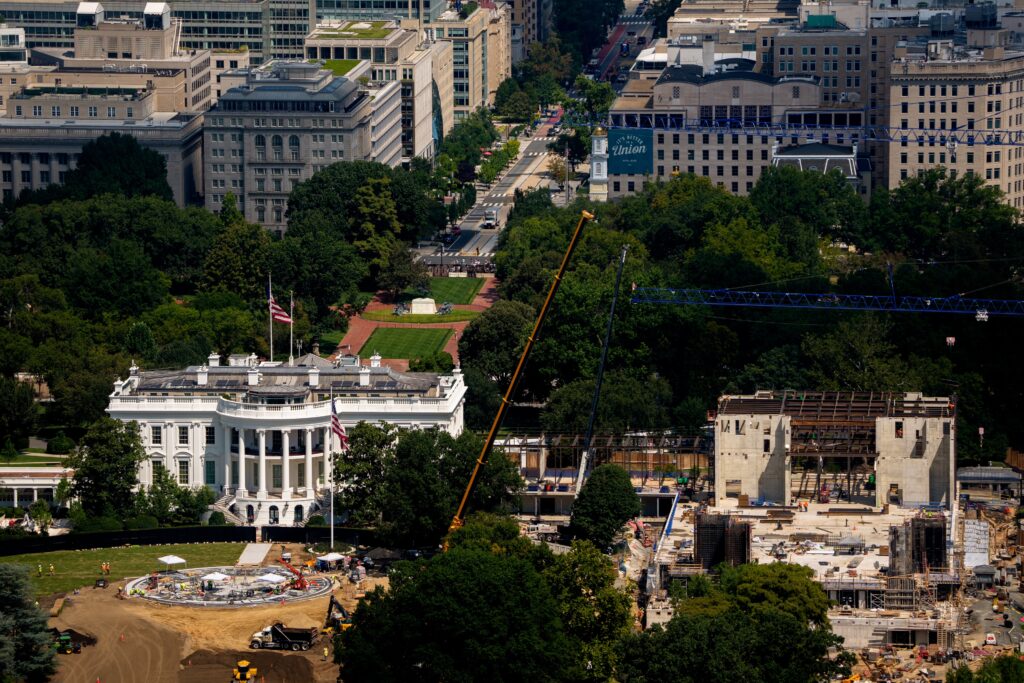
The Supreme Court could release an opinion any day on the legality of President Donald Trump’s effort to construct a grand ballroom on White House grounds. Compared with other executive power showdowns of Trump’s presidency, the practical impact of this one is modest. There aren’t a trillion dollars at stake, as there were in the court’s tariff decision earlier this year. The independence of government agencies doesn’t depend on the outcome, as it did when the justices decided the scope of Trump’s power to fire officials at the Federal Trade Commission and the Federal Reserve.
But the symbolism is significant. Physical monuments can reflect the distribution of political power. The appeals court that ruled against Trump’s ballroom construction leaned on that symbolism. “The founding architect of the Nation’s capital, Pierre L’Enfant, designed the capital city’s layout to focus on the towering Capitol building — the gleaming palace of the people in the new democracy — and to contrast it with the simple humility of the White House,” says the first paragraph of the opinion from the U.S. Court of Appeals for the District of Columbia Circuit.
In other words: Erecting a 90,000-square-foot ballroom at the White House would aggrandize the presidency, metaphorically if not in fact. The judges implied that the political message from Trump’s construction is one reason the National Trust for Historic Preservation, the plaintiff in the case, has standing to sue. The ballroom “would permanently impair the White House’s ability,” the judges wrote, “to embody George Washington’s intent for a ‘modest’ residence that reflects ‘republican simplicity.’”
The opinion might be over its skis in concluding that presidential splendor was anathema to the founding generation. Far from emphasizing the building’s “simple humility,” L’Enfant referred to the envisioned structure as a “palace” in letters to Washington in the early 1790s.
Thomas Jefferson, a strong opponent of monarchy, advised L’Enfant that the Capitol should be built in the classical style. But as Gary Schmitt of the American Enterprise Institute has pointed out, Jefferson mentioned “three royal Parisian structures” as possible models for the White House — “indicating, if only implicitly, that the executive was less closely tied to republicanism.”
Whatever message the architecture of America’s governing institutions was originally meant to convey, there’s a certain grim candor about Trump’s palatial ambitions for the presidential residence in the 21st century. Today, the White House — and not “the gleaming palace of the people,” as the judges in the ballroom case described the Capitol — is the focal point of American politics.
The buildings have remained at the sites L’Enfant assigned, but the presidency has eclipsed Congress as the prime mover of government. The president is armed with control of a sprawling administrative state within the country’s borders and the biggest military in the world beyond them. The founding generation didn’t anticipate such an enormous executive branch.
To the debatable extent that the founders did envision a system of government based on “republican simplicity” — with the people’s representatives in Congress forging policy and the president a humble executor of the laws — that system has given way to something else. The president sets the agenda, commanding the federal agencies that affect Americans’ lives. Congress reacts.
Trump’s second term has turbocharged the presidency, but the process didn’t start with him. The historian Arthur M. Schlesinger Jr. sounded the alarm about an “imperial presidency,” which he attributed in part to the security demands of the Cold War, in the 1970s. In the 2010s and 2020s, presidents of both parties have increasingly acted unilaterally to fulfill what they see as their democratic mandates — on immigration, student loans, tariffs and much more — treating political give-and-take in Congress as an obstructive inconvenience. There’s little reason to think the next Democratic president would significantly shrink the office after capturing it.
Though L’Enfant foresaw a majestic White House, he deliberately placed the Capitol at the highest point of the original city plan. As the National Capital Planning Commission notes, this broke from “European customs of reserving such sites for the leader’s palace.” An architect aiming to design a city from scratch that faithfully represents America’s system of government today — as opposed to the one its founders aspired to — would probably have to opt for the European model. Congress isn’t earning the pride of place it was granted in L’Enfant’s design.
In all likelihood, Trump is acting lawlessly by building the ballroom. His claims of legal authority to make such substantial changes to the White House’s structure without congressional approval seem awfully thin. But it might be easier for the Supreme Court to stop him if the construction weren’t bringing the capital city’s iconography closer in line with an alarming political reality.
The post The symbolism of Trump’s White House ballroom is all too apt appeared first on Washington Post.