Ryan Zickgraf is a columnist for UnHerd, from which this article was adapted.
Somewhere in America, a 26-year-old is standing in his bathroom, downing his stack: creatine, a fistful of supplements, ashwagandha for the cortisol. He dabs some tallow on the face, because seed oils are poison and beef fat is ancestral. He then mouths a wide-open vowel to sharpen his jawline — mewing, they call it — and checks the angle in the mirror, as a jeweler examines a stone. Down the hall, his girlfriend examines her birth chart, lights the palo santo and wonders whether Mercury is going to wreck her Tuesday.
Neither of them belongs to a church, a union or a recreation league. Neither has voted in a local election. But both are, in the deepest and most sincere sense available to modern people, working on themselves. They are self-maxxing.
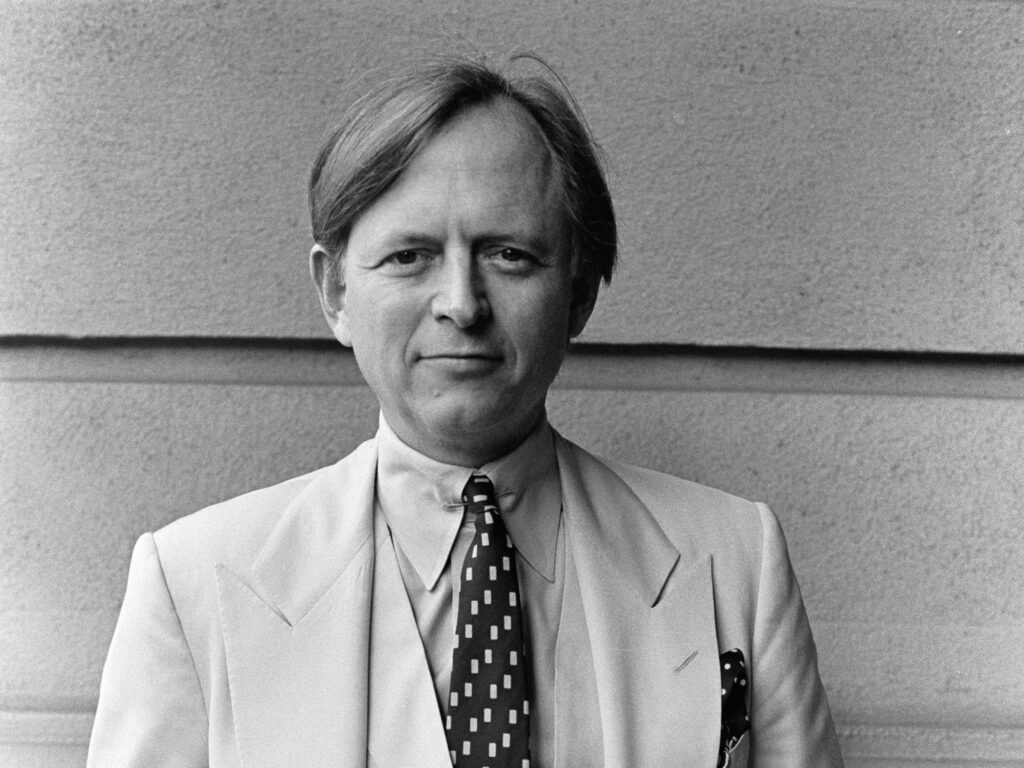
This month marks the 50th anniversary of the essay that observed the moment all this began: Tom Wolfe’s August 1976 cover story for New York magazine, “The ‘Me’ Decade and the Third Great Awakening.” It was Wolfe at his most gleeful and profanely merciless, a 10,000-word safari through Human Potential Movement talks, encounter groups, Aquarian communes and the new therapeutic religions. Americans had discovered a subject more absorbing than God, country or class: themselves. The project of the age was self-actualization.
Fifty years later, “The ‘Me’ Decade” feels like a Rosetta Stone for understanding the permanent navel-gazing that followed the collapse of the postwar order. The 1960s promised to remake the world, and when the world declined to be remade, the “we” of the New Left splintered into thousands of private quests for meaning. In the mid-2020s, after the politics of the late 2010s and early 2020s burned out, Wolfe’s Third Great Awakening has returned.
Wolfe, the thin white duke of New Journalism, was not simply mocking the narcissists. Across his books such as “The Electric Kool-Aid Acid Test” and “Radical Chic & Mau-Mauing the Flak Catchers,” the author, who died in 2018 at age 88, had watched the New Left and the counterculture at close range and seen the dream of political revolution give way to the search for private revelation. By the United States bicentennial, he was performing what he called a “social autopsy” on the ’70s. Wrote Wolfe: “The new alchemical dream is: changing one’s personality — remaking, remodeling, elevating, and polishing one’s very self … and observing, studying, and doting on it. (Me!)”
Wolfe’s claim was that this was something genuinely new. For most of human history, he argued, ordinary people had no self to speak of — not in the way people today mean it. They understood themselves less as sovereign individuals than as a link in what he called the “great biological stream,” living not only their own lives but also those of their ancestors, their children, their neighbors. The self was a vehicle, not a destination.
What changed, Wolfe believed, was money. America’s postwar bargain between capital and labor had handed the working and middle classes more leisure, privacy, mobility and bodily freedom than their grandparents could have dreamed of. The question was: What would Americans do with it?
Some, perhaps, used it to become enlightened citizens, but the rest, Wolfe said, bought ranch houses, ever-larger televisions, diet books and the right to be left alone. “Once the dreary little bastards started getting money in the 1940s,” he wrote, “they did an astonishing thing—they took their money and ran. … They discovered and started doting on Me!“
Wolfe called this the Third Great Awakening because the seminars and Diet Coke Buddhisms had religion’s structure but inverted its ancient formula. Where the old faiths began with self-abasement before something larger — God, the congregation, children, the dead — the new religion began, in Wolfe’s phrase, “with the most delicious look inward; with considerable narcissism.” The sacred object was the self. You did not join to submit but to be affirmed, to be seen.
Denominations appeared across the ideological spectrum. On the left, the energies of the ’60s diffused into mass-market psychology, communes, feminism, gay liberation, racial identity, and occult and imported spiritualities. Among conservative Americans came born-again politics and the Jesus People — movements that spoke the language of salvation but placed enormous weight on personal testimony, crisis and rebirth. For yuppies came the cult of the body: dieting, jogging, aerobics. These groups often hated one another but shared the belief that the inherited self was inadequate and the chosen self might be glorious.
By the end of the decade, Wolfe was not alone in sensing that something had cracked in America. In 1979, Jimmy Carter delivered what history lazily remembers as the “malaise” speech, although the 39th president never used that word. Officially an address on energy, it became a diagnosis of a country losing its appetite for sacrifice, common purpose and the future. That same year, the historian and social critic Christopher Lasch published “The Culture of Narcissism,” which offered a darker, Freudian analysis of the Me Decade.
Vanity is almost too healthy a word for what he described. Lasch’s American was psychically dependent on recognition, terrified of aging, suspicious of the future and estranged from the past. Carter, Lasch and Wolfe differed enormously, but each understood that the postwar world was giving way to a society in which the self would become the central arena of politics, religion, consumption, health and meaning.
What none of them could have known was how durable — and how renewable — that hyperindividualism would become. The obvious objection is that the ’70s ended, and the ’80s, ’90s and everything since have looked rather different. The hippies got haircuts and jobs. Reagan arrived to explain that the void in Americans’ private lives was actually a tax problem. The yuppies swapped mantras for corporate mergers. The inward turn looks like one phase among several.
But freedom from society has only been part of the ideal. What people have also wanted was recognition — to be seen not by the neighbor or the congregation, whose gaze comes bundled with obligations, but by the only thing that seems to confer reality: the media discourse, the national screen.
That craving for recognition found a delivery mechanism in the smartphone and social media. The latter offers the infrastructure the first Me Decade lacked: continuous self-regard with measurable feedback. It even swallows its own antidote: log off, move to the country, bake bread — congratulations, you can now make content about the moral superiority of not making content. The exit opens into the gift shop.
You can measure the deepening of the space left by everything Americans have stopped doing. This is the story Robert Putnam told in his 2000 book “Bowling Alone.” In 2020, membership in a church, synagogue or mosque fell below half of American adults for the first time in Gallup’s nearly nine-decade series. One in 10 workers belongs to a labor union. Each week, two local newspapers stop publishing; a quarter of adults told Pew in 2025 they had not read even part of a book in the previous year; and local elections — routinely fail to attract even 1 voter in 5. The Rotary Club, the Girl Scouts, the precinct meeting — the mesh that sustained American democracy has thinned to gossamer.
The present looks more like Wolfe’s 1976 than we care to admit. The engine of the ’70s was the failure of the ’60s. Fast-forward: The years from roughly 2016 through the early 2020s were America’s most feverishly political stretch in generations. On one flank stood a populist insurgency; on the other, the Great Awokening. Both failed to build the transformed society their rhetoric advertised.
What does thwarted revolutionary energy do when it has nowhere durable to go? As it did after 1968, it goes toward the one realm that still seems transformable: the self. It splinters into private quests for meaning — the pattern Bono identified in 1981 when he sang, “I can’t change the world / But I can change the world in me.”
On the left in the late ’70s, disillusion flowed into the New Age. Today, it flows into “self-care,” a term associated with Audre Lorde’s 1988 description of caring for herself while suffering from cancer as “an act of political warfare,” since domesticated into a marketing category for Johnson & Johnson and expensive spas. It flows into astrology, commercialized through subscription apps and personalized notifications, and into the witch with the imagined power to “hex” President Donald Trump. A generation that lit a candle for George Floyd in 2020 now lights a scented candle in the bathtub.
The right in the ’70s had the cult of fitness. MAHA, the manosphere and Silicon Valley have looksmaxxing and testosterone infusions, ice baths and the carnivore diet, along with the tech billionaire Bryan Johnson spending millions to reverse his own aging and streaming his bloodwork to the world. It is the body as a project to be perfected, but with the promise cranked up from fitness to immortality.
For all the tedious arguments about who is and is not woke, both sides now qualify in Wolfe’s sense of the word “awakening”: Each is trying to fashion a self strong enough to survive the collapse of everything the self was once supposed to belong to.
In “The ‘Me’ Decade,” Wolfe wrote that journalists of his time compulsively applied the f-word — fascism — to hippies, Scientologists and Moonies, He then noted that the term derives from fasces: sticks bound into a single, unbreakable bundle. Whatever else Trumpism may be, it is not fascism. It does not ask its followers to dissolve their personalities into a common national will.
Trumpism offers almost the opposite fantasy: national restoration through a man who appears free from every obligation, inhibition and shame. It is cheap, televisual and consumerist — and it demands no genuine self-abnegation. It is Spirit Halloween nationalism, a longing for the symbols of mid-century cohesion without the institutions that made such cohesion possible. Trump is perhaps the purest Me Decade product America has elevated: a man of appetites and grievances whose supporters love him because he appears unbound, unashamed and entirely himself.
Likewise, much of what has passed for radical left-wing politics in the past decade has consisted of locating oneself on the grid of identity and curating a public self certified as virtuous. It has offered the profoundest pleasures of the Me Decade — the look inward, the moral distinction, the separation from the unenlightened — while allowing the seeker to experience all of it as selflessness.
None of this is forever. There is a backlash now. It is stirring in the emergence of in-person reading clubs and the sudden fashions among some Zoomers for organized religion, “third places” and “touching grass.” It’s also visible in the small revolt against phones and artificial intelligence and the data centers that power them. But it is worth being honest about these countermovements. Withdrawal from society is still the mainstream, and the return to it a hobby.
The U.S. is now half a century into the inward gaze, and Americans are not climbing out. We are, at most, coming up for air. Wolfe’s cruel joke was that Americans had discovered Me. Fifty years later, we have not found a reason to drop the mirror, and we are more than ever transfixed.
The post Tom Wolfe’s ‘Me Decade’: Still going strong 50 years later appeared first on Washington Post.