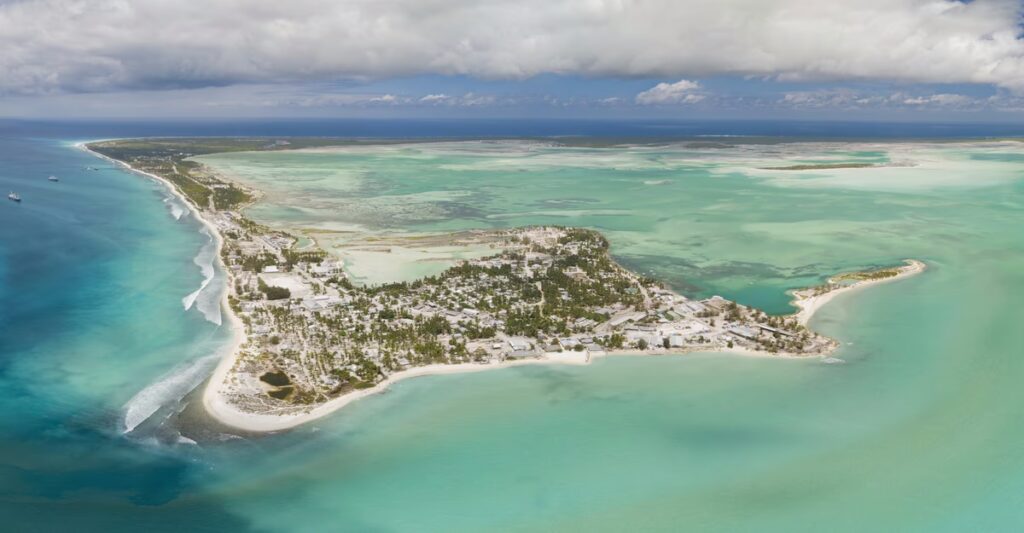
In the middle of the Pacific Ocean, along the equator, scientists have drawn a box. It’s a big box, two-thirds the size of China, yet hardly anyone lives inside it. This rectangular swath of open ocean is monitored by satellites and a network of moored buoys that measure minute changes in the temperature of the water, with an eye toward anomalies. Every few years or so, driven by changing winds and currents, the water temperature in this part of the ocean starts to rise; even a half degree Celsius above normal over months warrants a designation that an El Niño phase has begun. That’s enough warming to unleash floods and fires, drought and famine, around the world. The box is called Niño 3.4. Right now, it’s hot in the box.
“Like a baby pool,” Kristina Tietjen, who spent most of August scuba diving in the middle of this mass of abnormally warm water, told me. Tietjen has been coming to the world’s largest atoll, Kiritimati, for more than a decade to study its coral reefs. She usually dives in a medium-weight wetsuit; this trip, her team needed only rash guards. It is still early in this El Niño cycle—which is likely to be the strongest ever recorded—but the waters around Kiritimati have already been 3 to 4 degrees Celsius above normal.
Tietjen’s time on Kiritimati (pronounced like Christmas) has allowed her to watch, in brutal detail, what these repeated warm-water cycles, playing out in a steadily warming ocean, mean for the great tropical coral reefs here, which were once near pristine. During her first El Niño, in 2015–16, 90 percent of Kiritimati’s coral reef died. Years of slow, partial recovery followed. This month, Tietjen and her colleagues, part of the Canadian scientist Julia Baum’s lab at the University of Victoria, discovered that nearly half of the island’s remaining corals had already bleached—a prelude, if warming persists, to death. When Tietjen comes back, she may well be swimming over a graveyard.
Most of the world experiences El Niño’s ripple effects as the heat building up in the equatorial Pacific radiates into the atmosphere and around the globe. This means great gouts of rain in supercharged storms in some places; in other areas, crop-killing dry spells that can extend for months. Along the Pacific Coast of South America, torrential rains and landslides have forced the temporary closure of a main route to Machu Picchu, in Peru; deadly floods have swept through arid regions of northern Chile. Countries such as India and Ethiopia are enduring some of their driest summers on record. El Niños tend to mean more rainfall across the southern United States and drier stretches across a band in the North. Strong El Niños can mean record-breaking heat, and this one is shaping up to be unlike any catalogued in the past eight decades. A 2-degree-Celsius increase in the Niño 3.4 box typically earns the title of “Super El Niño”; we’re already past that threshold, and experts project that the warming could peak at roughly twice as high. “We are now pretty certain this will be an exceptional event,” Malte Stuecker, the director of the International Pacific Research Center at the University of Hawaii at Manoa, told me.
Part of the reason Stuecker expects this warmth to keep building is that the buoys along the equator can detect water temperatures well below the surface. Down more than 100 meters, an enormous mass of warm water has built up and will rise to the surface in the months ahead. The amount of heat brewing in the ocean has produced one of those graphs in which the current year departs drastically from past trend lines, wriggling up erratically into unfamiliar territory.
Although scientists continue to debate the extent to which climate change makes El Niño cycles more frequent or intense, they agree that these cycles are occurring in an ocean that is warmer than it was. Last Saturday, the daily global average sea-surface temperature reached 21.1 degrees Celsius (70 degrees Fahrenheit), its highest level on record, according to Europe’s Copernicus Climate Change Service. Even if El Niño cycles are not changing at all, as they spiral around that ascending baseline, the temperature peaks they hit keep getting higher, causing repeated blows to marine life and disrupting ecosystems in ways that may be irrevocable.
Carlos Zavalaga, the director of the seabird lab at the Universidad Cientifica del Sur, in Lima, began to comprehend the magnitude of this year’s warming in mid-June, when he visited Macabi and Guanape Norte, two islands off the northern coast of Peru. He’d been hearing from colleagues about dead birds washing up by the hundreds on the coasts of Peru and Ecuador. He’s seen the news stories about flocks of hungry Peruvian pelicans swarming the fish markets in port cities looking for food. On the two islands, which just last year were thronged with pelicans, Inca terns, and Humboldt penguins, Zavalaga found empty nests, some with eggs and starving chicks. “They were abandoned islands,” he told me.
These seabirds feed on schools of anchovies swept up in the Humboldt current, the cold, nutrient-rich upwelling waters that create bountiful fisheries off South America’s Pacific Coast. During El Niño years, that current gets displaced by warmer waters pushing east across the ocean, and these great schools of feeder fish can vanish from the coasts. The decline has been severe enough that Peru this month shut down an anchovy fishery that is a key economic engine for the country, with much of the year’s quota unfilled. Long before satellite monitoring, Peruvian fishermen noticed these cycles of warmer waters and dwindling fish stocks; they named the phenomenon, which peaked around Christmas, after the Christ child. References to El Niño in Peru’s scientific literature date back to the 19th century.
In his three decades studying seabirds, Zavalaga has witnessed die-offs before. But it is the rapid-fire nature of these blows and the severity of the disruptions that make him so concerned. Just three years ago—the same year avian flu killed more than 500,000 seabirds—another El Niño slammed into the coast of Peru. The birds that had made a tenuous recovery since then now face the prospect of another die-off. “It’s like a boxing match: You have a first knockout, you try to recover quickly, and then you have a second knockout,” he said. “I cannot imagine what will be the scenario by the end of this year.” He doubted that the birds could go extinct, but some species might move farther south in search of colder waters. The coastline in Peru and the culture that depends on the fish and the birds could be permanently altered.
When the warming started around Kiritimati, one of the few populated islands in the Niño 3.4 monitoring zone, Bill Newton, an island resident, was fascinated by how evident the changes were. He told me that the normally dry island turned sopping wet, and regular floods started washing out the roads. The wet brought swarms of mosquitoes (prior El Niños have led to outbreaks of dengue and chikungunya) but also clouds of dragonflies, which he hadn’t seen before. Higher-than-normal tides poured into seafront homes. Tuna, which can do well in warmer water, attracted dozens of fishing boats off the coast. Prevailing winds changed direction.
Corals have a particularly hard time when water warms; they can’t move elsewhere, and they are sensitive to heat stress. As little as four weeks in water just a degree warmer than normal can cause bleaching, the loss of the symbiont algae that supply corals’ food and brilliant colors, according to Baum, whose lab Tietjen works at. Baum, an ecologist, has studied Kiritimati’s reef since 2009. After the El Niño a decade ago killed off nearly the entire reef, Baum began to consider the possibility that she would witness the obliteration of an ecosystem in her lifetime. In a 2018 paper in Science, she projected that successive bleaching events could occur frequently enough that coral reefs, which take roughly 10 to 30 years to recover from mass mortality, would not have time to regrow. In the years since, she had been hopeful that nature could fight back as she watched surviving corals take up symbionts that were more heat resistant. This year’s warming and the pace of bleaching already under way have dispelled that hope.
What happens next is in some ways predictable. El Niño is not a haphazard force of destruction; it’s a warming phase in a specific area in the Pacific Ocean that scientists have determined shifts the probabilities for certain weather outcomes in various parts of the world. Those probabilities are reliable enough that, for example, the U.S. Navy already plans to send a hospital ship to the coast of Peru in February to be in position to help after expected floods. But as Baum and other scientists who study and love the delicate ecosystems in the equatorial Pacific are finding, just because El Niño is a familiar cycle doesn’t mean things will be the same when this one is over.
The post El Niño Has Become a Doom Loop appeared first on The Atlantic.