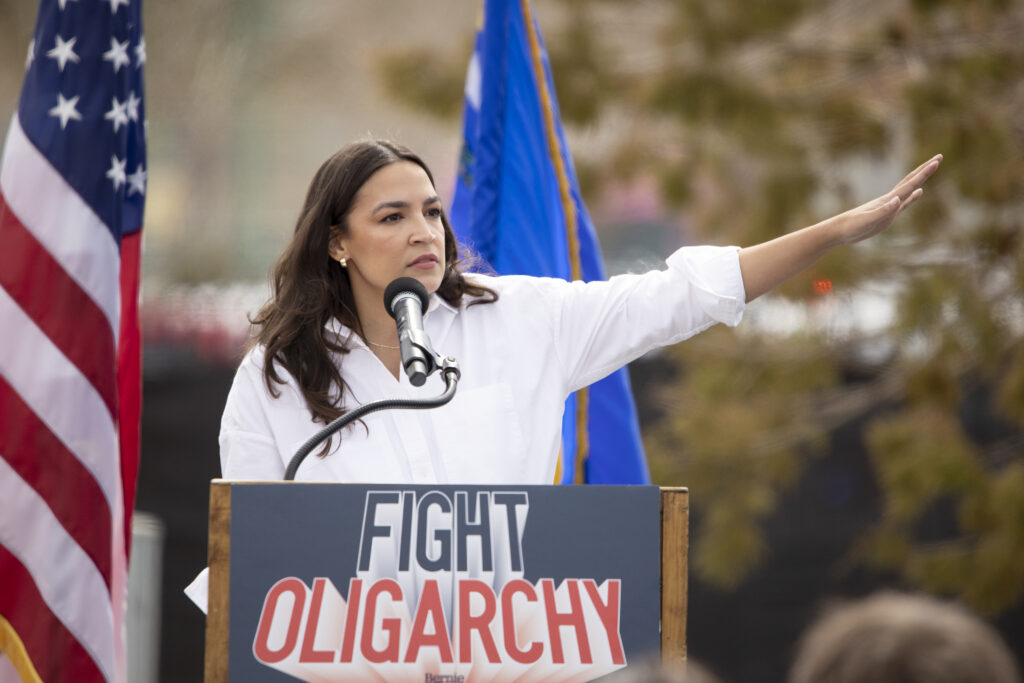
Is celebrity streamer Hasan Piker an elite? Is the president of Harvard just an ordinary working Joe? Or is it the reverse? Or is it the billionaires who really run things?
Who, in other words, is the elite?
In America’s populist era, everyone wants to believe they are the champion of Jane Q. Public against the corrupt, self-dealing insiders who are running the country to suit themselves. Almost no one will cop to being one of those insiders. Conservative legislators position themselves as plucky Davids standing up to the Goliath hive mind of left-leaning journalists, academics, activists and bureaucrats who exert a shadowy control over government and corporations. The left is equally convinced it’s the underdog but has been having a bruising fight over whether the hated elites should be defined as the White male power structure or as corporations and the ultrarich.
A poll of 3,000 registered voters conducted in late July by the Argument, a publication devoted to promoting liberalism, suggests that people are most receptive to the latter definition. For those polled, billionaires count as elites, as do celebrities and maybe corporate executives and politicians. College professors and journalists don’t. So were those of us who spent years complaining about the hard-left turn of elite institutions wrong?
Not quite. I’d argue we were right — five years ago. America doesn’t have one elite but many, and at any given time, the public is hopping mad at some of them, but not necessarily the same ones as they used to be. Right now, wealth looms larger than woke media, in part for the reasons I laid out in my recent column: Collapsing public trust and a fragmented media environment have greatly diminished the influence of legacy journalism.
For progressives dreaming of an economic revolution (and beating back Republican attacks on universities and mainstream media outlets), this might seem like heartening news: Their moment has finally arrived! Lakshya Jain, the Argument’s pollster, suggested that possibility in a recent newsletter that argued the public is “far more aligned with the left-wing theory of the elites, which indexes more heavily on economic power.”
That’s certainly the theory of every Democratic campaign ad I’ve seen this primary season, all of which seem to hit three themes: fight Trump, make things affordable for ordinary people and tax billionaires. But peering into the Argument’s poll, I came away unsure that there is such a thing as systematic anti-elite politics. Rather, I suspect that the only people truly obsessed with elites are other elites, and anti-elite politics is often intra-elite politics wearing glasses and a fake mustache.
The poll’s most surprising finding is that voters don’t really have a clear sense of what the elites are up to. “The electorate sees elites as believing in everything that ordinary people don’t agree with. To be elite is to be the opposite of the average American,” Jain wrote. For example, voters told pollsters that elites were mostly rich people and business executives — and then said that elites were more likely than other people to support nationalizing most American businesses.
This is incoherent. But then, ordinary voters are often incoherent in this way, because most of them don’t pay that much attention to politics, and even when they do, they’re often rooting for a team rather than rooting around in policy detail.
Though it’s now unfashionable to praise elites, this is why we need them. A complex modern society cannot be run by a show of hands. The public simply wants too many incompatible things, such as more spending, lower budget deficits and no new taxes on anyone except billionaires. Some group of people must be informed enough to understand that this is mathematically impossible and powerful enough to negotiate acceptable compromises.
Reaching tolerable accommodations requires the nation’s many different elites to maintain the public’s trust, which is why I spent the better part of a decade railing against the errors of Woke 1 in my own profession. It also requires elites to exercise self-restraint in their intra-elite battles, precisely because the public is not watching closely enough to referee them effectively.
The public knows when illegal immigration seems to have gotten out of hand but not how immigration rules affect the price of produce. It knows that it wants less crime and a fair shake from the justice system but not why judges prevent juries from hearing certain kinds of evidence. It knows it wants safe planes, comfy seats with legroom, minimal travel delays and cheap tickets, but it does not understand the first thing about aviation safety or airline operations.
Unfortunately, elites who do have strong opinions about such things have recently given in to the temptation to frame these questions not as disagreements over trade-offs but as a fight between the public and abusive elites. Some of that always happens in a democracy, of course, but not to the extent we’ve seen over the last 10 years. Elites are no longer merely sparring with each other; they are launching all-out attacks on the institutions that regulate elite power and make a functional democracy possible.
If it gets them one inch closer to power, they will pack the courts, censor the press, limit academic freedom, use prosecutorial power to persecute political opponents or deny the legitimacy of election results. They will do it under the pretense that this is necessary to stop elites from oppressing the common people. I don’t know how much the public buys any of this. But I do know that as long as elites keep trying to sell it, we’ll keep tearing each other apart.
The post If everyone claims to be an underdog, who are the actual elites? appeared first on Washington Post.