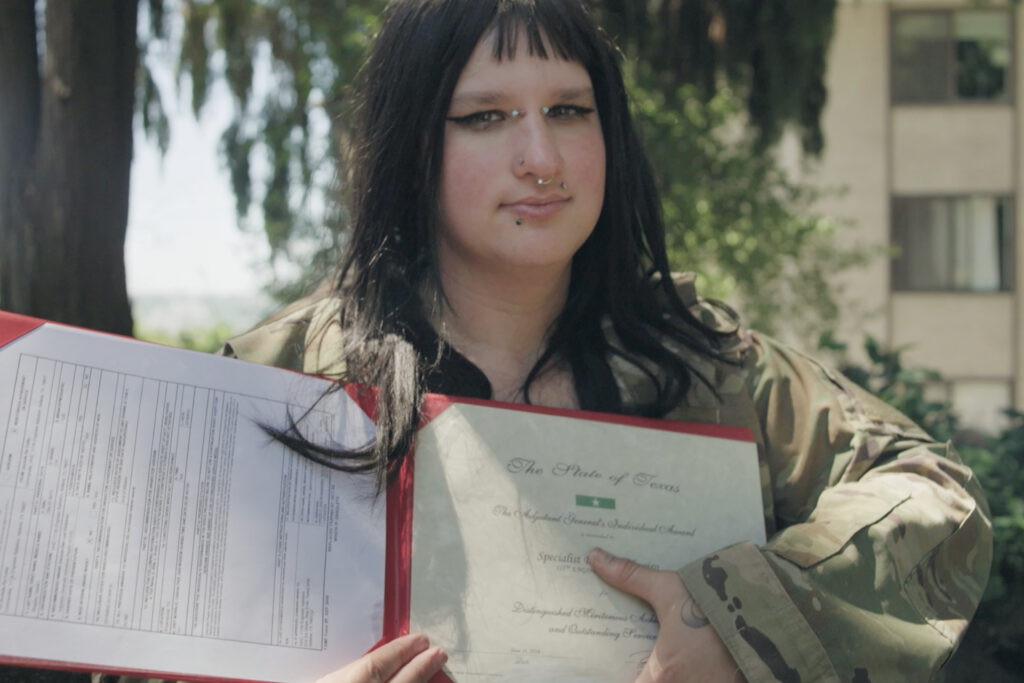
SEATTLE — By the time Chloe Shapiro reached Seattle, almost nothing remained of the life she’d thought she’d have forever. Her career was over. Her bank account was down to $30, and the only home she had was a two-door Honda Accord.
She’d spent the past few nights sleeping in the driver’s seat outside small-town Walmarts as she traveled the 2,100 miles from Texas. In Seattle, she parked her car and surveyed all she had left. She had folded a few dresses in the front seat. In the back, she’d laid her Texas Army National Guard uniform on top of a crate filled with her father’s Bibles and a DD214 certificate that said she was officially discharged from the military.
In the year and a half since Defense Secretary Pete Hegseth declared he would find all trans troops and kick them out, Shapiro had tried to do everything right. She’d given up the military job she’d held for nearly half her life. She’d filled out the paperwork and turned in her gear — all in exchange for an honorable discharge and the promise of an $86,665.32 severance check.
She was 30, young enough to make something new of her life. She’d planned to leave San Antonio and use the money to start college in the trans-friendly Pacific Northwest. Months had gone by, though, and her severance still hadn’t arrived. She couldn’t start college. She couldn’t even pay rent.
“I had my plan completely perfected,” Shapiro told a Seattle nonprofit worker on the phone the day she arrived. “If I had that money, everything would have landed where it needed to be.”
She planned to look for jobs as soon as possible, but she had no savings, and her family in Florida couldn’t help her. For now, she would have to rely on the kindness of strangers: Two trans women had agreed to let her sleep in their basement for a few nights. As Shapiro pulled a few possessions out of the car, she sobbed until she could barely catch her breath. For the first time in her life, she had no idea what to do.
She’d tried to track down the payment. She’d made exactly 100 phone calls to military officials. She’d contacted her senator and her representative. She’d filed an inspector general’s complaint, and she’d texted every former National Guard superior whose phone number she had. No one could tell her why she hadn’t received the money or if she ever would.
Shapiro’s case is extreme, but The Washington Post has identified at least a dozen transgender troops who still have not received tens of thousands of dollars of severance funds they are owed, according to nonprofit leaders and lawyers. The total number of former service members who might have had severance payments withheld is unclear because each branch has different payment procedures.
An Indiana Army National Guardsman with twin 3-year-olds amassed $10,000 in debt while waiting for a $130,000 check.
An Air Force major who flew search-and-rescue helicopters was supposed to receive $340,000 and now relies on food banks for groceries.
And at least 17 other Air Force members were promised early retirement, only to have the government claw back the agreement before the payments arrived.
Representatives from the Pentagon declined to comment because the department is facing multiple lawsuits over the order that removed transgender troops. A lower court temporarily blocked the order, but the Supreme Court allowed it to remain in effect while litigation continued. On Friday, the Trump administration asked the high court to overturn the lower court order.
“I’m still proud of the service I did,” Shapiro told the nonprofit worker on the phone. “But the trouble I’m in now, all roads lead back to the military.”
***
Shapiro signed up for the National Guard in 2013 when she was 17 and a senior in high school. By then, she already knew she didn’t feel like other boys. She tried to puzzle out her gender with online quizzes and her mother’s clothing. She didn’t understand what her feelings meant, but her career ambitions felt clear. She thought of soldiers as heroes, Captain America types who stand up to bullies, and she wanted to live that kind of honorable life.
She spent her first few years in the reserves, then, at 22, she went active duty. She served as a combat engineer and a noncommissioned officer in charge of training programs — a gig many soldiers consider “the backbone of the military.”
When the higher-ups moved her to a logistics job overseeing weapons and armored vehicles, Shapiro “took it by the horns and ran with it,” said Sgt. 1st Class Jeremiah Thompson, who met Shapiro in 2018 when they served in the 111th engineer battalion together.
“It’s a stressful position with a high turnover rate, but Shapiro was super dedicated,” Thompson said. “She would do anything she could to figure out a way to take care of her soldiers.”
Shapiro realized she was transgender a few years after she enlisted, but the Defense Department’s policy on trans soldiers changed with every new president, so she waited to come out. Trans soldiers were banned, then welcomed, under President Barack Obama, then barred again during President Donald Trump’s first administration. After President Joe Biden revoked Trump’s ban in 2021, Shapiro decided to risk it. She told her superiors she was a woman.
Shapiro’s bosses were supportive. They even agreed to move her from a small West Texas unit to San Antonio so she could access gender transition care in a city with doctors who specialized in it. She started taking estrogen and medicine to block her testosterone, and she felt settled for a while. But Biden’s policy, too, did not last.
A week after Trump began his second term, he signed an executive order that described being transgender as a “falsehood” inconsistent with the “humility and selflessness required of a service member.” He ordered the Pentagon to revoke Biden’s policy and bar trans troops. The new rule, senior defense officials said in court, would affect roughly 4,240 trans troops.
Soon, Hegseth laid out what Shapiro considered two bad options. Trans service members could leave voluntarily with a payout to ease their way into new careers. Or they could forgo the money, risk a dishonorable discharge, and wait for Hegseth to force them out.
“No more dudes in dresses,” Hegseth told military leaders at a Special Forces conference in May 2025. “We’re done with that s—.”
Shapiro never wore a dress to work. She showed up every day in the same uniform all male and female Guardsmen wear. But Hegseth’s comments disturbed her, she said. She started arriving late and missing deadlines. She messed up supply counts, and a few times, she spoke to a superior without addressing them by the proper rank. After the Supreme Court ruled that Hegseth was free to kick out trans members, Shapiro became so upset, a co-worker had to drive her home.
As part of the new policy, the Defense Department said it would give troops severance checks calculated from their base pay and years of service. The department would double their severance payouts if a soldier volunteered to go and agreed not to apply for unemployment.
For many soldiers, those were six-figure promises. Still, dozens tried to stay. They filed lawsuits. They showed up to separation hearings with hair clippers, afraid the military might make good on its threat to force trans troops to groom themselves in accordance with their birth sex.
Shapiro had earned regular promotions over her 12-year career, and she’d won several awards, including the national defense service medal, the humanitarian service medal and an Army achievement medal. She wanted to serve at least 20 years, but she didn’t think she had the energy to fight the Trump administration. If the government wanted to kick her out, she told her commander, she would take the money and go.
The Texas Army National Guard put her on administrative leave in June 2025, then officially discharged her Feb. 1.
Shapiro assumed she’d receive her severance quickly. When she worked as a noncommissioned officer, she said, she helped process severance checks in less than 24 hours. Some of her trans friends in the Navy reported they received their payouts the same day they left their jobs, and the Army’s pay office says it processes separation payments within five business days.
But five days passed, then a few weeks, and no check arrived. Shapiro’s former bosses told her they didn’t know anything, Shapiro says, then they stopped answering her calls. She called every week in March, her phone logs show, and each time, the calls went to voicemail within a few seconds. By April, Shapiro decided if she couldn’t reach the people who knew her, she’d call the Defense Department’s pay offices herself.
***
Often, the government workers who answered the phone referred Shapiro to another department. More than once, they sent her back to a department that had already referred her somewhere else. But Shapiro had at least half a dozen lengthy phone calls with customer service workers who said they could see she was owed money but that there was nothing they could do to give it to her.
Early on, Shapiro decided to tape her phone calls. She was still living in San Antonio, and Texas allows callers to record their conversations without the other person’s consent. She shared those recordings, along with dozens of emails from government officials, with The Post.
On May 18, Corey, a customer service worker at the military pay customer care center, told Shapiro her separation pay “should be coming, I would imagine, fairly soon.”
On June 4, a military pay employee named Karen told Shapiro the money is “just sitting here waiting to be released.” The woman said she could see Shapiro’s final pay stub, and it confirmed the amount Shapiro was owed, but someone had “zeroed it out so that it didn’t release.”
“They just literally need to hit the button,” Karen said, without explaining who “they” were or how Shapiro could ask them to hit the button.
“Well, it says in here that the case was closed and referred to the National Guard Bureau,” another worker, Elena, told Shapiro later that week.
“My unit won’t get a hold of me, or I can’t get hold of my unit,” Shapiro said.
“Well,” Elena replied. “That’s what it’s showing.”
Other transgender troops who were forced out say they haven’t received their separation either.
Hardy Cohee, an Indiana National Guard member who served 14 years, did not want to leave the military, but he and his wife have twin 3-year-olds, and he couldn’t risk a dishonorable discharge marring his future career prospects. He left last December. He planned to use the severance to pay for day care after he loses the child care stipend the military paid.
On April 5, local Guard leaders told Cohee he would receive the check in 30 to 90 days, but both of those deadlines passed, and he still has not received the money. His wife is currently deployed with the National Guard reserves, so they haven’t lost their child care stipend yet, but they did accrue $10,000 in debt after Cohee’s discharge.
Other former soldiers told The Post they felt so distraught over losing their careers, they didn’t have the energy to engage in what they suspected would be many phone calls to track down their payments.
“It felt like it was meant to be difficult,” said Evelynn Carrier, a sergeant and radio operator who left the Washington Army National Guard last December. “The people in the middle were told, ‘You have to do this, but we’re not going to tell you how to do it.’ My command team did the best they could, but they had never dealt with that. It seemed like nobody, all the way up to the Pentagon, knew what to do.”
***
Shapiro didn’t know anyone in Seattle. But trans people in blue states have organized underground housing shares in the wake of Trump’s reelection, and two women agreed to let her crash on their couch.
“I don’t know how civilians do it,” Shapiro told the women the next morning. “In the military, everything is pretty much handed to you.”
Now she had to figure out how to do things for herself. On her iPad, Shapiro found a website that allowed her to apply for Medicaid, food stamps and emergency housing.
“I’m applying for everything,” she said. “I feel guilty for asking for these resources, but I wouldn’t need them if the military just paid me.”
Shapiro spent a few nights, then the trans Samaritans needed their basement back. She visited a shelter overrun with people sleeping in chairs, and she tried not to think about the comfortable apartment she’d lost a month earlier. She told herself she’d slept in worse conditions in the military, but it didn’t matter: The shelter couldn’t take her in. Seattle has one of the nation’s highest homelessness rates, and the shelters and transitional housing nonprofits Shapiro visited said even their waiting lists were full.
Nearly a month after she left Texas, a counselor at Bellevue College told Shapiro she could use her GI Bill to pay for classes. A local nonprofit agreed to pay for two months in a dorm. For now, she could unload her car and hang up her clothes.
The temporary stability gave Shapiro enough brain space to try again to track down the money the government owes her. In between doing homework for her geology and interior design classes, she sent emails to her Texas representatives and the state military department’s inspector general.
The office of Rep. Greg Casar (D) reached out to the National Guard on Shapiro’s behalf and was told in early June that “the pay team recently encountered an administrative roadblock” with the finance department. The Guard told Casar’s office it was “conducting a detailed audit” of Shapiro’s case, but when she reached back out to Casar’s office in July for an update, the constituent advocate told her in an email they hadn’t heard anything, and “as a professional courtesy, we will allow sixty days prior to requesting an update from their office.”
Shapiro continued to call and email people every day. Then, in early August, she checked her bank account and saw the military had paid her $10,000 — a little more than 10 percent of what it owed her.
The Texas military’s inspector general told Shapiro that she would get her money in nine installments rather than a lump sum. And Texas, rather than the federal government, would issue the checks. The inspector general didn’t explain why Shapiro was being treated differently or what the schedule of payments would be.
Shapiro was ready to move on with her life. She wanted to change her name and focus on school, so in mid-August, she called the military pay office to ask when she should expect the second check. The woman said she couldn’t answer that.
It came three days later. The government still owes her more than $66,000.
The post A trans veteran became homeless after the military didn’t pay her severance appeared first on Washington Post.