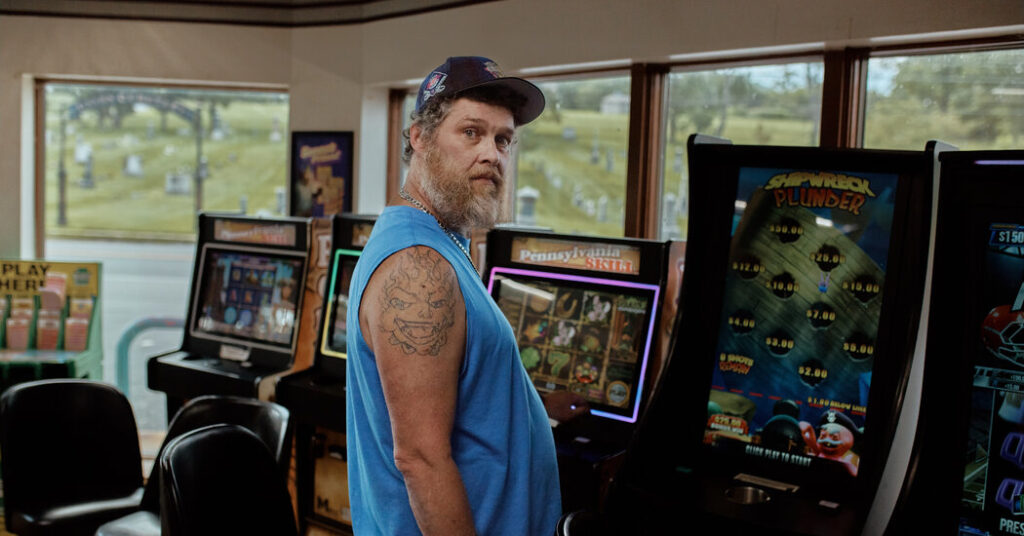
Driving home on a recent Friday after another monotonous week of installing drywall, David Peck passed by the sole gas station in Millheim, Pa., and felt a familiar urge.
The front of the Millheim Food Mart, the convenience store attached to the gas station, houses six video screen kiosks, each matched with a swiveling bar chair. With just $8 in his pocket, Mr. Peck, 46, stopped in the store and slipped the money into one of the machines.
His $8 was converted into 800 points and he pressed a button on the kiosk to make colorful icons fall into a tic-tac-toe-like grid. The game was called “Lucky Leprechaun” and the icons were kitschy symbols of luck: four-leaf clovers, golden horseshoes, white rabbits, pots of gold, leprechauns. Each time three of the same icons lined up in a row, points accumulated.
The kiosk looked like a slot machine. It acted like a slot machine. But its designer had carefully implemented one feature that, it argued, would exempt the kiosk from being considered a gambling device: If players lose a spin, they have the option to switch to a different game to win back their points.
These games are based on a skill, like remembering patterns, rather than luck. But they can be tedious, and many players choose not to try to win their points — and money — back.
Because this choice exists, the kiosks are known as “skill games” and were long considered legal in Pennsylvania, allowing them to bypass the state’s regulations on gambling. But a recent ruling by the Pennsylvania Supreme Court reclassified the games as a form of gambling, forcing lawmakers to decide how to regulate them.
Pennsylvania has amassed between 70,000 and 100,000 of the games, according to the state Gaming Control Board. They can be found in convenience stores, bars, beer distributors, grocery stores, vape and tobacco shops and even laundromats. These outlets have deals to keep a portion of the money lost by players, and some say the revenue and foot traffic is essential to their bottom line.
Mr. Peck played until he lost all his points, and as a consequence, all his money. The entire experience took about 25 minutes.
On other days, Mr. Peck sits in the Millheim Food Mart through cycles of up and down that last hours and end in losses of hundreds of dollars. “I win,” he said. “I win by a lot, but I don’t ever cash out.”
Over one six-month period, he said, he lost $60,000.
Frustrated Lawmakers
States have had varying responses to the skill games that challenge the spirit, if not the letter, of their gambling laws. Illinois and Georgia accommodated them and passed laws to regulate and tax them. Virginia and North Carolina have tried to ban them. In Wisconsin and Texas, they remain in a legal gray zone.
Pace-O-Matic, a company that leads the skill games industry, introduced its kiosks to Pennsylvania in 2013. State police quickly confiscated the machines, and the company sued to reclaim them — a test of the games’ legality. The next year, a state court ruled in favor of Pace-O-Matic, agreeing that the games on the machines were “predominantly” based on skill. Another state court came to the same conclusion in 2023.
The games have frustrated local lawmakers, some of whom have cited safety concerns about machines stuffed with cash in relatively unguarded businesses. In 2020, a robber murdered a convenience store clerk in Hazelton while stealing cash from the store’s skill games. State lawmakers have introduced various proposals to regulate them. Pace-O-Matic spent millions on lobbyists, and none of the bills became law.
The recent ruling by the state supreme court, in June, said that if a device is partially used for gambling, it is a gambling device. Unless lawmakers decide to pass new protections for the games, they become illegal in October.
A Lure for Addicts, a Boon for Businesses
For Mr. Peck, skill games are the latest in a long line of dependencies. In the last decade, he has kicked cocaine, heroin, alcohol and meth. In 2021, in a bid to get clean, he moved with his wife at the time to Millheim from the Philadelphia area because they didn’t know any drug dealers there.
Mr. Peck said he used drugs to escape anxiety and post-traumatic stress related to childhood trauma that includes sexual abuse. After he achieved chemical sobriety four years ago, skill games became his new way of blocking painful thoughts.
“I am an addict, plain and simple,” he said. “They are my way of escaping everything.”
A few decades of managing dependencies have instilled in him some self-discipline. He sets aside enough money for food, rent, utilities, taxes and support payments to two children who live with their mothers. The rest, he said, “is going into those machines.” Despite earning about $375,000 in his best year, he has no savings.
Josh Ercole, executive director of the Council on Compulsive Gambling of Pennsylvania, said that the nonprofit received about 100 calls per year from people seeking help who list skill games as their most problematic type of gambling.
Mr. Peck said he couldn’t pinpoint why skill games have a unique pull on him. Part of it is their ubiquity. Millheim is a town of 831 people within 1.3 square miles. It has one intersection with a traffic light and at least 16 skill game machines in five locations.
Across from Mr. Peck’s apartment is a lawn and gardening shop called This Is It, though a sign on the exterior advertising “Pennsylvania SKILL Play Here-Win Here!!!!” is more visible than its name.
Jason Tickner, a 26-year-old Millheim native, opened the shop in 2024 with a business partner who owns a landscaping company. He said they had installed the games to maintain profitability during the winter months.
After a licensing fee is paid to Pace-O-Matic, the profits are split between This Is It and Meile Amusements, the owner-operator of the store’s machines. Mr. Tickner said the games accounted for 25 to 30 percent of the store’s revenue.
Mr. Tickner plays skill games casually. They can take him into a “deep, dark hole real quick,” he said. But he doesn’t have any qualms about profiting from them. “I always just say, ‘Gamble responsibly,’” he said.
Doug Sprankle, president of the Pennsylvania Taverns and Players Association, a lobbying and advocacy group, said skill games were “supposed to be ancillary to what you already do, to help keep the lights on, help pay some of the fees around your business and create entertainment.”
Mr. Sprankle is one of the second generation of co-owners of Sprankle’s Neighborhood Markets, a small chain in Western Pennsylvania. Its skill games are meant to sway customers toward Sprankle’s instead of another supermarket, he said.
He compared them to “pool and arcade games of the old days,” adding that “it’s just something to do to pass a little bit of time in between activities.”
A Familiar Cycle
During the height of the Covid-19 pandemic, Jennifer Gower felt a dullness she could not quite articulate. She spent most of her time sequestered in the house she shared with her husband and youngest child near Scranton, Pa.
She had casually visited casinos and bought Pennsylvania Lottery tickets, but gambling never created a problem for her until the pandemic. On each grocery run, she began buying scratch-off tickets. Then she discovered casino game apps for her phone. The dopamine loop was irresistible.
“I would wake up in the morning, and as soon as my feet hit the floor, I was reaching for my phone and spinning slot machines online,” she said.
Ms. Gower, 54, declined to disclose her exact gambling losses, though she said they had quickly amounted to “tens of thousands” of dollars and were “very real for a middle-income household.”
The losses eventually spurred her to call 1-800-GAMBLER, the hotline run by the National Council on Problem Gambling, which connected her with online Gamblers Anonymous meetings and a therapist.
Critical to her recovery, she said, was self-exclusion. Like most states, Pennsylvania maintains a registry to which problem gamblers can voluntarily add themselves. Casinos are obligated to bar them from entry, and the Gaming Control Board sends their names to online gambling companies, ordering them to find and delete their accounts. The law is written so that if someone on the list somehow bypasses these roadblocks, gambling businesses can refuse to pay their winnings.
Ms. Gower self-excluded for a year. After it was up, she quickly relapsed. She then chose to self-exclude for life.
She successfully kicked her gambling habit — until, one day, at a gas station convenience store, she noticed a curious area full of skill games. She sat down and inserted a bill. The experience was indistinguishable from gambling, she said. “There’s the same lights. There’s the same noises. There’s the same dopamine rush.”
Because skill games were not considered gambling, self-exclusion did not apply to them.
Ms. Gower began playing them almost daily. She told her family she was running errands. It was easy; the machines were in places where she went for gas or groceries. She realized she was bleeding as much money as she had on casino apps. After an eight-month binge, she quit.
Skill games, she said, “absolutely need to be regulated like any gambling.”
Mike Barley, a public affairs officer for Pace-O-Matic, said the games’ potential effect on compulsive gamblers was “problematic” and “something we’re cognizant of.” He said the company hoped to address the issue when and if states passed regulations on skill games.
Skill games remove physical or psychological barriers between gambling and nongambling spaces, said Carolyn E. Hawley, a professor of rehabilitation counseling at Virginia Commonwealth University and the director of the Virginia Partnership for Gaming and Health.
The “skill game” label and the games’ presence in everyday places lend a deceptive air of banality, Dr. Hawley said. “It minimizes the potential that this could cause harm.”
The machines once saturated Virginia, but the state General Assembly voted to prohibit them in 2020. Enforcement was paused until the state’s Supreme Court upheld the ban in 2023. The games remain slippery. Some businesses have refused to remove them and Pace-O-Matic has responded with a new machine it claims is compliant with Virginia law, again daring vice squads to confiscate it and possibly restarting the cycle where courts and lawmakers figure out how to regulate the kiosks.
There is evidence that, despite the ban, skill games are enticing more problem gamblers in Virginia. In the Virginia Partnership for Gaming and Health’s annual survey of people referred to its program for help, 4 percent listed skill games as their primary form of gambling in 2024. The number grew to 10 percent in 2025.
In Pennsylvania, the Supreme Court essentially gave lawmakers a choice: pass a law addressing skill games by Oct. 13 or they become illegal.
State Senator Jay Costa, the Senate Democratic leader, said that lawmakers were trying to hash out a plan. He said he did not see a distinction between skill games and slot machines, but he said he thought the state’s best option now was to tax and regulate them.
For now, businesses are keeping the machines until they are forced to remove them.
Mr. Peck is unsure when and if he will walk away. The best scenario for him is that the latest court ruling goes unaddressed and skill games become illegal in Pennsylvania. He thinks he would quit gambling for the most part.
A few times already, it seemed as though he was finished with skill games. After the end of his marriage, he abstained for three months. Whenever he needed gas or cigarettes, he kept a map in his mind of places that did not have them. But he found himself back in the Food Mart’s swivel chairs. (The store’s owner did not respond to requests for comment.)
He is not sure he can quit another addiction. Each time the process seems to take a bit of some exhaustible force within him, he said.
“I don’t have another recovery in me.”
The post Pennsylvania Gambling Addicts Hope That ‘Skill Games’ Will Go Bust appeared first on New York Times.