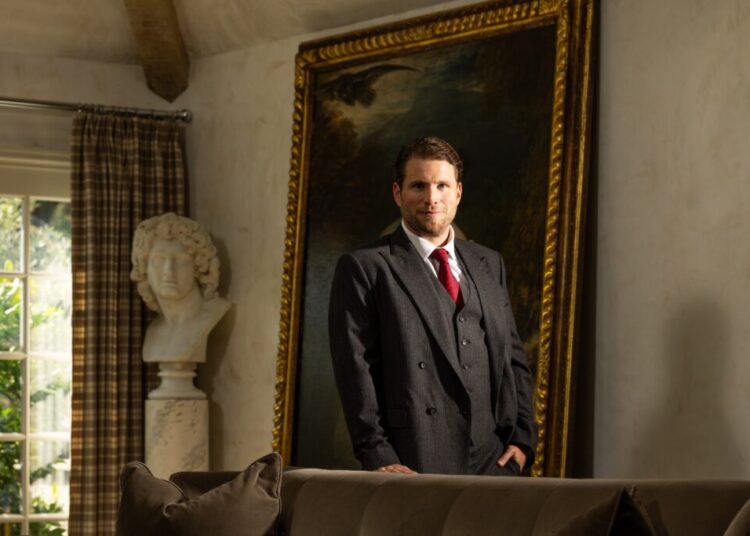
Too often the way we take in music is either quick-fire skipping or zoned-out, distracted listening. So there’s something subversive about the Canadian composer Sarah Davachi, whose work refuses extremes and forces listeners to pay it their undivided attention.
“There’s an ethical component to what I’m trying to do here,” Davachi, 38, said in a recent interview. “People have a really hard time listening to — and, more generally, confronting — things that are difficult or uncomfortable. They need more practice in just sitting with things, and not doing something else while they’re listening.”
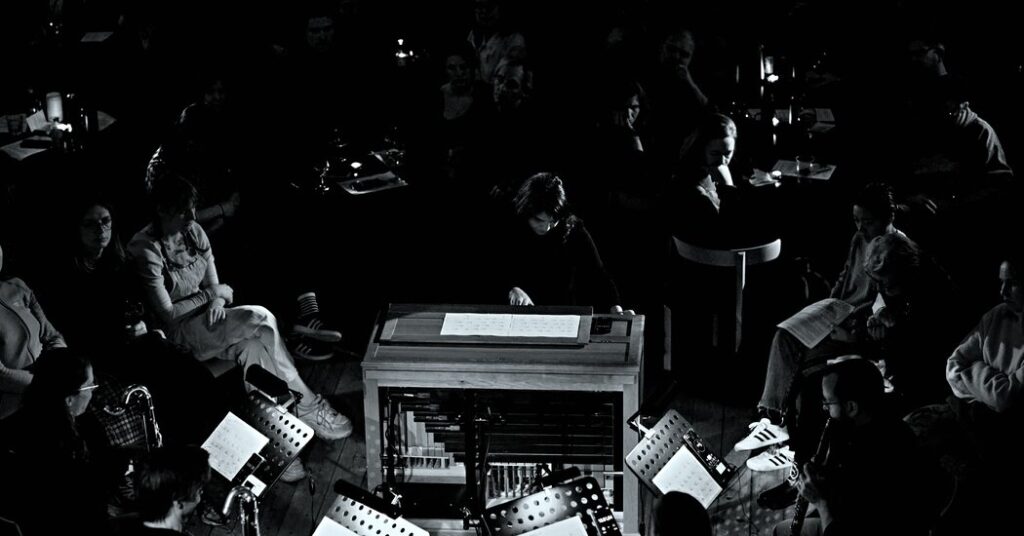
Davachi, who lives in Los Angeles, creates long-form acoustic and electroacoustic music in the lineages of Éliane Radigue, Alvin Curran and La Monte Young. In recent years she has released albums prolifically on her label, Late Music, and on Friday, she released another: the enormous “The Will of Tongues,” which runs two hours 19 minutes. It gathers solo and chamber music works written by Davachi in 2024 and 2025, performed with total commitment by Davachi on organ, along with the Chamber Choir of Ireland, the Renaissance flute consort Phaedrus, the Los Angeles brass group Diapason, and the celebrated string players Whitney Johnson, Eyvind Kang and Lucy Railton.
When played in isolated chunks, little about Davachi’s music appears experimental. “The Rose Dialogues” (for three string players, organ and tape) builds on the basic principles of a canon, something composers have used for centuries. The organ piece “Canto Solo” is made of familiar building blocks like chord sequences, cadences and resolutions; over 11 minutes, it winds slowly through a pattern of chords that could feasibly go on forever. The album’s most conventional work is the choral “Song of the Smile’s Fig,” which sounds like Renaissance motet, but smudged and slowed.
“Song” is rare in Davachi’s music for using equal temperament, the orthodox way of dividing the Western scale into equal segments. Elsewhere, she explores historical temperaments, which divide the scale into unequal parts, creating inconsistencies in timbre for her to exploit. “Four Narrow Forms,” for organ, uses a “well temperament” designed by Herbert Kellner in 1975. (Kellner sought a less consistent, more colorful tuning system that Bach might have experienced in the time of his “Well-Tempered Clavier.”) Mercurial tunings battle with harmonic stasis; a single chord is built and sustained in a variety of voicings, producing midrange rumblings and one screeching overtone. The tension between fragility and stability carries through Davachi’s minutely detailed textures to an eventual unresolved close.
Davachi thinks architecturally about sound. “My job as a composer is to create the particularities of a certain kind of space,” she said, “then leave the person who’s listening to their own devices.” Her interconnected worlds are like the free range of a desolate role-playing video game. Given the lack of encroachment — any foreign elements disrupting Davachi’s homogenous worlds — the music on “The Will of Tongues” feels natural, even primordial.
There’s an experimental streak in her background, too. Davachi’s undergraduate degree is in philosophy, and she carried her interest in phenomenology — the study of individual experience and subjective reality — into a musicology doctoral thesis that explored “timbre and the poetics of affect.”
Davachi said that she never seeks to control a listener’s experience. Nevertheless, her work carries the expectation of complete attention. A regular feeling while listening to “The Will of Tongues” is getting halfway through a track, realizing your mind has wandered — or that you have opened your phone — and having to start the piece again, feeling that you’ve missed some crucial information. In its steely restraint, the music lays bare our limitations, and makes us work to overcome them.
With compositional interests in duration and pacing, Davachi’s structures seem to proceed intuitively, even when building on established classical forms. “Over time, I’ve been able to lock in and understand what five minutes feels like, or what 10 minutes feels like,” she said. “The Will of Tongues” is broken up by three “Interludes,” taken from Davachi’s series of open scores designed for groups of similar instruments. (Normally, interludes are brief palate cleansers. Davachi’s shortest is six minutes long.) Their structures unfold kinetically, with performers given the freedom to take different paths. You can hear musicians working things out, achieving Davachi’s desired “consort-like” sound.
In slow-moving, long-form works, changes become events. John Cage’s “Organ²/ASLSP,” an organ piece that’s set to finish in the year 2640, takes this to the extreme, with every additional note that’s added to Cage’s cluster chord triggering an international media frenzy. Similar shifts occur on “The Will of Tongues.” Seven minutes into the second part of “The Rose Dialogues,” a violin gently grates against the mellifluous organ timbre. Toward the end of “The Second Tuning,” a form that seems close to expiration is resuscitated. These are the light punctuation marks on Davachi’s smooth, unchained sentences.
There is a sadness to Davichi’s music, given its power to expose our shortcomings as listeners. But it doesn’t admonish. Instead, on “The Will of Tongues,” it encourages, offering a manifesto for listening without distraction.
The post A New Album Doubles as a Manifesto for Listening Closely appeared first on New York Times.