When Wim Wenders was a 12-year-old boy growing up in Germany, he drew buildings in his spare time. His bedroom was full of press clippings and photographs of Brasília, the capital of Brazil, which was designed from scratch, primarily by the architect Oscar Niemeyer.
“This futuristic city built into the jungle: that was my dream. I wanted to go there,” the filmmaker recalled in a recent video interview. “I really thought being in architecture was the coolest job.”
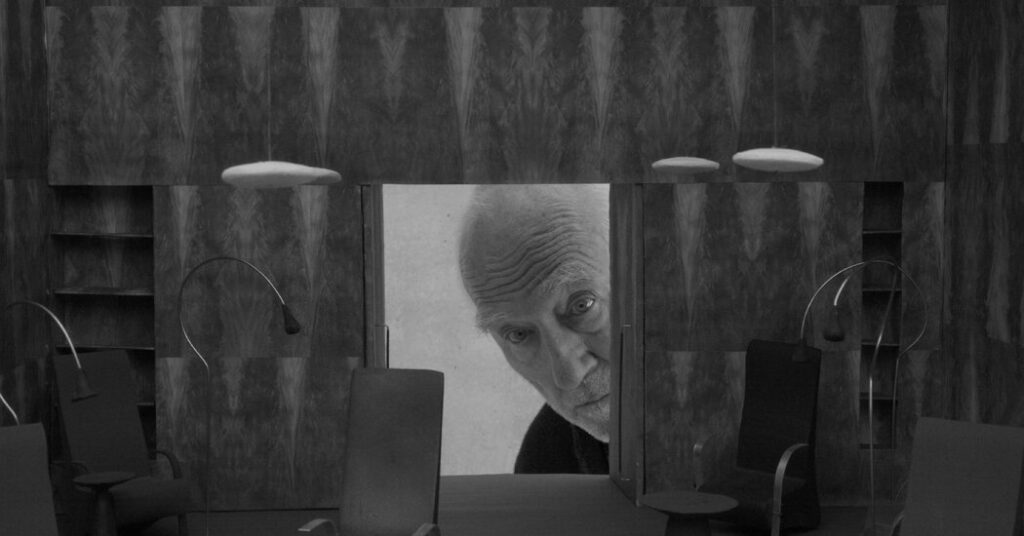
In his new movie, Wenders dives back into that childhood passion. “From Inside Out: The Architecture of Peter Zumthor” — shot in 3-D and premiering at the Venice Film Festival — is a two-hour documentary on the Pritzker Prize-winning Swiss architect.
The film culminates with Zumthor’s biggest-ever building: the $724-million David Geffen Galleries at the Los Angeles County Museum of Art (LACMA). The new space opened this year, nearly two decades after he was commissioned to design it.
Wenders has more than two dozen movies to his credit, including the multiaward winners “Paris, Texas” (1984) and “Wings of Desire” (1987). In the past three decades, he has mainly shot documentaries, clinching Academy Award nominations for three of them: “Buena Vista Social Club” (1999); “Pina” (2011), on the German choreographer Pina Bausch; and “The Salt of the Earth” (2014, co-directed with Juliano Ribeiro Salgado), on the Brazilian photographer Sebastião Salgado.
The director spoke of his fascination for architecture, the future of cinema, and his upcoming plans during the interview, which was edited and condensed.
How did this film come about?
In 2012, I shot a short film with Peter Zumthor. I got to see Peter’s atelier. Even if we only worked together for two days, we became friends, and agreed that we would do something longer.
We started the very first shoot that year, when he was going to build what later became the Chivelstone House Secular Retreat in Devon, England. He revealed that he had been given the commission for LACMA, but that it was far from being completed.
I said: “Peter, hold it. If you only start LACMA in four or five years, where does that leave me with my movie? You’re going to make your biggest building when the movie is finished. We cannot have that.” So we agreed to interrupt the shoot and wait until LACMA was confirmed.
Your Oscar-nominated 2023 movie “Perfect Days” is a mix of documentary and fiction, the story of a Japanese man who dedicates his life to caring for architect-designed lavatories around Tokyo. How are the two films connected?
“Perfect Days” began as a documentary proposition: to make a handful of little shorts on tiny toilets designed for the Tokyo Olympics by Japanese architects who usually built stadiums or hotels or skyscrapers. I was tempted, but then realized that nobody was going to see a series of little films on tiny architectural marvels, as beautiful as they were.
I told the producer that I could imagine something altogether different, in which all of these toilets would show up. He said: “If for the same amount of time and money, you can do a movie, I’m all for it.”
If you were worried that nobody would watch short films about those pieces of architecture, what made you think a two-hour documentary about Peter Zumthor would attract viewers?
Films have an ability to capture the audience that doesn’t want to see them. When I made the film about the choreographer Pina Bausch, everybody except my wife said: “This is crazy. Films on dance don’t work. Forget it.”
In the end, “Pina” was one of my most successful films. I knew that everybody who wasn’t interested in ballet or dance would want to see this film, because it would open their eyes, as had happened to me.
I had to be dragged to see my first performance of a work by Pina Bausch. But when I saw her “Café Müller” and “Rite of Spring” in Venice in the 1980s, we became very close friends, I saw every one of her works after that, and we decided to make a film. I thought: if I was weeping in a dance performance, everybody else would. I wanted people who did not care about dance to see “Pina.”
It’s the same with Zumthor. I really want people to see “From Inside Out” who are not interested in architecture. Architecture is so crucial to contemporary life, and most people don’t know anything about it. It would improve their life if they knew a little bit more. Peter was the right architect to take them into that territory.
Why?
First of all, he’s a great thinker. He does think a lot about the conditions of architecture. Second, he has a great respect for space, and a great sense of place, and he only builds what he thinks is necessary. He doesn’t build much. Each and every one of his buildings is exceptional for its purpose, and for the site where it’s built.
The film’s climax is the opening of LACMA, which faced controversy for cost overruns and reduced exhibition space. How do you feel about that project?
A strange quality of Peter’s work is that the buildings do something to you, and I think LACMA does something to the visitor. The idea of everything on one level is a genius idea. LACMA’s director, Michael Govan, and Peter did something revolutionary. They built the architecture for another way of looking at art: where there’s no hierarchy, where there’s no high art and low art, and where the audience make their own path.
You’ve said that making films has become expensive and complicated. How so?
The way movies are made now, even if you’re an old hack like me, nobody gives you any financing unless the script is really written. So you don’t really have to make the movie anymore. By the time you finally finish the 10th draft, you feel as if you’ve already shot it.
The filmmaking that I’m really good at depends a little bit more on being able to change things and steer things in a different direction while I’m making the film. That, in fiction, is getting so difficult — unless you make a very low-budget film like “Perfect Days,” where they let you do whatever you want to do.
If you want to have a bigger budget, you are tied to a completely pre-designed film. Not many people take the liberty of reinventing the film while they make it. That’s my forte.
I’d love to get back into fiction. I’d have to reinvent it again for myself, because I haven’t done it for so long. This next film will be a science-fiction movie, set maybe 20 or 30 years from now. I have only ever made one science fiction movie, “Until the End of the World” (1991).
How do you feel about the state of cinema today, with the streamers, and the endless Hollywood sequels?
I very much believe in the act of storytelling. I think storytelling is one of the greatest things that mankind came up with. Homer was one of the first, and we see how well his story still plays out.
But storytelling is an endangered species — because the very idea of it is that you invent it as you go. There are very few movies left these days where I see original, true storytelling. I’m saddened by the fact that most movies are based on the experience of other movies.
Today, there is so much prefab.
The post Wim Wenders Taps Into Childhood Love of Architecture With New Film appeared first on New York Times.