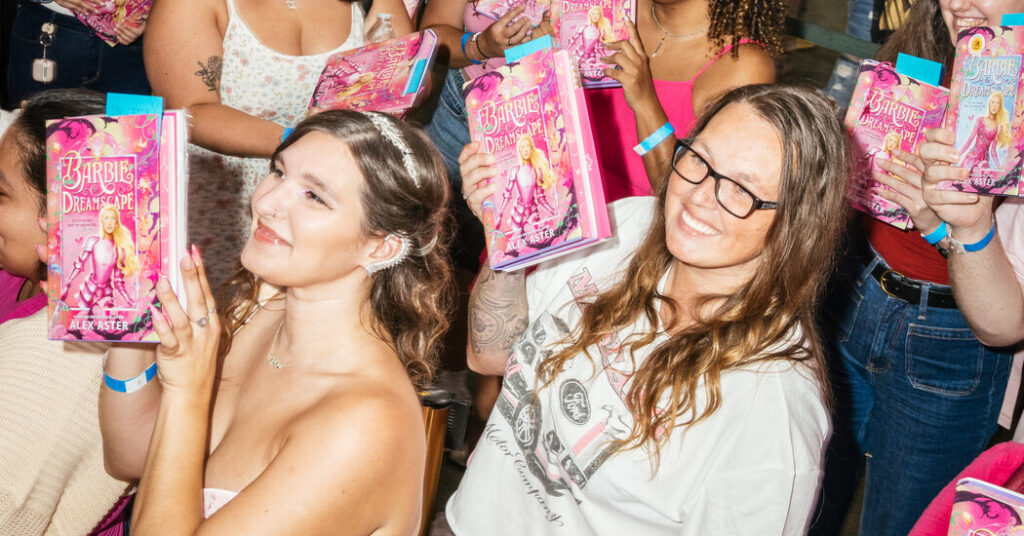
On a recent summer evening in Manhattan, the novelist Alex Aster greeted a crowd of ecstatic young women dressed in nearly every imaginable shade of pink — subtle pastels and dusty rose, bubble gum, blindingly bright magenta.
“Wow, that is so much pink!” said Aster, 31, who was wearing a bright pink strapless mini dress and sparkly pink high-heeled sandals.
The audience had come dressed in homage to the protagonist of Aster’s new novel: Barbara Millicent Roberts, better known to her legions of fans as Barbie.
“I can’t wait to hear what Barbie means to you,” Aster said, as the audience whooped and cheered.
“Barbie: Dreamscape” opens in a rosy fantasy world, the day before “Boxing Day,” when Barbie is supposed to be assigned a “fate” that determines her career. But when she fails to get one, Barbie, jobless and spiraling from an identity crisis, goes on a journey to find her destiny, and ventures to faraway lands, where she briefly encounters an unremarkable Ken and discovers magical abilities, which emanate from her charmed accessories.
It’s the first full-length, authorized Barbie novel developed in collaboration with Mattel, the toy company, which released the book through its publishing arm. While it’s aimed at young adults, it seems — based on the giddy crowd of more than 200 people gathered at a Barnes & Noble in Union Square — that grown women are flocking to it.
Fans snatched up glittery pink notebooks and pink bookmarks emblazoned with Barbie’s image. They posed for photos in a giant pink Barbie box. They wrote inspirational messages declaring what they love about Barbie on pink sticky notes.
Gisell Bastidas Jaramillo, a 29-year-old graphic designer who lives on Long Island, came wearing a Barbie jacket she bought in 2023, when the blockbuster Barbie movie came out. She frequently rewatches the animated Barbie movies and collects Barbies, but has been longing for more mature Barbie stories. “You can connect with Barbie in a different way as an adult,” she said.
Another die-hard Barbie fan, Alexandria Pedri, 26, a graduate student studying photography at Parsons School of Design, said she grew up as “a Barbie girl” and still finds the doll inspiring.
“There’s no way I’m not going to show up to a Barbie event,” said Pedri, who came wearing a hot pink silk dress with a floral pink scarf wrapped around her hips and pink and purple butterfly clips in her hair. “I am one of the people that was inspired by the idea that women can do anything.”
That idea — Barbie as an inspirational figure — was a common theme among the adult women who had turned out to celebrate a young adult novel about a toy made for children. They see Barbie not just as nostalgic comfort or a tether to childhood, but as a role model they can still look up to.
Several young women said that Barbie’s success in various fields, from paleontology to pizza making, felt inspiring, if a bit out of reach at a moment when young people are struggling in a shaky economy.
“Barbie inspires a lot of girls because she has 150 careers,” said Kareesa Reid, 26, a home health aide who lives in Mount Vernon, N.Y. (According to Mattel, Barbie has more than 250 careers, including astronaut, saxophonist, Target cashier, ballerina, Army medic, biochemist, robotics engineer and bee keeper.)
Whatever the reasons, the passionate response from Barbie fans suggests that some women who have aged out of playing with dolls still want to read about them.
Barbie isn’t the only doll getting main-character fictional treatment. In October, Mattel plans to publish a novel for adults about Samantha, one of the original American Girl dolls, which follows Samantha, now a 25-year-old living in 1920 New York City, as she navigates romance and work, fights for women’s right to vote, and infiltrates a criminal enterprise. (Plucky, independent and fond of burgundy dresses, she still shares personality traits with the original Samantha doll character, a child of about 9.)
While some say the arrival of more doll-themed entertainment for women is long overdue, there’s still some discomfort around the idea of extended girlhood — and around “girly” content that celebrates traditional femininity as a kind of empowerment, but can feel like a hollow form of feminism.
“It’s legitimate if people have concerns that women are being infantilized,” said Rebecca Hains, a professor of media and communication at Salem State University, who has studied and written about girlhood and Barbie. “But on the other hand, I think there’s something to be said for it being considered normal for women to keep enjoying things, the same way that men continue enjoying things from their childhood.”
For decades, there’s been a glaring gender gap when it comes to “kidult” content. Most of it has been geared toward men, who can remain passionate fans of Star Wars, Lego and superheroes into middle age and beyond without anyone badgering them to grow up. Women who want stories about their favorite doll characters have far fewer options.
Alex Lebensburger, a 38-year-old lawyer who lives in Manhattan, will forever be an American Girl doll fan. She got her first when she was 8 and collected four more, which she kept until age 17, when her mother stashed them in the attic.
She said she was thrilled to learn that an American Girl novel for adults, by the historical novelist Fiona Davis, was coming out. “For American Girl fans, now, as women, we want to see them grow up like we did,” she said. But she resents that there’s so little content for American Girl women like her.
“My husband is a Star Wars fanatic, and there is so much memorabilia and so much opportunity for nostalgia,” she said. “This is all we got, this book.”
It makes sense that publishers and toy makers are following Hollywood’s playbook by catering to “kidults” with nostalgia-driven intellectual property that can galvanize a built-in audience. Adult Barbie lovers emerged in droves for the live-action movie, which became the highest-grossing film of 2023, earning $1.5 billion worldwide.
“We got a big signal there that people want to see more from Barbie, and they want to see more from Barbie in a modern, relevant way for them as an adult,” said Natalia Premovic, Mattel’s chief consumer products and experiences officer.
Two years ago, Mattel reached out to Aster, a best-selling fantasy and romance author with a passionate following on social media. At her first meeting with Mattel executives, Aster won them over with her unabashed love of Barbie. She got her first Barbie when she was 4, and made her Barbies custom clothes out of paper towels.
Aster was wary at first of taking on an I.P. project and giving up creative control, but Mattel executives assured her she could write the story she wanted to tell. “It was shocking, because I know Barbie is so protective of the brand,” she said.
Aster took a research trip to Mattel’s headquarters in Los Angeles, where she got a history lesson on Barbie’s stylistic and cultural evolution. She rewatched the Barbie animated movies, and checked out Barbie displays in stores to see what was popular.
She came up with a fantasy adventure story that she hoped would appeal not only to teenagers facing the pressures of impending adulthood, but also to women who are struggling with the fear of failure. “I was definitely thinking about, How can I make this journey accessible to a teenager but also to an adult who maybe didn’t get the job that they wanted?” Aster said.
Aster expected adult Barbie lovers to come to the novel, but has been surprised by the full force of the fandom.
“People are so hungry for nostalgia,” she said. “They want to feel like they’re back in their teenage years and back in these magic worlds where there are balls and dresses.”
Chloé Laverson, 27, who lives in San Diego and works in marketing, grew up loving Barbies and never stopped. She has three Barbie-themed tattoos. She dresses up in Barbie’s iconic outfits. She wears so much pink that people often call her Barbie, which she takes as a compliment. She saw the Barbie movie in theaters seven times, and has a collection of around 30 Barbies.
For Laverson, the Barbie novel is a hopeful sign that there’s a place in the culture for Barbie adults.
Broadcasting her love of Barbie and dressing up like a princess helps her to stay upbeat in depressing times, she said. “The world is in ruins and the only way to continue to be happy and positive and hopeful is getting in touch with who we were when we were little,” she said.
As a Barbie adult, though, things are different: The dolls stay in the box.
“I don’t play with Barbies anymore,” she said. But for people who do? “Zero judgment.”
Ash Wu contributed reporting.
The post Barbie for Grown-Ups appeared first on New York Times.