SEVIERVILLE, Tenn. — The reunion began at dusk here, outside the small courthouse square that had become an impromptu shrine to hometown legend Dolly Parton.
Robbie Thompson had flown in from Orlando. Garner Byram Jr. had raced south from Waynesboro, Virginia. Libby Rollf had rushed in from Kansas City, Kansas. Others made their way from Dayton, Ohio; Asheville, North Carolina; and elsewhere in Tennessee and Florida.
“We gravitated here because we need each other now,” said Aaron Hamby, 30, of South Carolina, about what drew them once again to East Tennessee, where most of them had met years earlier.
Those who had arrived this Wednesday evening carried bouquets of roses, wore T-shirts from past Dolly concerts and hugged the way old friends do. They were young and not-so-young, straight and gay and transgender, married and unmarried. They work in health care and education, in government and in the airline industry. They have varying political views and economic means.
But for all their differences, the small group had forged a bond over time that runs far deeper than the music. Their shared love of Parton had given them something precious: a community some had never expected to find.
“We’ve become like a family. A Dolly family,” said Thompson, 44. “We like this family more than some of us like our own families.”
On a week when much of the nation remembered Parton as someone who embraced people of all stripes and transcended so much that divides the country, here was a living manifestation of her power to unite. A group of far-flung souls who had first met in line on a long-ago day at Dollywood and forged a bond deepened by time.
Many of them have traveled the nation and the world together to see Parton, from London to Red Rocks in Colorado. Their reunions have unfolded in South Dakota, Oklahoma, Kansas, Iowa and all over the East Coast. They have come to nearly every opening day at the Dollywood theme park, spent too much money on travel, burned too much vacation time — and had a blast doing it.
“We paid for her last tour bus, honey,” Byram, 42, joked.
Their faithfulness to Dolly has sometimes strained relationships in their daily lives. “My ex told me we broke up because Dolly came between us,” he said, with little remorse.
Fifteen years on, even as their numbers have grown and changed, this small group has remained loyal to their patron saint — and to one another.
Now, they had gathered again to celebrate her luminous life, to grieve her passing and to give thanks for bringing them together.
“This is where I feel most at home,” Thompson said. “Here with my people.”
‘They just show up for you’
There was Dolly’s celestial voice, of course. And her soul-filled mountain music. But for many of the friends, there was something else that drew them to her decades ago.
“Acceptance,” Thompson said Thursday on the porch of a cabin the group had rented together near Great Smoky Mountains National Park.
Growing up gay and feeling out of place in small-town Virginia, he was struck by Parton’s insistence that it was okay to be who you are, no matter what.
“That message resonated with me from a very early age,” he said.
It was much the same for Byram, who first saw Dolly with his parents in the early 1990s.
“She was her own unique person, so you could be, too,” he said. “You could tell that she didn’t judge anybody.”
That message made its way to Rollf, 50, who as a girl in Kansas remembers listening to Parton in her father’s blue Chevy truck and becoming obsessed with her music.
“I was a very overweight child,” she said. “And she was just so accepting. She was just a ray of sunshine.”
As childhood gave way to adulthood, they and others in the group made numerous pilgrimages to Dollywood, even when few others in their lives understood why they were so drawn to her presence.
“I did it for so many years alone,” Brittany Mixon, 51, of Pensacola, Florida, who also was there as a 10-year-old the day the park opened in 1986.
About 15 years ago, the group began to discover one another after several of them met by chance outside an event where Dolly was greeting fans at the park.
They began traveling together to shows around the country and returning to Pigeon Forge almost anytime Parton was scheduled to appear at Dollywood. They embraced Rollf’s mother, who often traveled with the group, dubbing her the “Dolly Mama.”
Over time, they found, their friendships only deepened.
When Byram’s mother died, Thompson and Rollf traveled unannounced to be with him in Virginia.
“They just show up for you,” he said. “It would be just absolutely miserable without them. … My life is totally different because of them.”
When Rollf’s mother died unexpectedly years later, numerous members of the group showed up at her door in Kansas the next day.
“I was never alone,” she said.
They call one another on birthdays and even email Shoney’s gift cards. They send each other Christmas presents. They commiserate over breakups and job changes. They maintain an endless text chain, and always check on one another by noon each day.
“If you are having a bad day, you can call any one of them,” said Carrie Reinig, 52, who lives in Ohio. “We celebrate each other’s successes and support each other when things are crappy. … They are legit family.”
Could those deep ties weaken now that Parton, their north star, has died? Could the thread that held them together all these years fray?
“I don’t feel that part will change,” Reinig said. “If anything, we will probably need each other more.”
The gift she gave
Thursday evening in the mountainside cabin, more than a dozen Dolly-loving friends gathered to laugh and shed tears, share old photos and reminisce about their many encounters with the singer.
Some cars in the driveway had Dolly-themed license tags and bumper stickers with phrases such as “Dolly vibes only.” At least two attendees had Dolly’s signature tattooed on their arms.
Inside, a Dolly-branded peach cobbler baked in the oven. The living room television was playing a Dolly marathon — the movie “Steel Magnolias,” a documentary of her career, and a replay of her 50th anniversary performance at the Grand Ole Opry. Virtually everyone in the room had attended that show.
“How are you doing?” one person asked Kimberly Baker-Boyle, 55, who moved to East Tennessee from Maryland with her husband and daughters more than a decade ago, mostly to be closer to the Dollyverse.
“You know, it’s like losing your mother,” she said, sighing.
“This time is different. … Usually we are riding high,” said Jonathan Brashier, 52, of Greenville, South Carolina, who has been coming here since the 1980s.
That day, a sadness lingered in the room, even though the friends were comforted by one another’s presence.
“I always imagined we’d be together on a night like this,” Brashier said.
They talked about the plans they had to see Dolly, the music and memories that now will not happen.
“How many of us had tickets to Las Vegas?” one asked of a planned residency there that Parton had previously postponed and then canceled altogether.
Every hand went up.
They talked about the countless times they met Parton at Dollywood, about the scores of shows they attended — for some, more than two dozen on one tour alone. They laughed at the outrageous sums some spent on front-row concert tickets or meet-and-greets or traveling to distant shows.
They vowed to stay close, whatever lies ahead.
“The biggest gift [Dolly] gave us is the friendship and relationships with each other,” said Hamby. “Now that the inevitable has happened, that’s what is going to carry on … these bonds we share.”
At the end of the night, there were hugs and I-love-yous, and posing for pictures together in their many colors of Dolly shirts.
Outside, in the warm August night, the only sound came from the hum of cicadas. A full moon hung over the Smoky Mountains, its light shimmering off the Little Pigeon River.
‘We will always love you’
Early Friday, in the light of a clear blue morning, the group of friends drove down the mountainside and headed north toward Sevierville.
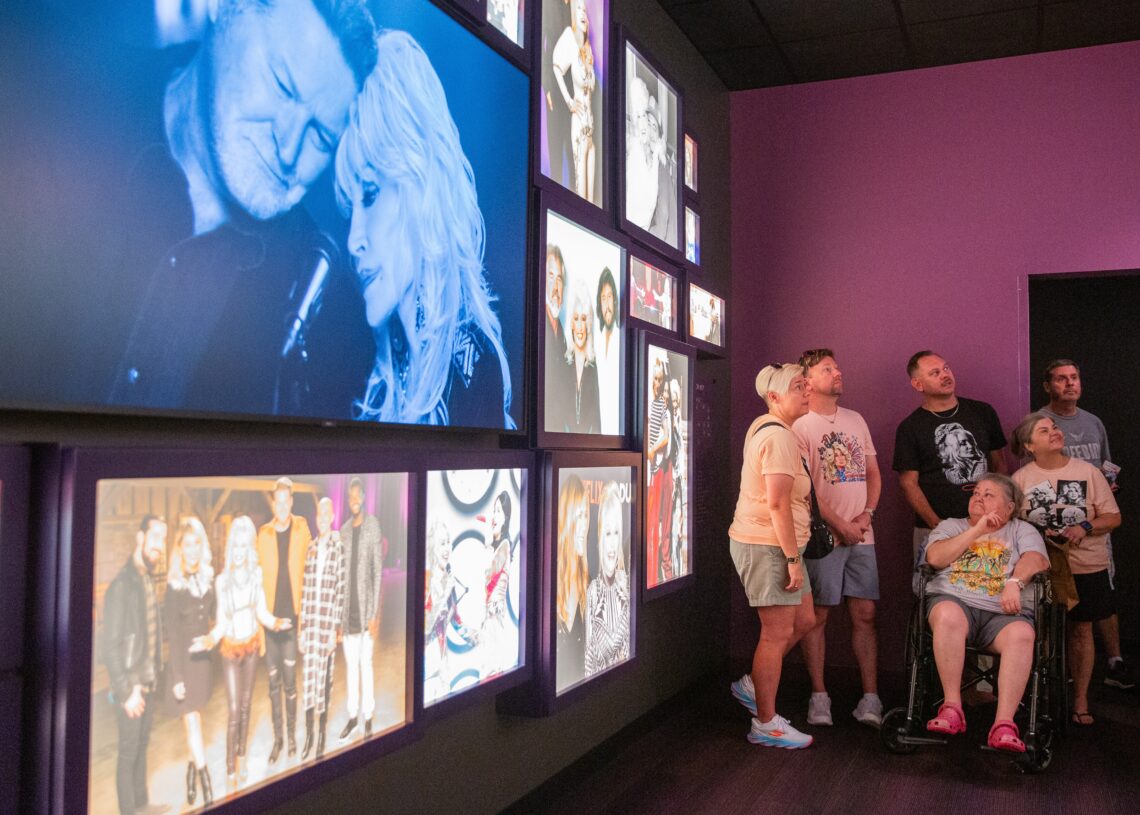
In Pigeon Forge, they passed the glittering entrance to Dollywood, where they planned to return later in the day to visit the place they had first met and carved out so many happy memories. It would be healing, they thought, to commune with fellow mourners pouring into town from Georgia, Ohio, Texas, Alabama, New York and even Canada.
On they drove, past so many flags at half-staff. Past the pancake houses and souvenir shops, past the dinner theaters and mini-golf courses. Past signs that proclaimed “We will always love you, Dolly” outside Andy’s Frozen Custard and the Suds car wash and the Sonic drive-in.
Outside the county courthouse, they gathered once again in front of the statue of Dolly, where dozens of pink buckets had been set up to hold the endless flowers and notes from fans.
They carried bouquets of yellow roses and colorful cardboard butterflies. Thompson wore a shirt that read, “In Dolly We Trust.” Byram slid on his sunglasses to shield his tears.
“I woke up heavier today than yesterday,” Brashier said to no one in particular.
“How is it getting worse?” Reinig said.
They walked together to the statue, which they had visited so many times on happier days, and stood with their arms wrapped around one another, heads on shoulders, in silence.
After a few minutes, Byram asked a stranger nearby if he could snap a photo of the group of friends in front of Dolly.
“You want the whole family in there?” the man asked.
Yes, Byram said. Every last one.
The post How a chance meeting at Dollywood led to the deepest friendships of their lives appeared first on Washington Post.