Beijing widened its purge of top military leaders this week, dismissing more generals in the latest stage of a shake-up that has removed scores of senior military leaders since 2022, calling into question combat readiness as President Xi Jinping seeks to project power across the Indo-Pacific.
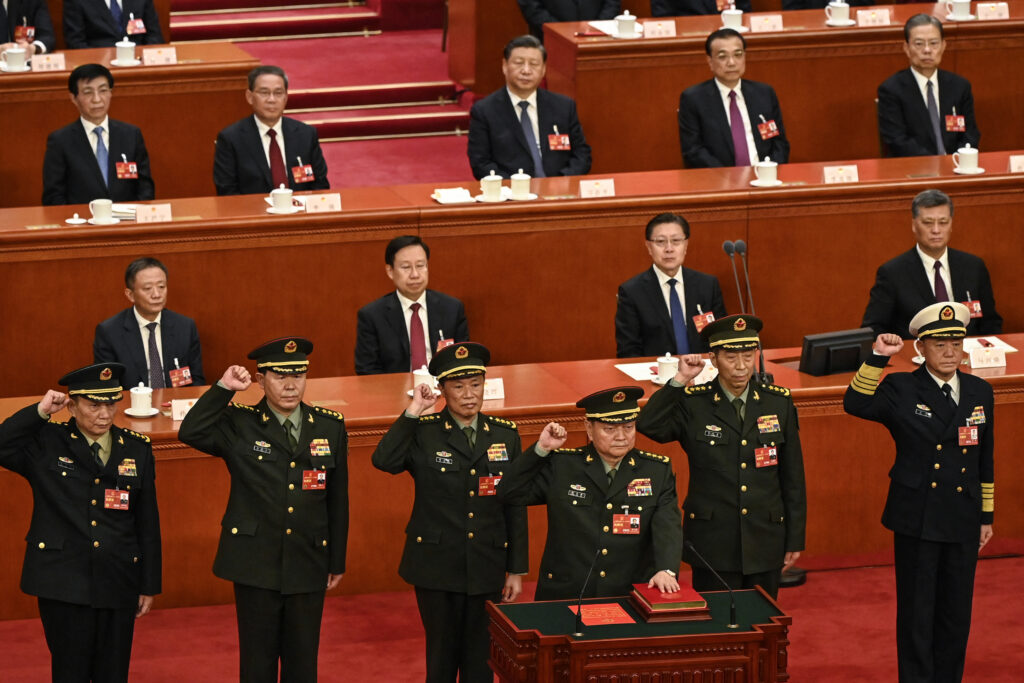
On Friday, the Standing Committee of the National People’s Congress — a top decision-making body for China’s rubber-stamp legislature — voted to remove Zhang Youxia and Liu Zhenli from their positions on the seven-seat state Central Military Commission (CMC), the country’s top military decision-making body.
Both four-star generals had been placed under investigation in January, making Friday’s decision largely ceremonial. But in a separate series of votes this week, Beijing’s leadership also removed lower-level and retired officers, investigations into whom had not been as widely telegraphed.
Zhao Zongqi, a retired four-star general who oversaw China’s Western Theater Command, was stripped of his membership on China’s top political advisory body. Zhao, the top commander of Chinese troops during the 2020 China-India border clashes, is one of few Chinese generals with combat experience.
The latest chapter of the purge appears to target officers affiliated with previously ousted leaders such as Zhang Youxia, said Dennis Wilder, a former top China analyst for the CIA. “Xi does not only rid himself of the top generals who he believes are disloyal but also their subordinates. This is likely to continue until Xi assesses that he has completely wiped out the influence of Zhang Youxia within the military.”
Separately, Zhong Shaojun, a Xi confidant and aide at one point entrusted to monitor corruption in the CMC, was also removed this week from his post in China’s legislature. Zhong disappeared from public view last fall amid rumors he had fallen out of favor with Xi.
Zhong’s dismissal was a “surprise,” Wilder said. But “it fits Xi’s pattern of purging seemingly loyal subordinates.”
The fight against corruption in the People’s Liberation Army (PLA) could explain some of the new dismissals, said Victor Shih, a professor of Chinese politics at the University of California at San Diego, noting that “hundreds of billions of dollars” of procurement flow through the CMC each year — creating ample opportunity for graft.
“I think the enticement just got to be too much for Zhong Shaojun, even though his job was to be the eyes and the ears of Xi Jinping,” Shih said.
The downfall in January of Zhang Youxia, the second-in-command of the Chinese military under Xi, was an especially stunning moment of upheaval given Zhang’s high rank, rare combat experience in the 1979 Sino-Vietnamese war and longtime personal relationship with Xi.
The votes — combined with past purges — now leave the Central Military Commission with just two members: Xi himself and his deputy, Zhang Shengmin.
Xi’s hollowing-out of the military top command comes even as the Chinese leader pushes ahead on rapidly modernizing the PLA — in part to meet his stated goal of being ready to invade Taiwan by 2027.
“In the near-term, this will likely limit the PLA’s preparations for a large conflict,” said Zack Cooper, a senior fellow at the American Enterprise Institute, a Washington think tank, who specializes in U.S.-China competition.
Under China’s “party-state” system, the Chinese Communist Party and the Chinese state maintain separate Central Military Commissions, though in reality the parallel bodies usually function as one structure.
The removals Friday stripped the two generals of their positions on the state CMC but not the party’s version of the same body.
The post Beijing expands purge of top generals appeared first on Washington Post.