The bill began as an effort to protect immigration aid workers, who said they were increasingly fearful of being doxxed and threatened as immigration raids swept through California last summer.
Democratic state lawmakers presented it as a simple expansion of a longstanding program, Safe at Home, that had shielded the addresses of vulnerable residents in public records. Many states created such programs in the 1990s to protect survivors of domestic violence or stalking victims. Over the years, some states expanded the programs to include abortion-clinic workers or law enforcement officers.
In California, such expansions never became free speech controversies. Last year, the state added health workers who provide gender-related treatment to the list, with little hubbub.
It wasn’t until state lawmakers moved this year to include immigration aid providers that a firestorm ignited. And that largely occurred after a Republican opponent of the bill gave it a catchy nickname: “The Stop Nick Shirley Act.”
Mr. Shirley, 24, has quickly become a hero in the MAGA movement as a YouTube influencer whose viral videos claimed to expose fraud in Democratic-led states. His videos last year on Minnesota child care centers run by Somali immigrants caught the attention of President Trump, who was cracking down on illegal immigration in the state. Soon after, Mr. Shirley made his way to California, where he recorded videos outside the homes of licensed child care providers, most of whom were immigrants, and the offices of hospice care providers.
Mr. Shirley has focused on fraud, and Republicans have mostly attacked the bill on free speech grounds, saying that it would prevent problems from being exposed. But immigrant aid groups have faced criticism from supporters of Mr. Trump because they provide everything from food to legal aid to the undocumented residents who have become especially vulnerable to deportation in the president’s second term.
The California bill this year was the first in the nation to expand address protection to workers and volunteers for immigration support services who face threats of violence or harassment. It says that, starting in October 2027, a person whose address is protected can sue someone who posts their image or personal information online after being asked in writing not to share it publicly.
Democrats say the bill only restricts people from posting violent threats with the intent to do imminent harm. Mia Bonta, the Bay Area assemblywoman who introduced the bill, said it was “150,000 percent absolutely not” inspired by Mr. Shirley. A spokeswoman for Gov. Gavin Newsom, who signed it into law last week, argued that it would have no impact on the conservative influencer.
But Mr. Shirley and his supporters argue that the bill was written to deter him from posting videos about what he says is fraud in social service programs for immigrants. In particular, they take issue with the provision allowing aid workers to sue.
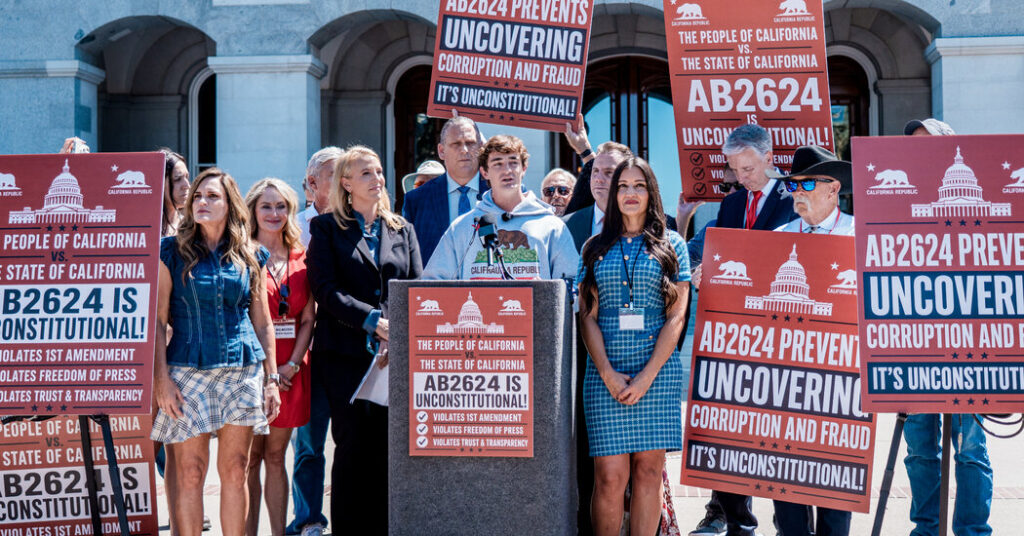
Mr. Shirley, who has nearly 2 million YouTube subscribers and an online merch shop he calls the “Anti Fraud Club,” has turned fighting the new law into a cause célèbre, drawing national attention to what might otherwise be an obscure piece of legislation. Through viral video clips, appearances on Fox News and a rally this week at the State Capitol that attracted hundreds of people, Mr. Shirley has helped Republicans reframe the address bill into an argument over exposing fraud and protecting free speech.
“Welcome to the Cali-fraudia Republic,” Mr. Shirley said as he stepped to the microphone at the rally on Wednesday in Sacramento. “Here in California, the politicians, instead of going after the fraudsters, they’ve now gone after those that are going to expose the fraud.”
For a few hours, the plaza outside the State Capitol had the feel of a MAGA street fair, with booths selling Charlie Kirk-themed T-shirts and posters celebrating ICE officers. Trumpets and drumming blared from masked counterprotesters that the police kept on the perimeter of the event after a fistfight broke out during the rally’s opening prayer. (Three people were detained, according to the California Highway Patrol.)
Mr. Shirley began speaking after the crowd chanted, “Nick! Nick! Nick!” He was joined on stage by several Republican lawmakers and candidates. Numerous speakers said they looked forward to the law being overturned in court.
In an interview after the rally, Mr. Shirley said it was a “lie” that the bill was not directed at him. He said there was no need for the new law because it’s already illegal to dox people and make violent threats.
“They’re making a protected class by specifically saying ‘immigration support service providers,’” he said.
Mr. Shirley said he worried that the law could be used against him by people who hire someone to commit a crime and say they were incited by him.
“Then Nick Shirley is responsible,” he said, and, under the law could have to pay a fine of at least $4,000.
In California, recent expansions of Safe at Home have generally gone to groups aligned with Democrats, who control the state legislature. Democrats argue that these workers have been most targeted through doxxing by opponents.
But it is not clear what the threshold should be, and courts could ask how California has decided certain groups deserve a higher level of privacy. Eugene Volokh, a First Amendment scholar at the University of California, Los Angeles, School of Law, thought the bill could be vulnerable to challenge for protecting one group over another.
“It might be the case that a court would say this is unconstitutional because it specially protects immigration service providers,” Mr. Volokh said. He added that a court could rule that “you can’t single out threats and incitement against immigration service providers from threats and incitement against other people who might be just as vulnerable as they are.”
Early versions of the bill included broader prohibitions on posting information that free speech advocates said would have violated the Constitution. But the bill was later narrowed.
Carolyn Iodice, legislative and policy director with the Foundation for Individual Rights and Expression, a group that promotes free speech, was among those who criticized the bill in its early stages. She said the final version shouldn’t inhibit Mr. Shirley.
“The way I read it now is, unless he posts videos with threats or incitement, which is a very high bar, he should not face liability under the bill,” Ms. Iodice said.
However, she said, the law could wind up chilling some speech because people who receive legal demands that they not post images or information may not know that they are only prohibited from making comments that threaten or incite violence.
Immigration service providers who sought the new law said they have been facing intense harassment since Mr. Trump began his second term in office.
“We are an enemy that they feel is their patriotic duty to go after,” said Angelica Salas, executive director of the Coalition for Humane Immigrant Rights of Los Angeles, which worked with Ms. Bonta to develop the law.
Ms. Bonta, who is married to Rob Bonta, the state attorney general, said her bill was inspired by stories of fearful encounters. Ms. Salas said that someone showed up at her mother’s home looking for her.
Ms. Bonta said the law would not stop Mr. Shirley from making videos or inhibit journalists from covering groups supporting immigrants. She said her bill had been misrepresented by opponents who attached it to Mr. Shirley and that he was “not being honest with his viewers.”
“I am greatly disappointed that our legislative process can be so ambushed, if you will, by ill-intended legislators and people who are likely wanting to get more clicks for their own personal gain,” she said.
Online, many of Mr. Shirley’s followers seemed to believe “Stop Nick Shirley Act” was the bill’s formal title.
Carl DeMaio, the Republican assemblyman who came up with the moniker, said that he had never talked to Mr. Shirley when the nickname occurred to him during a committee hearing this spring. Invoking a popular figure helped him draw attention to his concerns.
“It’s the best way to simplify the scheme that they’re trying to hide,” he said.
“A bad bill needs public transparency, and I’m not going to apologize for that.”
The post How a California Bill Sparked a MAGA-Sphere Uproar appeared first on New York Times.