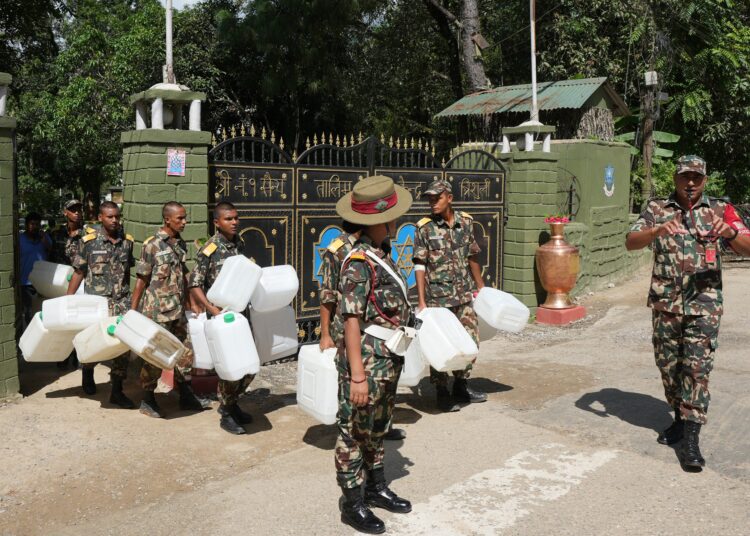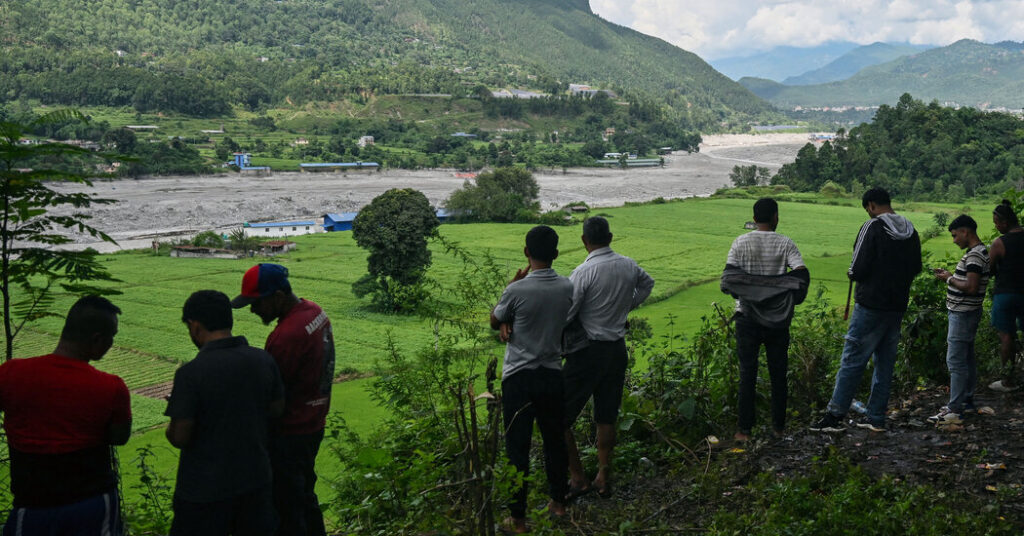
On the morning of Aug. 26, an entire glacier-covered mountainside in northern Nepal collapsed. Within minutes, a towering, churning wall of mud, rock and water engulfed villages in the valley of the Bhotekoshi River along the border between Nepal and Tibet. For many of those in its path, there was little time to escape. At least 580 people are dead; more than 1,900 people remain missing. The toll is expected to rise in the coming days.
The several-story-high mass coming out of nowhere to explode buildings and snap bridges was not like the floods or avalanches well known in this region. It was more like a bomb, some said.
This is a sign of a new, disorienting danger in cold mountain zones: the rapid destabilization of glaciers and permafrost that can remake entire landscapes in the blink of an eye. The processes leading to these cascading failures are complex, but the hidden hand behind them is human-caused climate change. Our fossil fuel burning is pulling down the world’s highest peaks.
Initially, Nepalese authorities speculated that an earthquake may have triggered the disaster. Satellite images indicate instead that an immense mass of ice and rock on the northern side of a mountain called Langtang Lirung likely gave way and plummeted 4,000 feet until it slammed into the valley floor. The resulting surge ricocheted down the river with a force so great it mimicked a 5.2-magnitude seismic event — big enough to be detected by seismometers around the world.
In 2011, I spent a week visiting this part of Nepal while researching a book about the causes and consequences of glacier loss in the Himalaya. I started the journey in the riverside settlement of Syapru Besi, a town that was mostly erased this week.
Worldwide, climate change is causing glaciers to disappear at an accelerating rate. Few places are as vulnerable as the Himalaya and the Tibetan Plateau, where the rate of glacier ice loss has doubled since 2000. As those frozen water towers dwindle, the two billion people downstream who depend on the Brahmaputra, Indus and other great rivers of Asia will have less water for drinking, farming and hydroelectricity in decades to come. More people will also be exposed to glacial lake outburst floods, a dangerous phenomenon triggered when glacial melt fills basins and overwhelms dams.
Fifteen years ago, my reporting focused on those daunting but largely anticipated twin impacts of vanishing ice. I saw villages in north India abandoned as receding glaciers led to extreme drought. I heard farmers on the Tibetan Plateau describe their shock at seeing once reliable springs dry up. People in Nepal and Bhutan described their fear of losing their homes and their lives in glacial floods.
Now something else is coming into view: Like termites gnawing on a house’s framing, rising air temperatures seem to be chewing away at the ice and permafrost holding slopes together at high elevations.
In April 2015, a 7.8-magnitude earthquake struck northern Nepal, shaking loose a nearly seven-foot-thick mass of snow, ice and rock from the southern face of Langtang Lirung that killed more than 300 people including more than 100 whose bodies were never recovered. In 2024, researchers concluded that climate change had likely made the tremor-induced avalanche more deadly.
A slope on the north face of that very same mountain has just collapsed, a very likely sign it is further buckling under the weight of climate change. It’s far from the only one.
In 2016, two glaciers in the Aru mountains of western Tibet spontaneously crumbled into fast-moving ice avalanches — highly unusual events that came in quick succession, just two months apart. The first one killed nine shepherds and coated three square miles with debris. The north face of Ronti Peak in Uttarakhand, India, broke off in 2021, sending a surge of pulverized ice and rocky debris downriver through the district of Chamoli. More than 200 people were killed or missing and two large hydropower plants were damaged.
The risks extend beyond the Himalaya. In 2022, following a period of anomalously warm weather, a permafrost-buttressed glacier in Italy’s Dolomites collapsed and killed 11 mountaineers. In May 2025, a rock-ice collapse buried the village of Blatten in Switzerland after its 300 residents had been safely evacuated. Geologists are now closely watching a similarly unstable rock face that threatens another Swiss village.
Conventional flood warning and disaster response systems may be no match for these events. Days after the cataclysm in Nepal and Tibet, there is an ongoing risk of further flooding to both survivors and rescuers, from new lakes that have rapidly formed upstream by debris blocking the river’s flow.
As rescue and recovery efforts unfold in the days ahead, one question we should consider is how many other mountains might be quietly coming undone. In a recent post analyzing the disaster, Bethan Davies, a glacial geologist at Newcastle University, warned that in the years ahead “we should expect to continue to experience such catastrophic events.” A study she co-authored documents how glacier ice loss in Nepal’s Langtang region has been speeding up in recent decades. Many glaciers are shrinking and fragmenting at a geologically breakneck pace, leaving exposed dark rock that has been insulated for millenniums.
We are accustomed to thinking of mountains — especially the Himalaya, which means “abode of snows” in Sanskrit — as fixed, timeless, immovable, permanent. The disaster in Nepal is the latest disturbing sign that mountains are fragile. The speed with which humans are warming the world is pulling them apart at the seams. Even mountain dwellers who have learned, across generations, to adapt to the vagaries of monsoon rains, periodic landslides, spring and summer floods and winter avalanches have now been dragged into alien terrain, without ever having moved.
In the minutes before this week’s deluge struck and tore away the life he and others had known, a survivor downstream of the border said he heard what sounded like a “thunderclap” — the sound of one of the planet’s tallest mountains falling. This new warning alarm of climate breakdown is loud and terrible enough to echo around the world — if we choose to hear it.
Jonathan Mingle is a journalist in Vermont and the author, most recently, of “Gaslight: The Atlantic Coast Pipeline and the Fight for America’s Energy Future.”
The Times is committed to publishing a diversity of letters to the editor. We’d like to hear what you think about this or any of our articles. Here are some tips. And here’s our email: [email protected].
Follow the New York Times Opinion section on Facebook, Instagram, TikTok, Bluesky, WhatsApp and Threads.
The post Mountains Are Coming Undone appeared first on New York Times.