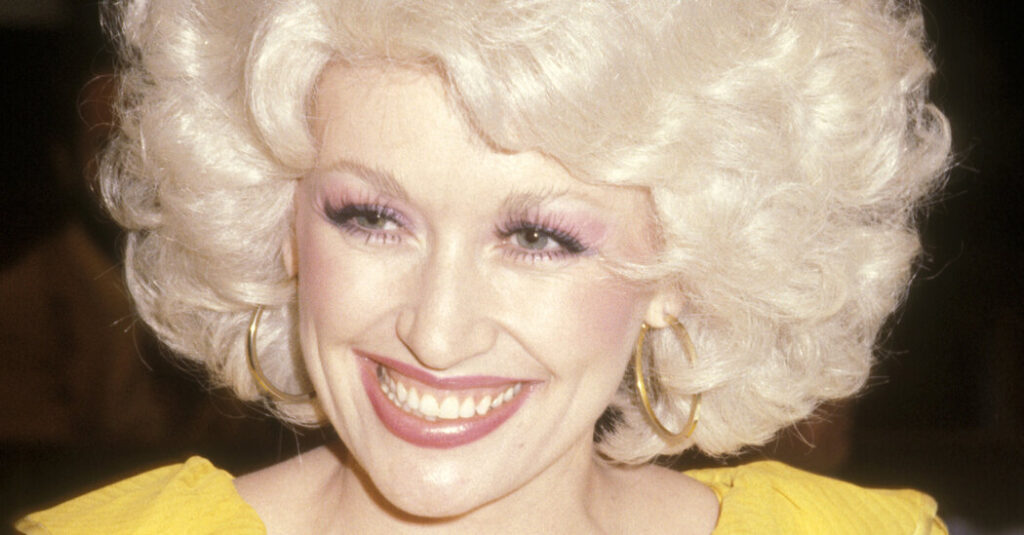
From the beginning, Dolly Parton was utterly real about her unrealness. She played with the over-the-top details she shared with a long line of platinum femmes fatales — Mae West, Jayne Mansfield and Marilyn Monroe with even a dash of Daisy Mae, the country bombshell from “Li’l Abner,” Al Capp’s satirical comic strip about “hillbillies.”
In a way, Ms. Parton was a drag artist. We all know the ingredients: big uberblonde hair, big lashes, big smile, big bosom, vertiginous heels and an hourglass figure poured into the tightest, sparkliest dresses. They’re exaggerated versions of the standard feminine proportions and embellishments that women are encouraged to strive for. These are the building blocks of beauty culture, which I’ve loved and hated all my life.
Like many women, I learned about beauty from my mother. My sister and I adored watching her prepare for a night out. She’d open her cosmetics drawer, revealing its colorful tubes and pots — magical items that would transform her into a glamorous second self. (“Glamour” originally meant “magic spell,” as in “to cast a glamour.”) My mother enjoyed this process, but it was also clear that beauty was often a chore, an exacting discipline, a burdensome disguise. Though never overweight, Mom would periodically diet to “improve” her figure. And she increasingly despaired over the physical effects of aging, and mused about rejuvenating surgical procedures, though she never had any.
I learned early that a woman’s face and body were composed of separable units, ones I had to maintain, enhance, hide or control. It could be a pleasurable, even powerful process, but it was also fraught with self-doubt and alienation.
As a young woman, I struggled to strike a balance between glamming it up and wanting to be taken seriously. Once, many years ago, I dressed for a dance party in a gold lamé mini dress, fishnets and heels. It felt fun and festive, until a friend announced, “You look like a drag queen.” I was deflated. I knew they meant that I had gone too far, and fallen off the continuum of acceptable female appearance. Femininity may be a kind of “masquerade” as the psychoanalyst Joan Riviere wrote, but it works only if you occult most of the effort involved. Looking “like a drag queen” meant I had failed at feigning feminine naturalness. I’d desexed myself with the accouterments of my sex. This is how precarious the whole beautification enterprise can be for women.
Drag beautification is another matter. Drag performers show all work. They celebrate it. Their goal is a deliberately artificial-looking persona. For years, I hated drag. I thought the performers were mocking women for conforming to social conventions we did not choose, taunting us with their liberty to play with, then set aside those same conventions. I felt like they were showing me up, beating me at my own game.
I’ve learned better. I now love drag. I can appreciate it as a commentary on the theatricality of female gender expression. And Ms. Parton knew that power and freedom. She showed us how a woman could appropriate the costume of femininity for her own purposes.
Ms. Parton seemed to gaze upon her stage persona from an amused distance. In a vexed 1977 interview, a disapproving Barbara Walters pressed her to justify her flamboyant style, saying: “You don’t have to look like this. You’re very beautiful,” adding, “You don’t have to wear the extreme clothes.” Ms. Parton, wearing a giant blue fabric flower in her giant blond wig, replied with disarming sincerity. She explained that her look was designed not to compensate for any lack of natural beauty, but simply to capture audience attention. “I’m very real where it counts, and that’s inside,” she said. “Show business is a moneymaking joke.” The distinction was clear — there was glitzy, outside Dolly and real, inner Dolly.
Eventually, the outer Dolly multiplied into thousands. That is, the Dolly Parton look was so beloved and so easy to copy that it became a popular drag persona. Ms. Parton, a great supporter of the L.G.B.T.Q.A. community, joked fondly about her imitators. In a 1978 Playboy interview, she wondered if she might lose if she entered one of the many “Dolly look-alike” contests. “Wouldn’t that be hysterical?” she said. “But I doubt if I would. I mean, I look too much like her.” That third-person “her” was the perfect reminder of Ms. Parton’s pragmatic understanding of her showbiz self. Years later, she claimed that she had in fact entered such a contest — and lost.
With her good-humored, practical view of bombshell style, Ms. Parton drained it of its potentially oppressive quality. She was not trying to be “natural” — to convince us she really had that hair, those lashes or that extremely ample bosom (whose origins she left mysterious). The costume was a tool to get her true gift — her music — noticed. And as she grew older, she held fast to that costume, admitting freely that she needed outside help to maintain it. “If something is bagging, sagging or dragging,” she explained, “I’ll tuck it, suck it or pluck it.” That funny little rhyme bore no trace of vanity or ageism. This was not trying to look young; this was brisk practicality, just Dolly taking care of business. To me, this feels feminist, but when asked in 2019 if she considered herself a feminist, Dolly rejected the notion. “No I do not,” she said. “I think of myself as a woman in business.” (I think she was both, though. Avoiding the feminist label was itself likely something of a business decision.)
Ms. Parton’s “9 to 5” (the title song for the 1980 film she also starred in), is an upbeat anthem to women’s (and workers’) solidarity. The comic movie took on a serious issue of its era: women’s challenges entering male-dominated workplaces. Ms. Parton played Doralee, a secretary whose sexist boss demeans and harasses her. Ms. Parton infuses her character with a humanity that transcends Doralee’s provocative wardrobe of clingy dresses and low-cut blouses. And Dolly’s memorable song for the film echoed her character’s plight, decrying the dehumanizing grind of corporate life: “It’s a rich man’s game no matter what they call it/And you spend your life puttin’ money in his wallet.”
Dolly Parton showed us how what can feel like a constraint — the conventions of beauty, sexiness, body type, even age — can all be repurposed as a costume to wear with wit and self-awareness. Her supremely artificial persona made her seem only more human and approachable. She made the trappings of femininity seem joyful, and liberatory.
Although married for nearly 60 years to Carl Dean, who passed away in 2025, Ms. Parton was almost never seen with him. Few people even knew what he looked like. He was “very independent,” she said, and “liked being alone.” As a result, Ms. Parton too seemed independent and unattached. She existed outside of the traditional setting of a couple. She was a wife, but only privately; and she was not a mother. This permitted her to retain her artful, self-enclosed stage persona untethered from the domestic labels and tabloid exposés (about marriages, divorces, pregnancies, etc.) that tend to define — and limit — high-profile women. Her intimate, offstage life was kept permanently under wraps, much like her natural hair. We didn’t know much about her personal life, but we didn’t need to. We could see, enjoy and learn from the wonderful, brilliantly talented creation that was public Dolly Parton — bedecked in all her ultrafeminine, ultra-artificial drag that she wore so knowingly, yet so lightly.
Rhonda Garelick is the founding director of the Institute for Public Humanities and the Arts at Hofstra University, where she is also a distinguished professor of literature. She is the author of “Mademoiselle: Coco Chanel and the Pulse of History,” the forthcoming “Why Fashion Matters” and other books.
The Times is committed to publishing a diversity of letters to the editor. We’d like to hear what you think about this or any of our articles. Here are some tips. And here’s our email: [email protected].
Follow the New York Times Opinion section on Facebook, Instagram, TikTok, Bluesky, WhatsApp and Threads.
The post Dolly Parton Was So Fake She Was Real appeared first on New York Times.