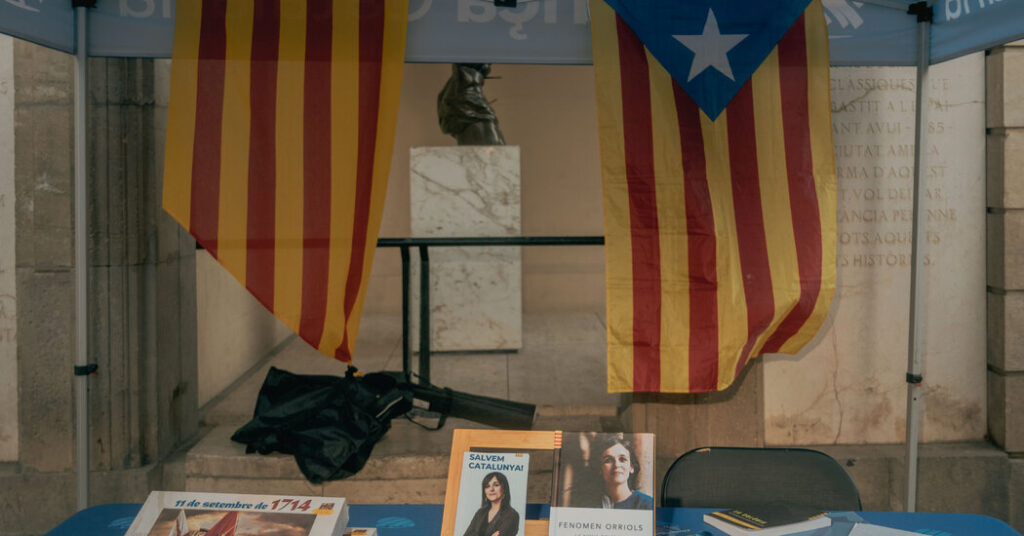
A lot of politicians in Spain were disoriented this summer when more than 70,000 migrants overran the beachfront border that separates Morocco from the Spanish outpost of Ceuta. But not Sílvia Orriols. The mayor of Ripoll and a member of the Catalan regional legislature in Barcelona, she was on familiar ground: By fiercely opposing migration from North Africa, she has turned her small Catalan Alliance into one of the fastest-growing political parties in Europe, with the potential to disrupt Spanish politics on a much larger scale.
Ms. Orriols criticized the lack of an effective police presence in Ceuta and mocked the Spanish state’s priorities. She reminded her followers on X that in 2017, Catalonia’s attempt to stage a vote on independence from Spain led to a far more severe crackdown by the national police. “They beat Catalans with truncheons and fired rubber bullets at us for voting in a referendum,” she wrote. “Have you seen any truncheons or rubber bullets in Ceuta? It is urgent that we break with this state that allows repeated violations of its borders.”
In the stridency of her anti-immigration position, Ms. Orriols, 41, can sound like the staunchest kind of right-wing nationalist, a type familiar in European politics today. She wants a moratorium on immigration. She has called for deporting all immigrants who have broken the law in Catalonia, even those who have committed small crimes. She has campaigned to remove halal menus from public schools and argued that Islam is incompatible with Western values. She is the latest example of how anti-immigration fervor can galvanize voters in fast-changing societies.
But apart from her attitude toward migration, Ms. Orriols’s views are not particularly conservative. She has no objection to the constitutional innovations of the past century in women’s rights and gay rights. “I don’t believe in abortion,” she said when I interviewed her at Ripoll’s City Hall in June, “but I believe in the right to abortion.” She wears a cross but appears more comfortable talking about Catalonia’s Christian roots than about Christianity itself. Nor does she see herself or her party as wrapped up in any international movement of the right or in sympathy with other European parties.
This is not necessarily a contradiction. For most of the past century, the tradition that Ms. Orriols represents — Catalan nationalism — has been left-leaning, opposed to authoritarianism and associated with a cosmopolitan elite in Barcelona. Catalonia was a last redoubt of the second Spanish Republic against the military uprising of Gen. Francisco Franco, which triumphed with the backing of Nazi Germany and Fascist Italy in the late 1930s. Catalans chafed under his dictatorship for four decades, venerating their history of resistance and being venerated for it, thanks in large part to George Orwell’s “Homage to Catalonia.”
There is no question, however, that in her unwavering opposition to immigration, Ms. Orriols is fashioning a version of Catalan nationalism that is more populist, more rural and more confrontational. The people she represents are farmers and villagers in the Pyrenees, not professors and consultants in Barcelona. The main threat to the region, in her view, comes not from Madrid but from the Muslim world. She has shifted the question of Catalonia from one of political power to one of ethnic survival — and opened herself up to accusations of bigotry in the process.
Her outlook is built on familiar themes of culture and language. Catalonia’s history runs back to Charlemagne. Its language has less in common with Spanish than with the Occitan tongues of southern France. “Before Franco, 95 percent of the people spoke Catalan; with Franco, big waves of migration began,” Ms. Orriols said, referring to an influx of labor from poorer parts of Spain in the 1960s. “And now, thanks to immigration all over the world, we’re down to 30 percent — from 95 percent to 30 in less than a century.”
She added: “That’s our death knell as a nation. If we don’t reverse this, if we don’t manage to change this, our nation is dead.”
This message is gaining political momentum. Catalan Alliance took only 3.8 percent of the vote in regional elections in 2024, winning two seats in the regional assembly. But a June poll delivered a shock: It showed the party now has the backing of 15.1 percent of Catalans, enough for 25 seats if elections were held today — which would marginalize the region’s old center-right party, Junts, in the same way the National Front has done to the center-right Gaullists in neighboring France.
The political scientist Xavier Torrens, the author of a book on Ms. Orriols, told an interviewer for the Barcelona daily La Vanguardia that whereas Marine Le Pen had taken a “slow route” to power, Ms. Orriols and Catalan Alliance were more likely to take the “fast route.”
Many Spaniards have been shocked to see anti-immigration sentiment making such headway in progressive Catalonia. There may be a larger lesson here for the West. Immigration has helped bring a once-repudiated ex-president back to power in the United States, made nationalist parties the most popular in Germany and in France, driven Britain from the European Union and strengthened restrictive parties in Hungary and Poland. While Ms. Orriols’s magnetism and oratorical power have been indispensable to her success, her rise is further evidence that among electoral issues, limiting migration has a singular power to reshape politics and buoy up politicians, in any kind of society.
Ms. Orriols was born in 1984 in Vic, a city just south of Ripoll with a vast, picturesque plaza, and a meatpacking industry that has made it a magnet for immigrants. Today 30 percent of residents there are foreign born, and in 2022, more children had fathers born in Africa (35.1 percent) than fathers born in Spain (34.5 percent). Ripoll, which has a population of about 11,000, is also changing fast. There were few immigrants to speak of in its schools when Ms. Orriols was a student a quarter-century ago. Today immigrants account for 16 percent of Ripoll’s population and about 45 percent of its births.
Ms. Orriols read a lot of Catalan history in her youth and earned a library science degree in 2004. During our interview in Ripoll she described a political trajectory that took her from sympathy with the youth wing of the Republican Left of Catalonia (the present-day powerhouse of the nationalist left) to her present position.
In 2017, in her early 30s, she rallied to the movement for independence by referendum spearheaded by the Republican Left and the center-right party that would eventually become today’s Junts. The Spanish government deemed the referendum illegal. When the vote produced a low-turnout landslide and a Catalan declaration of independence, Madrid suspended parts of Catalonia’s autonomy and prepared sedition cases against the referendum organizers (many of whom were later convicted and sentenced). Ms. Orriols’s commitment to Catalan independence only intensified.
But something else happened in 2017 to affect Ms. Orriols’s nationalism. That August a group of young men carried out Spain’s worst terrorist attacks in more than a decade, including racing a van through Las Ramblas, the iconic pedestrian street in Barcelona, killing 13 and wounding 130 others. The ringleader of the ISIS-linked plot turned out to be Abdelbaki Essati, a charismatic imam at Ripoll’s mosque who had recruited most of the plot’s operatives from young members of Ripoll’s Moroccan community. They spoke good Catalan and had struck their neighbors as well integrated.
Even today, Ms. Orriols’s social media accounts radiate an undiminished incredulity and rage. “A Moroccan tried to stab a 13-year-old girl to death,” she posted this month on X, referring to an assault in the Catalan town Puigcerdà allegedly by a North African man. “And yet there are still scoundrels who want to ‘welcome’ more of them.”
In May 2019, Ms. Orriols won a seat on the Ripoll City Council for the National Front of Catalonia, the name of an old party of the nationalist left. Her platform, however, was already so hostile to immigration that her rivals attacked her as a xenophobe and a rightist. The attacks hardly dented her popularity.
As late as the 1990s, Spain had little immigration to speak of. That changed with a vengeance. Starting the century with one of the lowest fertility rates in the world (1.2 children per woman) and roughly 40 million people, it now has close to 50 million, and about 10 million of these are foreign born. Most immigrants arrive from Latin America, sharing Spain’s language and its religious traditions.
Madrid, where many restaurant workers and gardeners hail from Central and South America, will remind urban Americans of the Clinton years. So will the booming economy. Spain’s gross domestic product is the fastest growing in Western Europe (though many economists doubt the boom is a boom at all, if one measures G.D.P. per capita). Prime Minister Pedro Sánchez offered permanent residence to hundreds of thousands of immigrants last winter; more than a million have applied.
But Catalonia’s experience with immigration has been different from — and more disruptive than — the rest of Spain’s. Like the rest of the country, Catalonia has seen its population bulk up, from six million in 2000 to more than eight million now. But there, Spanish is not the ancestral language. In addition, more foreign-born arrivals come from Morocco than from any Latin American country. Longtime residents, particularly in Barcelona, feel their culture is being drowned. It is a worry of long standing: When Catalonia experienced migration from poorer parts of Spain in the 1960s, it led to a rising linguistic assertiveness among Catalans.
The stimulative effect of immigration has also been less evident in Catalonia than in Madrid. Greater Madrid’s G.D.P. blew past Catalonia’s in 2019. And with less upside, the downsides of the surging population are felt more acutely. Alleging that Ripoll’s immigrant minority collects nearly half of the town’s welfare benefits, Ms. Orriols has tightened scrutiny of the municipal procedure by which people register for services and benefits, excluding those who cannot document their residence.
Many Catalans have been left confused: They traditionally thought of their nationalism as an exceptional one, an underdog’s allegiance — not provincial and jealous but open and idealistic. Even before Catalonia’s opposition to Franco, urban progressivism was part of its national identity. Generally, Catalans can accept that their nationalism is a matter of soil but prefer not to consider it a matter of blood. Or so it seems in Barcelona.
But like other polities dominated by one big, glamorous city, Catalonia is provincial practically everywhere else, and it is the countryside that is now the driving force of its nationalism. Ms. Orriols’s electoral stronghold is in what journalists often call the “fuet corridor,” after the dry sausage that mountain residents gnaw on. In Parliament, with her bootleg jeans and her Dr. Martens, a print top with a blazer thrown over it and a visible silver cross, she not only represents rural Catalonia; she embodies it.
She is blunt. “I will keep speaking clar i català, no matter how much they rebuke and fine me,” she posted on Instagram — “clar i català” being the Catalan equivalent of “plain English.” When I asked at the end of our interview whether there was anything that might help people understand her better, she replied, “Just this: The key to our electoral success is that we’ve abandoned the political correctness they imposed on us and adopted the language of the people.”
That language has raised alarms. In 2024, a foundation filed a hate-crime complaint against Ms. Orriols in Barcelona that cited her heated statements and the restrictions she imposed on municipal registration. Last year, in a parliamentary debate over a burkini ban that Ms. Orriols imposed on her town’s public swimming pool, the president of Catalonia, Salvador Illa, accused her of practicing a “discourse of hate.” In July, the Catalan Parliament reprimanded Ms. Orriols for having said that a veil-wearing member “normalizes misogyny and Islamic fundamentalism.”
But the accusations of racism and intolerance routinely lobbed her way seem to have been dulled by overuse. Except as cynical attempts to shut her up, the words mean nothing to her. “This is not racism,” she told Le Monde in the spring. “This is survival.” And on Instagram recently, she posted, “The only ‘extreme right’ that threatens our rights, liberties and lives is Islam.”
What truly discomfits more traditional Catalan nationalists, however, is not Ms. Orriols’s radicalism; it’s that her nationalism and her radicalism are inseparable. Immigration policies are the responsibility of Madrid, and she has stated unambiguously that her party has no interest in taking part in the Spanish government. So without independence, her hard-line anti-immigration posture is just idle talk. It makes sense only as part of what Catalan nationalism is becoming.
The nationalist torch was once carried by those who feared fascism. It’s now carried by those who fear globalism. And not just in Catalonia.
The Times is committed to publishing a diversity of letters to the editor. We’d like to hear what you think about this or any of our articles. Here are some tips. And here’s our email: [email protected].
Follow the New York Times Opinion section on Facebook, Instagram, TikTok, Bluesky, WhatsApp and Threads.
The post Her Movement Used to Fight Fascism. Now It Fights Globalism. appeared first on New York Times.