In Washington, anything can become a metaphor, and there may be none greater this summer than the Reflecting Pool. It has everything: A surface-level fix becoming a growing chasm for money and attention. A chromatic tribute to the American flag that was covered in green ooze. Reflection replaced with deflection. It’s shallow, and yet, it goes so deep.
I spent my summer at the pool, and not the kind you can swim in, or, apparently, even touch. Ever since May, I have visited the Reflecting Pool one to three times most weeks to report on the renovation and deterioration of Washington’s most visible construction project. I was there when they sprayed the “American Flag Blue” paint. When they refilled the pool. When the algae took over. When the paint flaked off.
I have always loved the Reflecting Pool, a defining part of the capital’s landscape since its completion in 1923. When I went to college at George Washington University, my freshman dorm was a mere four blocks from the stretch of the National Mall that includes the Vietnam Veterans Memorial, Constitution Gardens pond, and the pool. “America’s Front Yard,” as the Mall is called, became my front yard, and my dorm mates and I liked to walk along it at night, when the monuments were glowing. It felt like a whole new way to get to know my adopted city.
But I never really thought the area needed a glow-up. It had capably hosted throngs of tourists and protesters for decades. Yes, there was algae, but that’s what happens to a shallow and still body of water exposed to heat and sun — it’s just science. I had the same questions as many taxpayers over the price and necessity of this particular project, but as it moved along, aesthetics were not among them. After all, a darker surface is more reflective. Maybe it wouldn’t be so bad?
Initially, the Reflecting Pool was an odd sideshow to President Donald Trump’s many other construction projects, including the ballroom, the arch, and “The Claw,” the UFC arena that had temporarily altered the D.C. skyline. The focus was mainly on the color: Would it be the hue of a swimming pool, as the president had once quipped, or the more somber shade that the space demanded?
As with many things Trump and construction, a lawsuit soon followed. The Cultural Landscape Foundation, a preservation organization, sued to halt the renovation, saying that the color amounted to an “aesthetic injury” — an erudite way to call something ugly in the eyes of the law — and that the government did not follow proper review procedure for the project. I was there in court the day U.S. District Judge Carl Nichols tried to parse out exactly how blue the blue liner would be. In a particularly dramatic turn, one of the plaintiff’s lawyers grew suddenly ill — presumably not because of the magnitude of the aesthetic injury — and fainted in the middle of the hearing, necessitating a call to paramedics (he recovered).
It only got wilder from there. Protesters dressed in inflatable frog suits held up pro-algae signs on the steps of the Lincoln Memorial. The president posted an AI-generated image of himself, shirtless, floating in the pool with other members of his administration (never mind that its maximum depth is 30 inches). The presidential motorcade drove across the surface, but it wasn’t the only vehicle — I would regularly see contractors’ pickup trucks and golf carts traversing the basin, some flying big American flags. And Trump continued his characteristic bombast in his descriptions of what had seemingly become his pet project.
The renovation would last “100 years,” and the water was “crystal clear.” And then there was his peculiarly prescient assertion: “It’s very strong. You couldn’t — if you had a knife, I don’t want to give anybody ideas — if you had a knife you can’t even cut it,” he said of the pool liner. (When he later alleged that vandals had cut the pool, his descriptions of those cuts changed length and shape several times.) When Trump brought out the infographic comparing the length of the Reflecting Pool to the height of One World Trade Center — as if the two structures could have anything in common — we were firmly in the realm of the surreal.
Then it started to fall apart.
The algae grew, then receded to reveal that the pool liner underneath was flaking up in sheets — which curious passersby were arrestedfor touching. And The Post turned to its visual forensics team to investigate the president’s and Interior Department’s claims about the pool, now under stress. I joined up with reporters Meg Kelly and Jarrett Ley, who used contemporary and past satellite images of the pool to show that the algae bloom — which the Interior Department attributed to residual algae in the pipes — was actually the largest in at least five years. I spent one morning painstakingly photographing every area where the blue liner was peeling, and the geotags on those photos helped Jarrett and Meg match those peeling areas to places where sections of material overlapped during application.
Swimming pool and waterproofing experts were able to explain to us that the materials used on this project would fail to adhere in places where there was overlap if they were not applied in a timely manner, or if the surface was not specially prepared. The material dries in four hours, and The Post confirmed that for five spots where I saw peeling, five hours or more had elapsed between when adjacent sections were sprayed.
Before this summer, when I went to the pool — the swimming pool, that is — it had never occurred to me to wonder how one had been sealed and painted and maintained. Now this was all I thought about: epoxy and polyurea; the layout of transverse expansion joints; the potentially catastrophic effects of hydrostatic pressure; the ideal conditions for cyanobacteria to thrive.
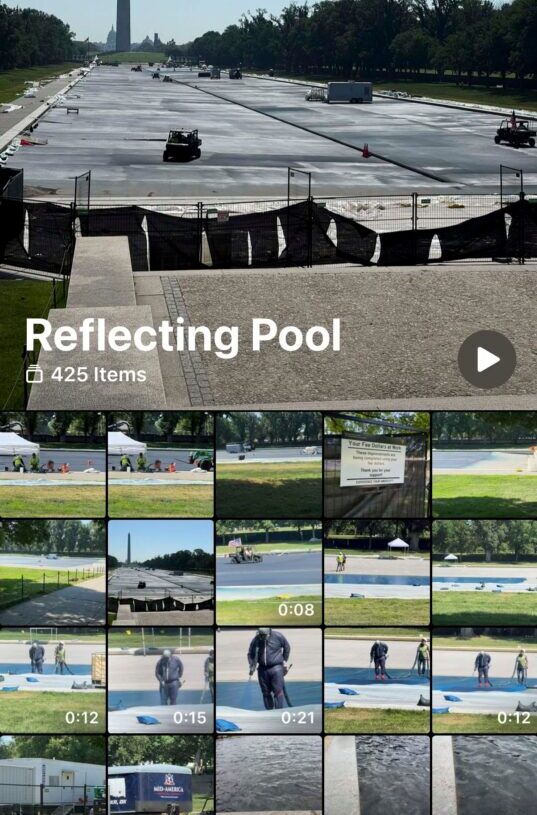
Pre-July 4th, when the algae and peeling paint problems converged into one news cycle, most of the people I encountered at the pool were there to gawk at what had, by then, become a major story. Some told me they had to see how green it was; others, wearing MAGA caps, had come to see how blue it was. Twice, I struck up a conversation with a stranger only to find out that they were a reporter covering the story, too. There were more than a few jokes about my “pool reports,” (journalism lingo for daily dispatches a small group of White House reporters distributed to the full press corps) and my “pool boys,” what an editor dubbed the collection of swimming pool experts who had become sources. My phone’s camera reel filled up with murky pictures of green algae, and close-ups of paint flakes and mysterious craters.
I began to keep running shoes and gym clothes in the office, so that I could quickly change and dash down to the pool without having to worry about sweating through my nice office dresses in the 95-degree heat. A few times, when parenting and work schedules collided, I had to bring my preschool-aged daughter along. Her visits coincided with peak algae bloom, and she came to call the memorial the “Yuck pool.” We loved the baby ducks. I did not tell her what happened a few days later, when a few of them were found dead. Officials never told us whether the duck died from eating toxic blue-green algae, or of another cause.
An Interior spokesperson replied to some of our inquiries with an accusation of “Trump Derangement Syndrome,” the administration’s standard term for anyone who asks too many questions. But we reporters wouldn’t have focused so much coverage on the Reflecting Pool if Trump hadn’t made such a big deal out of it — and continued to do so. It was classic Streisand effect. Only last week, the president posted yet another AI-generated image of the Reflecting Pool, this time with an image of his profile in the water. Curiously, it appeared to be made of algae.
What had started as one more metaphor in a seriesof storiesabout Trump’s aesthetic, became a story of hubris and prosecutorial sloppiness, with real consequences. According to Trump, six people were arrested for touching the pool; at least one lost their job. And, given the president’s anger toward her for dropping the cases and acknowledging the “botched” construction job in a remarkable court filing, U.S. attorney for D.C. Jeanine Pirro could be in danger of losing hers. Not to mention the money and time wasted, the ducks that died, all the attention spent on this giant puddle of water that could have been directed to more pressing matters.
And the place is still not fixed.
It was great to spend so much of my summer reporting outdoors — I don’t mind the sweltering D.C. heat, luckily. In addition to my crash course in pool linings, I learned more about peak algae blooms than I ever have learned about peak cherry blossom blooms — and the possibility of banishing the former with something called “advanced nanobubbler technology.” I consulted with a vexillologist — that’s someone who studies flags — about the origin of “American Flag Blue.” I learned how much hydrogen peroxide it would take to harm a duckling (vastly more than workers used, thankfully), which someday I will tell my daughter about, when she’s ready.
But what I really enjoyed was witnessing how much this place — the shimmering bridge between Washington and Lincoln, part of the landscape of D.C. that I so often take for granted after 20 years of living here — means to people. For some tourists, it’s hallowed ground, much like the monuments and memorials that surround it. Crowds once waded in it as protest. They thronged around it to hear the voices of Marian Anderson and Martin Luther King Jr. Hundreds of lights encircled it in 2021 as a tributeto those who died of covid.
I do not know if this new round of renovations will be able to eliminate its algae or leaks, but I do know that the Reflecting Pool looked better with those problems than it does now, with construction equipment, a patchy, uneven coloration, and fences with signs posted by the National Park Service that do not even correctly state its name, calling it the “Lincoln Memorial Reflecting Memorial Pool.” It has become a symbol of inefficiency, though Trump quoted an Interior official yesterday that it’s “Coming out great!”
Summer is almost over. The work on the pool has begun once more. I’ll keep walking around the pool and reporting on what happens there. Maybe it can be the kind of place it used to be, again.
The post How I spent my summer: At the Reflecting Pool appeared first on Washington Post.