Mount Everest, which straddles the border between Nepal and China, is in transition. Study after study shows that it’s melting.
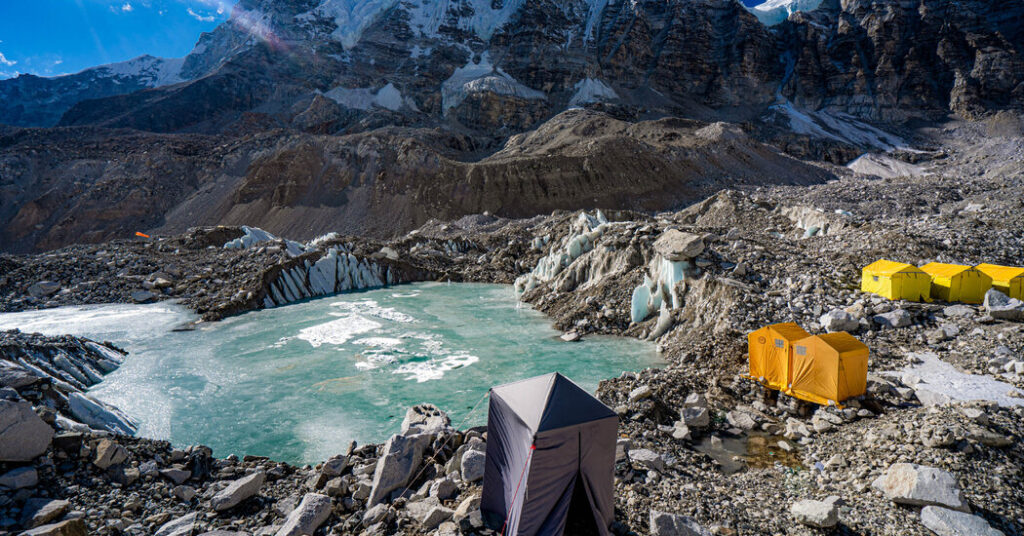
With record numbers of climbers hoping to summit its peak, the mountain has become a tourist trap. This is especially apparent at Everest Base Camp, where there are espresso bars and big-screen TVs, fast Wi-Fi and hot showers, even tents with Persian carpets and heated floors for the thousands of climbers and the support crew members who spend months there.
Now a new study reveals the cost of this activity to the thawing Khumbu Glacier, with researchers estimating that about three million kilograms of glacial ice and snow is lost each spring, thanks to the energy it takes to create these comforts.
In 2023, that meant 824 cylinders of liquefied petroleum gas, 18,935 liters of kerosene and 5,130 liters of gasoline were used for cooking, heating and powering about 1,600 tents at base camp.
One of the most shocking findings: Human urine is responsible for an estimated 154 tons of melt in the Khumbu Glacier.
“If you drink more water, you have to let it out,” Khim Lal Gautam, a geospatial scientist who is the study’s lead author and Nepal’s chief survey officer, said, referring to the body’s need to hydrate more at higher altitudes.
More than 6,000 liters are produced daily by thousands of climbers and guides.
Pit-vault toilets collect waste at base camp for about 2,000 people, which is hauled downhill, but most people urinate on the glacier, a water source communities drink from. “You don’t need to be a scientist to see we’re losing more ice every year — you can see it with the naked eye,” said Mr. Gautam, who has spent over 365 days on Everest since 2011.
Although the impact of human urine is concerning, Dr. Sudeep Thakuri a Nepali climate scientist and an associate professor at Tribhuvan University who was a co-author of the study, said that the findings were “not really surprising” and that the urine ultimately has less impact than all the fuel used for heating, cooking and lighting.
To conduct the study, Mr. Gautam collected data from base camp operators, while, in her office in Louisiana, Virginia Burkett, a study co-author and an emeritus scientist with the U.S. Geological Survey, helped organize decades of satellite data that showed temperature change over time across the glacier, relaying those figures to Mr. Gautam as he inspected real-time changes on the glacier.
It wasn’t easy. Low Earth orbit satellites measure infrared radiation or heat emitted, but they can’t get readings if there’s cloud cover, which Everest is notorious for. So the team looked at every cloud-free thermal image from 1991 to 2023, Dr. Burkett said. The researchers observed trends in land surface temperature over that period, and compared results from base camp with the snow-covered area of the glacier and a neighboring site off the glacier.
“That was the stunning effect,” she said. “We found the snow-covered area increased in temperature only half as much as the base camp.”
Base camp temperatures increased about twice as fast as elsewhere on the glacier. The human footprint could be worse, Mr. Gautam warns, since he did not include heat sources like helicopters, trekkers and yaks.
While larger climate shifts drive change across the Himalayas, ice loss rates have nearly doubled since 2009 across Everest’s glaciers. And while bodily fluids may not be affecting melt as much as activities like cooking, it does threaten Nepali economic activities, especially climbing, and drinking water sources, hydropower and irrigation. Mr. Gautam says there’s also risk for deadly flooding from glacial outbursts, which early reports indicate caused recent devastating floods in Nepal and China. This localized melt can “cause more avalanches and make a dangerous climb more dangerous,” notes Peter Hackett, an altitude researcher who was not involved in the study.
There’s also an aesthetic impact experts say is harder to quantify.
“There’s nothing worse than getting into a high camp, looking out at the horizon at sunset and seeing dozens and dozens of frozen turds,” said Dr. Hackett, who summited solo in 1981.
Climbers are supposed to use sanitary bags to pack out their waste, but the higher you go, the harder it can be to follow rules, especially as low oxygen makes all movements more difficult.
Dr. Burkett said the study has implications for the potential impact of climbing and climate globally, as glaciers continue to retreat. She said moving Everest base camp off the glacier to stable ground could help logistics like helicopter support and might slow localized melting. It also sets a precedent for protecting other at-risk sites. “We have to think about the future,” she said. “What better place to start than Everest?”
The post Mount Everest Base Camp Is Melting. Human Urine Is a Contributor. appeared first on New York Times.