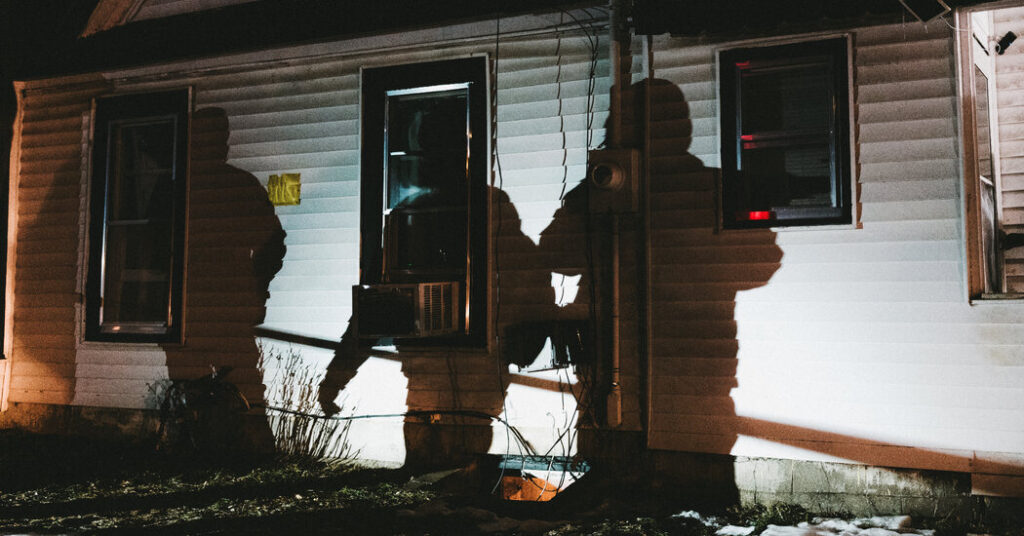
Early in a new film at the Venice Film Festival, an S.U.V. rolls up and stops on a residential street. A black-gloved hand emerges from a window and points emphatically at one house.
It’s a chilling moment, but this is not a scene from a fictional thriller. “They’re Here” is a short documentary about the immigration crackdown in Minneapolis — when U.S. Immigration and Customs Enforcement agents arrested thousands of undocumented immigrants and protesters from December 2025 through March 2026, though the film’s timeline focuses on the period between December and February. The surge began in Minneapolis and later spread across Minnesota. Two U.S. citizens, Renee Good and Alex Pretti, were fatally shot by ICE agents, intensifying protests across the country.
Premiering on Sept. 7 in Venice, “They’re Here” was co-directed by Laura Poitras, an Academy Award-winning director who won the festival’s top prize in 2022 for “All the Beauty and the Bloodshed,” and Rachel Lauren Mueller, a Minneapolis-based filmmaker, journalist and cinematographer.
Poitras and Mueller began filming in January of this year to document the events as they unfolded. The challenge became how to convey the scary reality of the operation in Minneapolis, which resulted in killings, injuries and separated families. Poitras recalled seeing a brief video on Instagram that showed an idyllic winter landscape, but offscreen, people could be heard screaming at others to stay inside and lock their doors because “they’re here.”
“We were very interested in how cinema could express the kind of reign of terror that was happening,” Poitras said in a video interview.
“They’re Here” uses street-level filming of the action by Mueller and others, footage from dashboard cameras, crowdsourcing and mapping data to show how Minneapolis residents worked to stay safe during the crackdown. Civilian observers compare notes on mysterious vehicles and keep a record of people snatched off the streets by masked men. Law enforcement vehicles roll across the screen amid clouds of tear gas, while at the airport, prisoners are seen from a distance trudging onto planes.
Interspersed throughout the film are scenes from the point of view of and narrated by a man identified as Edén Villa. Villa describes taking extreme measures just to get to work safely, including hiding in a car trunk. Like many others in the film, he remained anonymous for his own protection. Many of the civilian observers went by handles like Liz Lemon or Red Fox.
“The risks are real, particularly for the immigrant communities who are being hunted throughout the country,” Poitras said. “And also now there is the targeting of people who are organizing. (The New York Times has reported on homeland security officials using “an array of invasive tactics during the first half of this year to gather information on many groups and individuals who were never accused of crimes.”)
The documentary blends video and audio to show observers as they give each other eyewitness reports. Volunteer operators can be heard taking calls about possible abductions or sightings of ominous newcomers in town wearing head-to-toe military gear, with one caller asking if that’s normal. Another caller was dissuaded from following a car that they thought looked suspicious as it went down an alley.
“The organizing effort was completely decentralized, entirely organic. There were tens of thousands of Minneapolis residents that were a part of it,” Mueller, the co-director, said.
Rather than communicate with a central office, volunteers took reports from their living rooms or in the streets. After the killings of Good and Pretti by agents, “droves of people” came out to join the ranks of observers, Mueller said.
Detailed map graphics onscreen show the extent of the homeland security operations. Spanning across the city’s neighborhoods, reports pop up on the maps about abductions of adults and children through January and the months after. Poitras and Mueller say this visual component offers a clearer picture of the scope of the crackdown.
“This is always a dilemma of a documentary. There is this way in which telling the story through individuals is grounding emotionally, but then how do you communicate the horrific nature of the scale?” Poitras said.
The filmmakers were also mindful of covering recent events in a short film, opting not to make a long-form documentary that could take too much time to produce. They also tried not to show footage that has appeared in the media nor to depict any killings, though “They’re Here” does include confrontations in which federal agents shove and spray people in the street. At one point, Gregory Bovino, the former leader of the Trump administration’s deportation campaign, is seen moving people aside.
Poitras and Mueller centered Villa, the man trying to get to work, as the film’s protagonist and wanted to tap into the kind of fear sometimes found in genre movies. Poitras cited “Children of Men” as an uncomfortably evocative dystopia, and “Get Out” for its use of a protagonist’s perspective. The filmmakers wanted to show how thousands of citizens in Minneapolis were able to affect their real-life circumstances.
“Eighty percent of these agents were forced out of town because of the work of organizers,” Poitras said. “This is what it looks like, how volunteers were able to not just be scared at home but to do something about it.”
Mueller was filming among the volunteers outside in subzero temperatures at the height of the homeland security operations. Her recollections mirror the tone of resilience common among the voices featured in “They’re Here,” even when she is talking about coping with tear gas.
“The gas masks were great because they kept you a lot warmer than if you weren’t wearing them,” Mueller said. “Until the condensation would freeze and then you have to take it off.”
Poitras and Mueller were finalizing the short in mid-August, with remaining elements including work with a composer, Alessandro Cortini, who has performed with Nine Inch Nails. They have been encouraged by the response at feedback screenings.
“I think that if we can capture the emotional felt sense of what the decay of civil liberties looks like and the terror and the intensity of being under military occupation, that feels like a success,” Mueller said.
The post At the Venice Film Festival, a Close View of ICE in Minneapolis ICE appeared first on New York Times.