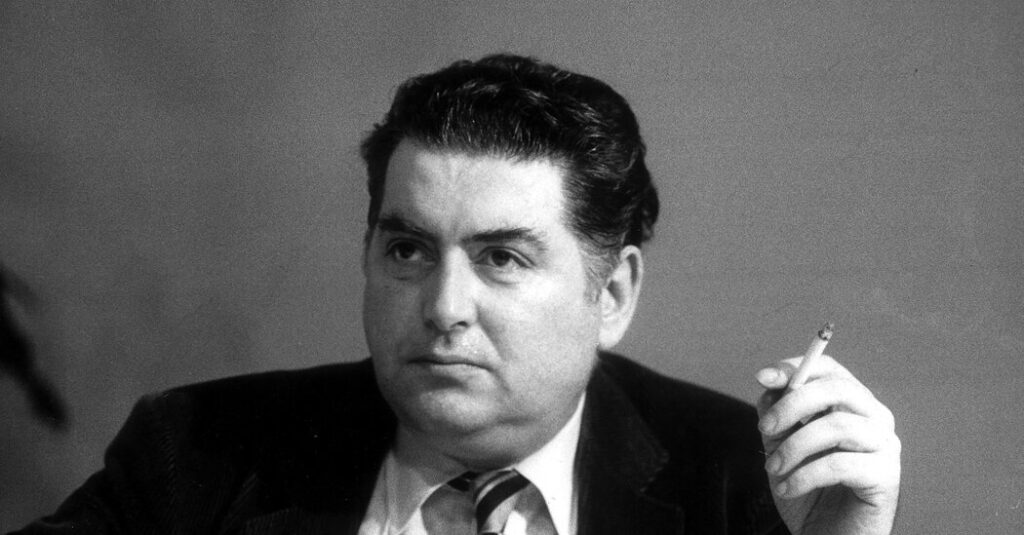
Moritz de Hadeln was a global film festival pioneer who firmly believed that finding great films meant traveling the world much like an outdoorsman searching for the rarest of creatures.
De Hadeln, who ran the Venice Film Festival in 2002 and 2003 — as well as the Berlin Film Festival for more than 20 years, and two smaller festivals in Switzerland — died on July 4 at age 85. At this year’s Venice Film Festival, which kicks off Wednesday, de Hadeln’s legacy is undeniable.
“Moritz was also someone who was convinced that you have to travel to find film, and he always tried to understand the culture that gave birth to these films,” Christian Jungen, who wrote “Mister Filmfestival: The Many Lives of Moritz de Hadeln,” said in a video interview. “Moritz organized more film festivals than any other, and there will never be someone like him because he started extremely early and for more than a decade ran two festivals, Berlin and Nyon, at the same time.”
Born in Exeter, England, in 1940 and educated in Paris, de Hadeln began making short films in his 20s, and with his wife, Erika von de Hagen, founded the Nyon International Documentary Film Festival, now Visions du Réel, in Switzerland in 1969. He also headed the Locarno International Film Festival in Switzerland from 1972 to 1977. His longest stint was as head of the Berlin Film Festival, also known as the Berlinale, from 1979 to 2001.
“He was one of the first Western curators who went to China in a time when China was a very complicated, closed, far away country from a European perspective,” said Jungen, who is also chief executive and owner of the Zurich Film Festival. “One of his biggest achievements was bringing Chinese films to the West.”
Jungen pointed to “Red Sorghum,” 1988, by Zhang Yimou, and films by Chen Kaige, including “Farewell My Concubine,” 1993, as examples.
“He lived on Lake Geneva, and he was inspired by Edgar Snow, the American journalist who also lived there and wrote the book ‘Red Star Over China’ about his encounter with Mao Zedong,” Jungen explained. “The two met, and Moritz wanted to follow his example.”
And de Hadeln also broke barriers closer to home, traveling behind the Iron Curtain when few others did.
“In the late 1970s and early ’80s, for Eastern European films, he went to the other side of the Berlin Wall and brought so-called forbidden films from the Soviet Union to the West,” Jungen said. “Dealing with the bureaucrats, talking to people, drinking vodka, having lunch, having dinner — it was a very different kind of business than we do today.”
Jungen cited the 1979 film “Tema,” by the Russian filmmaker Gleb Panfilov, which won the Golden Bear at that year’s Berlinale, as a major achievement.
“That film would have never been released or liberated if it wasn’t for Moritz,” Jungen recalled.
That kind of political maneuvering defined de Hadeln at a time when film festivals weren’t blockbuster events with red-carpet opulence and paparazzi; rather, they were about bringing obscure movies to audiences.
“In Berlin, everything felt political because of the Cold War, but Moritz decided to work on bringing East and West together, and that was in the spirit of the progressive political world at that time,” said Wieland Speck, who coordinates the Berlinale’s Panorama program, known for championing independent cinema.
“We had films from Kazakhstan and places that other festivals didn’t have. He managed to slowly, step by step, get deeper into the Eastern world.”
Many see that finesse as his legacy.
“Here is this guy whose father was a British military officer, who liberated Italy, his mother was Romanian from the Eastern bloc countries, his wife, German, and he was the neutral Swiss guy mediating between East and West,” Jungen said. “He was the right person to go behind the Wall. He was like a diplomat who knew how to talk to different people.”
Jungen views de Hadeln as a historical figure in the fall of Communism in Europe.
“Because of him, people for the very first time saw films from Soviet republics,” Jungen explained. “Today you can find everything on YouTube, but this was a period where you had to go to the movie theater and see a physical movie print being projected to know about the world.”
Under de Hadeln’s leadership, Speck helped start the Teddy Awards at the Berlinale in 1987, which Jungen described as the first recognition for gay filmmaking at A-list festivals.
“At that time, that was very controversial, and in Bonn, the capital of West Germany at that time, there were very conservative cultural ministers,” Jungen said. “This was a big fight. That’s another legacy of Moritz’s. He was a trailblazer for the L.G.B.T.Q. community and never really got credit for that.”
When he arrived in Venice in 2002, the maneuvering didn’t stop.
“At a very delicate juncture for the Venice Film Festival, after the Berlusconi government had removed Alberto Barbera from the directorship a year before the end of his term, Moritz was appointed to lead the festival,” Oscar Iarussi, the artistic director of the Bari International Film & TV Festival in Italy who still serves as an adviser to the Venice Film Festival, said on a call. “He set to work in a pragmatic manner. He was multilingual and free-spirited and had a truly European outlook.”
Iarussi offered an example of de Hadeln’s character at the time.
“He had been appointed by a center-right government, but he had ‘The Internationale,’ which is the workers’ anthem, set as his cellphone ringtone,” he said.
For Jungen, de Hadeln’s two years at Venice capped a career spent bringing film to the masses and celebrating the artistry and camaraderie of film festivals.
“He spent his childhood mostly in Florence, so he spoke fluent Italian, and he loved Italy, Italian food and Italian drama, but it was a big deal that a foreigner took the reins of an Italian festival,” Jungen said. “I would say he was a turnaround artistic director in Venice. He had a very detached relationship with Berlin and Locarno, but Venice, he loved that festival until the end.”
The post Remembering a Champion of Independent Filmmaking appeared first on New York Times.