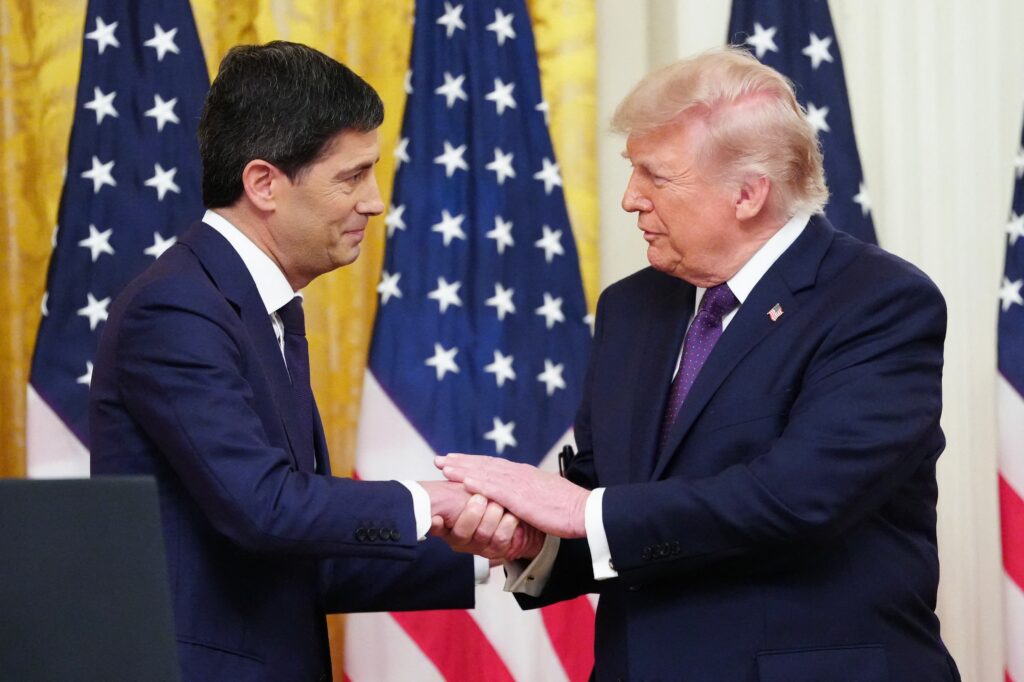
Federal Reserve Chair Kevin Warsh promised to bust inflation in his first major speech since his nomination by President Donald Trump, but he also lavished attention on a new focus for the Fed: artificial intelligence.
“We’ve come to a hinge point in history” because of AI, Warsh said on Friday, adding that the technology could turbocharge economic growth.
Warsh’s remarks followed a recent shift in the Fed’s views on AI, which the powerful financial institution treated largely as a bit player since ChatGPT’s 2022 debut sent unprecedented geysers of cash gushing through the U.S. economy.
As recently as last fall, AI seldom came up in public summaries of Fed policy meetings, where officials discuss how to steer the U.S. economy, according to a Washington Post analysis. This year, the technology is playing a starring role, with dozens of mentions of AI and its ripple effects on jobs, economic growth, the cost of living and the risks of financial meltdowns.
The surge in the Fed’s attention to AI shows the technology’s growing importance in matters central to Americans, policymakers and global business. In 2026, AI “is the story of everything,” said Claudia Sahm, a former Federal Reserve economist who is now chief economist at the investment firm New Century Advisors.
This is how that happened at the Fed, one of the world’s most influential institutions.
AI who?
The Fed’s policymaking group, the Federal Open Market Committee, meets eight times a year to discuss the economy and financial markets, and to vote on the direction of interest rates. Its decisions influence how much you pay for a mortgage or a car loan, prices at the grocery store, your investment portfolio, how much businesses are hiring and more.
The meetings are secret, with the public minutes offering a manicured look inside the consequential gatherings. Elected officials, Wall Street analysts and business titans analyze the summaries and Fed officials’ public statements with the ferocity of teenagers interpreting group text chats.
Fed meeting minutes don’t explicitly mention AI in 2023 and early 2024. One passage shows the Fed was noticing its effects without name-checking the technology. (The Post added the bolding.)
Jan. 2024:
“Broad equity prices reached new highs over the intermeeting period, but they were driven mostly by the strong gains of large-capitalization technology companies.”
Translation: The stock market went up a lot in 2023, mostly because of the stock prices of AI-related tech giants such as Amazon, Meta, Microsoft and the computer chip maker Nvidia. (Jeff Bezos, Amazon’s executive chairman, owns The Post.)
Enthusiasm for AI’s potential to send future corporate profits into the stratosphere continues to push up stock markets around the world.
The minutes of the Fed meetings don’t necessarily reflect all that officials care about or discuss. Some Fed officials have talked about AI in speeches and news conferences, for example.
The first explicit mention of AI in summaries of the crucial meetings at the heart of the Fed’s mission didn’t come until spring 2024, about a year and a half after the debut of ChatGPT.
April/May 2024
“A few participants commented that higher productivity growth might be sustained by the incorporation of technologies such as artificial intelligence into existing business operations or by high rates of new business formation in the technology sector.”
Translation: AI might help businesses crank out more stuff for the same work hours, which is essential to lift the U.S. economy. Maybe AI will create more start-ups, which could be good for the economy and jobs. We’re not sure, though.
The discussion previewed one of the hottest debates about AI. More than two years later, many economists say AI has probably not yet made businesses more productive across the country, but it’s difficult to know for sure.
The Fed becomes AI-curious
Sahm said AI’s effects on the Fed’s twin goals — keeping employment high and consumer prices in check — weren’t glaringly obvious last year.
But by the middle of 2025, AI had set off an unmissable economic earthquake.
Leading technology companies started to spend hundreds of billions of dollars a year on big-ticket projects including building and outfitting data centers stuffed with AI-calculating computer chips. The flurry of spending prompted comparisons to the dot-com bubble and became the talk of the financial world.
This past fall, Fed officials started gabbing about this titanic AI spending, the meeting minutes show. By late in the year, they were also debating whether AI could deliver a dream economic scenario.
Dec. 2025
“A number of participants noted that structural factors such as technological progress and higher productivity growth, possibly reflecting increasing use of AI, could boost economic growth without generating price pressures and could also damp job creation.”
Translation: Some of us think AI will make businesses so productive that the economy can keep growing without inflation getting out of control.
Warsh and Trump believe AI can produce a miraculous combination of a fast-growing economy, workers who can do more with less effort, and lower consumer prices.
For now, though, AI hasn’t produced the productivity miracle, and the enormous spending to build AI computer hubs is making inflation worse, said Michael Strain, an economist at the American Enterprise Institute, a public policy think tank.
Spicy AI debates
This year, AI references at Fed policy meetings exploded as attendees discussed what the technology might be doing to the economy, the cost of living, jobs and financial markets.
Jan. 2026
“Some participants discussed potential vulnerabilities associated with recent developments in the AI sector, including elevated equity market valuations, high concentration of market values and activities in a small number of firms, and increased debt financing. A few participants commented that the financing of the AI-related infrastructure buildout in opaque private markets warranted monitoring.”
Translation: Uh oh. Is this AI thing a bubble? AI-related stocks have gone totally bananas, and tech companies are borrowing tons of money from every nook and cranny to afford their fancy AI computers and data centers.
“Fed officials rightly are nervous that AI poses some real risks to the economy,” said Mark Zandi, chief economist of Moody’s Analytics.
July 2026
“Several participants assessed that the effects of the AI buildout on consumer prices had so far been limited to select categories. However, several other participants viewed investment in AI as already having broader effects on prices by pushing up aggregate demand or assessed that it would likely do so relatively soon.”
Translation: The central bankers are fighting.
How much AI is contributing to inflation is one of the most important debates over the economy, and one of the Fed’s most contentious. AI companies are spending so much on AI computer equipment and building AI data centers that it is resulting in higher prices, including for electronics such as Amazon Kindle e-readers, Nintendo Switch video game systems and Mac computers.
Sahm said the big question for the Fed is whether AI-related inflation is measurably piling onto five-plus years of already-spiraling prices that are wearing down Americans. (After Warsh’s speech Friday, futures market activity indicated that traders expected the Fed to boost interest rates next month to try to bring down inflation.)
In his speech Friday, Warsh asked a string of questions about what AI might do to the U.S. economy and Americans’ financial well-being. Would AI raise living standards for U.S. workers or crush them? When might businesses see a payoff from AI?
But he wasn’t ready to offer answers.
The post The Fed confronts a powerful new economic force appeared first on Washington Post.