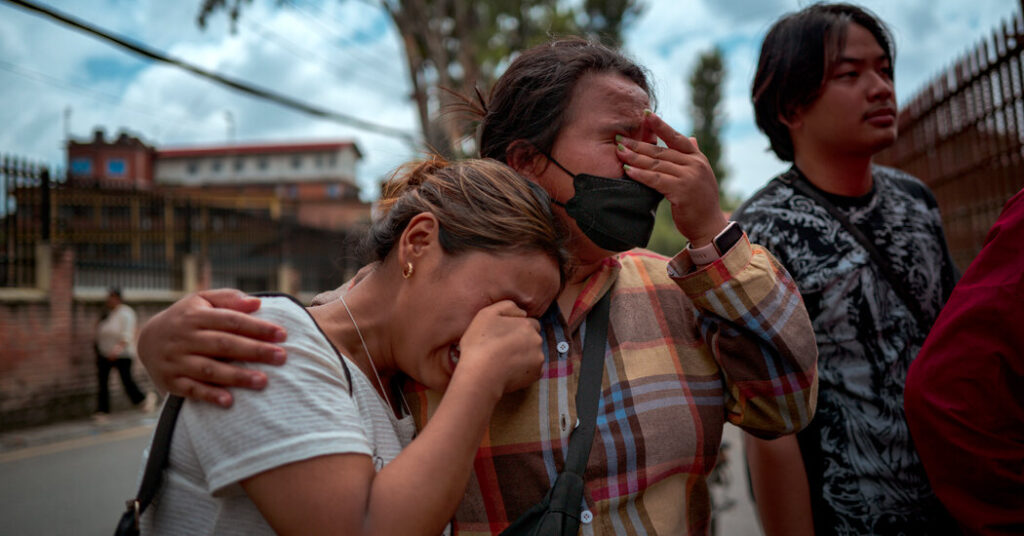
A city in Nepal has received far more bodies than its morgues can accommodate.
Bharatpur, the headquarters of Chitwan district, lies downstream from the devastated sites of the floods that killed hundreds of people this week, with many more still unaccounted for. The district has become the main collection point for bodies that were caught in the initial torrent of floodwaters, or that have been floating to the banks of the Bhotekoshi River since.
By Friday afternoon, the remains of about 220 people had washed down to the district, according to Nepal’s disaster management authority. But the morgues at hospitals across Chitwan can barely house three dozen bodies, Rameshwor Poudel, the district’s police chief, said in a phone interview.
On Saturday, the authorities in Chitwan said they would bury those remains, still unidentified, because they were decomposing and posed a health risk.
The town had been relying on a government building that the Nepali authorities had turned into a makeshift mortuary for about 150 bodies, Mr. Poudel said on Friday, as they were trying to arrange for dry ice to help preserve them.
“It has no chilling facilities,” he said of the hall. “It only has air-conditioners.”
At least two other districts in Nepal have reported similar difficulties in storing such large numbers of remains.
The devastating flooding has stretched government resources in Nepal, a deeply poor country where hospitals and infrastructure already had limited capacity. Resources have been strained even in Bharatpur, a transportation hub that connects much of Nepal to the road network leading to the capital, Kathmandu.
Mr. Poudel said dozens of bodies had been pulled up to the riverbank in pieces, making identification difficult. Before burying them, the authorities will preserve DNA samples so that families can later claim any remains that are identified, Chitwan’s district administration said.
Before the decision to bury the bodies was made, Mr. Poudel said the police were cleaning and taking pictures of them. If one was recognizable, they posted photographs outside the hall so that people searching for missing relatives could have a first look.
As of Friday afternoon, he said, two bodies had been identified and handed over to families.
One of them was Kabir Lal Chaudhary, 23. He was working for a hydropower company more than 100 miles upstream when he was swept away by the flood.
Mr. Chaudhary’s brother, Sugrib Tharu, said he had waited for two hours at the temporary morgue in Bharatpur before the authorities handed over his remains.
“The body is decaying,” Mr. Tharu said by phone, as he traveled home in an ambulance. “If there had been a chilling facility, it would have been in a better condition.”
Mujib Mashal contributed reporting.
The post Nepali City Struggles to Handle the Many Bodies on Its Riverbanks appeared first on New York Times.