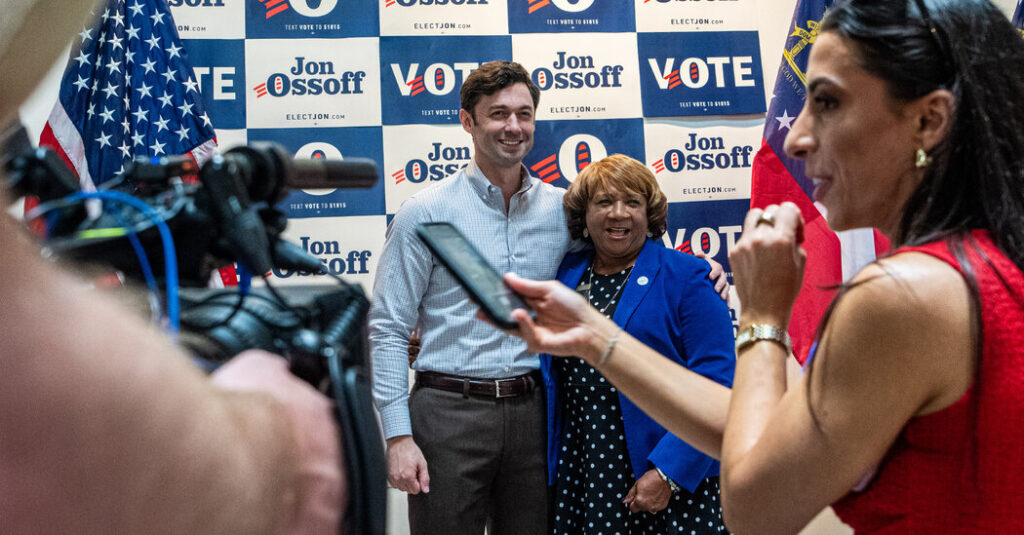
Senator Jon Ossoff of Georgia entered this election cycle with every reason to tack to the political middle.
He is the only Senate Democrat seeking re-election this year in a state President Trump carried in 2024, making him one of the most vulnerable incumbents in his party and an obvious Republican target from the start.
But Mr. Ossoff hasn’t moderated his votes or his message to appeal to a broader swath of voters, as Democrats in competitive statewide races often do in the conservative-leaning South. Instead, he has dived into his party’s efforts to thwart the president’s agenda in Congress, and sharpened his attacks on Mr. Trump and Republicans on the campaign trail.
The approach risks alienating some members of the coalition whose backing he needs to win re-election in Georgia, including independents and conservative-leaning voters.
His strategy appears to be based in large part on taking advantage of two factors: Mr. Trump’s sagging approval ratings — a Fox News poll in June found him with net-negative ratings in Georgia, with 56 percent holding an unfavorable view of him — and a Republican challenger endorsed by the president, Representative Mike Collins, who is regarded by strategists in both parties as relatively weak.
Mr. Ossoff has submitted himself to little tough questioning and has not pushed any major policy proposal. He has leaned heavily on circulating flattering video clips of himself making his case, and in a recent interview with The New York Times, stuck to a disciplined script as he laid out his theory of the race.
“The crisis that the nation’s mired in is born in large part of widespread disillusionment that flows from negligent and ineffective public service,” he said between campaign stops in Savannah. “Trumpism feeds on and deepens the sense that the Constitution, the Congress, elected officials, don’t care and can’t deliver.”
The message appears to be resonating. Less than three months from Election Day, Mr. Ossoff leads Mr. Collins in every major public poll and holds a commanding fund-raising advantage, putting him in a strong position to keep a key seat critical to Democrats’ uphill battle to win control of the Senate.
At rallies across Georgia this summer, he has delivered a series of blistering rebukes of the president and Mr. Collins.
In Savannah, standing in front of a large crowd of supporters last month, he said Mr. Collins lacked the “judgment and integrity to serve in the United States Senate” and labeled him a Trump “puppet.” In Atlanta this month, he said Mr. Trump and those close to him — a group he calls the “Mar-a-Lago mafia” — have “taken American corruption to spectacular new heights,” a line he has used repeatedly. He has called Mr. Trump a “draft-dodging, crook president,” and recently drew the president’s rage by mentioning the name of his most devoted aide, Natalie Harp, as part of a screed in which he said that Mr. Trump “doesn’t want to do the job” of being president.
Along the way, his adherence to anti-Trump talking points — he repeats some so consistently that he can at times sound almost robotic — has turned Mr. Ossoff, at 39 the youngest member of the Senate, into a social media sensation. It has fed speculation he refuses to indulge about his potential as a presidential contender in 2028 at a time when other Democrats have struggled to coalesce around a clear message.
Mr. Ossoff still faces challenges in a state Mr. Trump won less than two years ago. Mr. Collins, the 59-year-old son of former Representative Mac Collins of Georgia, has focused heavily on the issues that animate the Republican base — illegal immigration, transgender athletes, crime and grievances surrounding the 2020 election — while adopting an aggressive online persona of the kind Mr. Ossoff has eschewed.
Mr. Collins wrote legislation requiring that immigrants in the country illegally who are accused of crimes be detained for possible deportation. It was named for Laken Riley, the 22-year-old nursing student who was murdered on the University of Georgia campus in 2024, and became the first bill Mr. Trump signed into law in his second term. (Mr. Ossoff and 11 other Senate Democrats voted in favor of the legislation in January last year.)
In Washington, Mr. Ossoff has not made the traditional election-year pivot to the center. He joined Democrats last year in voting to shut down the government — and against repeated efforts to reopen — in an unsuccessful bid to force Republicans to extend expiring health care subsidies. He did so again this year as part of Democrats’ failed attempt to impose new limits on the tactics of federal immigration agents.
As his party has shifted away from unequivocal backing for Israel, Mr. Ossoff has grown more critical as well; he has voted repeatedly, including twice this year, to limit or block some American weapons transfers to the Jewish state. But this week, he broke with Hasan Piker, the left-wing streamer, saying he “unreservedly rejects” a comment Mr. Piker made warning that support for Israel could prompt violence against American Jews.
He also drew outsized attention last month when he questioned Jay Clayton, Mr. Trump’s nominee to lead the nation’s intelligence community, so intensively at his confirmation hearing that Mr. Clayton was briefly left speechless. In the Times interview, Mr. Ossoff — who has made it a standard practice to repeat the same question several times in such settings — said he meticulously prepares for such moments.
“I take great satisfaction in putting folks who have abused their power on the spot and forcing them, through effective investigation and interrogation, to answer for what they’ve done,” Mr. Ossoff said.
But in recent months, the senator, a former congressional aide and documentary film executive, has also aggressively courted Republican backers. He appears to be winning over some, despite his frequent verbal broadsides against the president.
In Toccoa, a city of less than 10,000 residents in the foothills of northeast Georgia, Mayor Gail Fry, a lifelong Republican who voted against Mr. Ossoff when he ran six years ago, is backing the senator.
“We have gotten more support from Senator Ossoff than any other office that we’ve contacted,” she said in an interview, citing an $8.4 million federal grant he secured to replace aging natural-gas infrastructure. “He calls us and says, ‘What do you need?’”
Other local Republican officials, including Mayor Scott James Matheson of Valdosta and Mayor Julie Smith of Tifton, also endorsed Mr. Ossoff.
In the interview, Mr. Ossoff said that bad public service is what ushered in the Trump era and that voters would reward him for focusing on the basics.
“Thousands of folks across the state have my cellphone number,” he said. “They know that I will move heaven and earth to deliver for them, no matter their politics.”
He rejected the notion that his harsh criticism of the president — in the interview, he called Mr. Trump “a disgrace” and his administration “an obscenity” — would alienate the voters he needs to win. And he argued he was still able to work with Republicans when necessary.
“A big part of my job is to have the legislative skill and the relationships across the aisle to get results for the state,” Mr. Ossoff said. “I don’t think these things are in tension.”
That is a tricky balance to strike in an election year. Partisan tensions are running high as Mr. Collins is working to draw a stark contrast with Mr. Ossoff on issues including law enforcement and border security in a state that remains conservative.
At a campaign event this month, Mr. Collins said the choice between himself and Mr. Ossoff was “common sense versus communism crazy.”
Speaking to a crowd of supporters in Augusta, he called Mr. Ossoff a “trust fund kid” and portrayed him as out of step with the state’s deeply conservative values, accusing the senator of voting “to have that border wide open,” for the Biden-era domestic policy bill “that caused all this runaway inflation,” and for legislation “to allow men to play in girls’ sports.”
(Mr. Ossoff voted with his party last year to block Republican-written legislation aimed at barring transgender women and girls from school sports teams designated for female students.)
Mr. Ossoff, for his part, has attacked Mr. Collins for his ties to aides who have trafficked in racist and antisemitic material and associated with prominent bigots. The Washington Post reported this week that a former staff member had posted an image of a swastika and one in which he appeared to be dressed in Ku Klux Klan garb. (In a statement to The Times, a spokesman for Mr. Collins said he “unequivocally condemns” the posts.) The Republican also replaced his chief of staff last month after reports that he had been in communication with the white supremacists Nick Fuentes and Richard Spencer.
Mr. Ossoff’s strong position in the race, formidable fund-raising and increasingly prominent confrontations with Trump administration officials have supercharged speculation about his presidential prospects, a topic he stubbornly avoids.
“I have zero interest in running for president in 2028, and, frankly, zero interest in the 2028 fantasy football right now,” Mr. Ossoff said in a recent interview on MS NOW.
Mr. Collins has sought to capitalize on the presidential chatter to portray Ms. Ossoff as out of touch with the state.
“Jon Ossoff sees Georgia as nothing more than a steppingstone and has abandoned our state to court the radical El-Sayed, Hasan Piker wing of the Democrat Party,” said Meyer Siegfried, Mr. Collins’s spokesman, referring to Dr. Abdul El-Sayed, the progressive Democratic nominee for Senate in Michigan.
Yet some longtime Republicans are looking past Mr. Ossoff’s party affiliation.
Gary Paulk, a fifth-generation muscadine grape farmer in Wray, a small community in deeply Republican South Georgia, once backed Mr. Trump and plans to vote this fall for Rick Jackson, the Republican nominee for governor.
But for Senate, Mr. Paulk plans to support Mr. Ossoff.
He disagrees with the Democrat on abortion, among other issues, but Mr. Paulk has experienced the negative impacts of many of Mr. Trump’s policy moves — including tariffs that have raised his costs, an immigration crackdown he complained left crops to rot for lack of workers to pick them, and health care cuts that have hit rural areas like his particularly hard.
“You pick what’s important, and you go with the person that’s best,” he said. “You’re never going to find anybody that does everything like you want it.”
The post In Georgia, Ossoff Courts Broad Appeal With an Anti-Trump Script appeared first on New York Times.