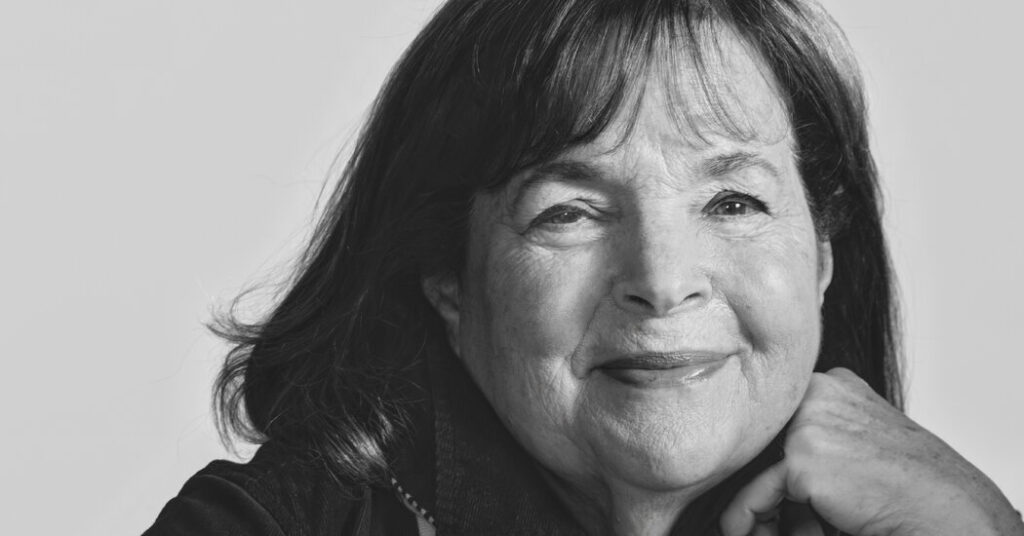
Ina Garten’s laid-back style in the kitchen, warm personality and staying power have made the cookbook author and Food Network host both a household name and a cult figure. She is lovingly parodied on social media by fans wearing her trademark denim shirt and her chin-length bob, holding a giant cocktail glass. And when we spoke, she told me that a bride in the Hamptons recently asked her bridesmaids to dress up like Garten, which the real Garten found flattering and also a little crazy. “I was like, Are you kidding? What were they going to explain to their kids in 10 years why everybody was dressed in a denim shirt?”
But you don’t get to be an icon with a multimillion-dollar brand on cocktails and niceness alone. As she documented in her 2024 memoir, “Be Ready When the Luck Happens,” Garten grew up in a home filled with negativity and pressure, where nothing she did was ever good enough for her cold mother and her judgmental, difficult father. In Garten’s telling, it was only when she met Jeffrey Garten — now her husband of 57 years and also a frequent sidekick on her TV shows — that she started to believe in her own abilities and trust her instincts.
Those instincts led her to buy a small specialty food shop in the Hamptons called the Barefoot Contessa, which eventually led to best-selling cookbooks (the first, in 1999, named after the store) and cable TV fame (her first show, also named after the store, premiered on the Food Network in 2002 when she was 54). Her evolution from an unsupported young woman to a hospitality powerhouse who found success later in life has lessons for us all, including when to listen to your inner voice and when to shut it down.
Now 78, Garten is starting something new: a podcast called “Happy Hour With Ina Garten,” in which she will put down the kitchen utensils and instead just have a drink and talk with her famous guests. She is also releasing a new cookbook, her 14th, called “Simply Ina.” She told me that over the years, while having fun has been a huge driver in her success, she has also learned to surround herself with people who are on the Ina train — and to tell people who aren’t to “get off and get out of my way.”
Subscribe: Apple Podcasts | Spotify | YouTube | Amazon | iHeart
I’ve been doing the math on your life. Uh oh.
You’re 78 years old. And you are just about to start this whole new chapter, launching a podcast. You started your celebrated Food Network TV show when you were in your mid-50s. And you wrote your first cookbook when you were in your early 50s. I find this very inspirational as a woman also in my 50s. What have you learned about taking on challenges in later life? When I look back and I think about the things that I’ve done, I love working scared. It keeps me up at night. I love this expression “getting out over your skis,” where you have no choice. You’ve invested your money, you’ve made a stake in what you decided to do, whether it’s books or TV. And very often I’ve said no to things for years until I figured out, How can I do this differently? I don’t like doing it the way everybody else does it. When I started in 1999, most cookbooks had like 250 recipes. Who needs 250 recipes? I need 75 really good recipes that I can make over and over again. I’m not even sure my publisher was convinced that was going to work, but it worked out OK.
I think one of the things that happens when people get older is that you get more afraid. That’s interesting. I thought you were going to say get more confident. Afraid because you have more to lose?
You have more to lose, you get more set in your ways. I’m just the opposite actually. I have a very low threshold for boredom. If I know how to do something, I don’t want to do it again. It’s really clear for me. I ask myself one question: Is it going to be fun? If it’s fun, then I really want to do it. I just have to figure out how to make sure it’s fun, working with people that I love, working with creative people where we create something that’s better than any one of us alone. And I’m responsible for the team. I love that feeling.
Let’s talk about your two new projects, a podcast and a cookbook, the first one in four years. It’s called “Simply Ina.” The recipes all look easy and delicious, which is your signature. Have you ever been tempted to make something off-brand? Complicated Ina? Fussy Ina? Pretentious Ina! [Laughs] Let’s make cassoulet!
Exactly. I’m not that good a cook. I think of myself more as a taster. I know what I’m looking for in flavor and texture, but I don’t like spending hours in the kitchen cooking. When I wrote my first book, which was “The Barefoot Contessa Cookbook,” I wanted it to have gorgeous photographs so that when you looked at it you thought, Oh, that looks delicious. And then you looked at the recipe and thought, I could actually make that. And you looked at the ingredients and thought, I can get all those ingredients in my local grocery store. That was a guiding principle of the first book, and it’s still the guiding principle.
Do you like eating complicated food? Like when you go to a restaurant, do you order complicated food? Hate it. I’m the first one who’s going to order a roast chicken in a restaurant. I really don’t like complicated food, and I don’t like tasting menus. They give me a headache. All those flavors, oh, my god. And I don’t like when somebody puts something down in front of me that I have no idea what it is. I’m just not an adventurous eater at all, and I think my recipes reflect that. I like raspberry cheesecake. You know exactly what it’s going to taste like.
Let’s talk about your podcast. You’ll be making cocktails and mocktails with a guest, is that right? I’m going to serve a cocktail or mocktail to each person. People are invited at 5 o’clock, so it’s cocktail hour. But it’s really about the conversation.
What makes a good conversation to you? What I’m always looking for is where I connect with the guest. So, for example, with Alison Roman, she writes cookbooks, she has a specialty food store in upstate New York, we have a lot of common experiences. So it’s really fun to talk about how she sees building a business, how she sees writing recipes. And it’s interesting, no matter what the guest does, whether it’s a movie director or a writer like Ann Patchett, we can find a common thread.
You know, I think having a good conversation also means having a little bit of tension at some point. But I think that’s probably not your philosophy. Am I right? Hadn’t thought about it! But now I’m going to. What’s tension in a conversation? Where you disagree about something?
You know, there are a lot of celebrity podcasts, where famous people interview other famous people. They’re very friendly, and they’re very fun, but I think they often steer clear of difficult questions or touchy questions, in part because the interviewer and the interviewee are friends, or they’re in the same social circles, or they’re going to see each other again at some point. And sometimes the conversations don’t go very deep. Have you thought about how you navigate that? I actually think it should be fun. I think the person should have an interesting point of view. But I’m really conscious that I want every conversation to have things that the listener can take away. So it’s not just you and I talking. It’s that we’re sharing our experience about how we do something. And that’s like the way I write cookbooks, and it’s the way that I do the TV show. What’s the user experience?
Why did you want to have a podcast, which is nowadays a TV show because it’s going to be filmed? I think it really goes back to my childhood, where I couldn’t connect with my parents. I crave that connection with people. And that’s why my friends are very important. And I find this so interesting. The stories that people have told me on “Be My Guest,” like Emily Blunt talking about having a stutter, which was debilitating when she was a child. I find people’s stories really inspiring. And it’s the difficult things in their lives that have led to the things that have changed them.
What is that for you? I had a very tough childhood. It was lonely.
You had a mother who was very —— Disconnected. And my father was always mad at me. I don’t know why. He tried to control me. What goes in early goes in deep, and I’m always trying to recreate what I craved when I was a kid.
I think either people repeat their parents’ mistakes or they really try to move away. I had a lot of help figuring out what happened. I don’t think I understood it until I was probably 40. And then once you understand it, and you say, Oh, that wasn’t everybody’s childhood, because when you’re a kid, you think everybody lives like that. And then you realize, no. And you make a decision to do it differently. Your history isn’t necessarily your life.
Your story can be seen as a series of beginnings or a series of endings. You stopped catering at a certain point, and catering had helped to propel you into the food world when you had your specialty store. I would run Barefoot Contessa during the day, and then we would do like 10 parties at night, and I’d get home at 1 o’clock in the morning exhausted. On Sunday, my only day off, I couldn’t even talk, I was so exhausted, and I thought, OK, this is not working. I couldn’t work and have a personal life at the same time.
And then you sold your store for similar reasons? I think I sold the store because I knew how to do it, and it was no longer a challenge. If you’re not bringing new energy and new ideas to a business, it’s time to pass it off to somebody else who will.
Then you stop selling prepared foods at a certain point. You know, some people expand their business, they keep adding and adding, and you seem to replace. You’re absolutely right. I hadn’t thought about it that way. One time I took a year off to try and figure out what to do next, and I remember in the middle I thought, This is the worst year I’ve ever had because I have nothing to do, which is not my favorite thing. But I never would have started writing cookbooks if I hadn’t done it. I always see this as like tapping on a wall, just tap, tap, tap until I hear a hollow sound, and then I’m like, OK, that’s where I’m going to go. And maybe because I like to have control over what I’m doing, I don’t like expanding it with more and more people.
You’ve always spoken about learning to trust your instincts, and I think that’s one of the hardest things for women in particular to do. Our inner voice is sometimes our harshest critic. How did you learn to trust yourself? As a child, I was always taught that whatever I wanted to do was a bad idea. And when I married Jeffrey, he always supported whatever I wanted to do and encouraged it and didn’t question it. And I think I really learned how to be in the world that way. I had gone from such a negative childhood to such a positive life. Everything I do he thinks is brilliant, and he has encouraged me to do more of it.
When did you realize that the harsh inner critic was not there anymore? Oh, it absolutely is! But when I was around 40, I started seeing a therapist, and what I learned is that when I hear that voice I say, Oh, that’s my mother’s voice, that’s not my voice.
And how do you deal with external pressure, when people don’t believe in you? Because there’s the internal voice, and then there are people in life who underestimate you. Oh, yeah, there are a lot of them. I just have this philosophy: You’re either on my train or get off and get out of my way. Because I had such a difficult time as a child I don’t like negative people around me. I just don’t like to be with them. So if you’re going to be positive and you’re going to bring things to the party, come along for the ride. But if you’re going to be negative and question what I’m doing or not listen to what I want, just get out of my way. [Pauses] Is that tough? You know what, I don’t think it’s tough. I think it’s clear.
How, then, do you take feedback? Oh, I ask for feedback all the time. Every morning I meet my team, and we talk about what we’re doing. I want to know what they think about it. But at the end of the day, it’s my decision. And once I’ve made a decision, I don’t want to discuss it.
At this stage in your career, people are going to be on the Ina train. You are a person who has a proven track record. But when you were first trying to move into things, Martha Stewart helped launch you [Stewart invited Garten to appear on “Martha Stewart Living” in 1999 and wrote the foreword to her first cookbook] and there was a lot of pressure to be a mini Martha. Well that was one of the models. She changed how it happened. She did it brilliantly in her vision.
You walked away from your first foray into television because they wanted you to be a mini Martha. How did you just have a sense that it wasn’t the right fit? You’re stubborn, clearly! [Laughs] I’m clear. I’m determined. It was her film crew that was filming a show for me. They kept saying to me, “No, no, no, you can’t do it that way.” And I kept saying: “You have Martha. You don’t need me to be Martha. You need me to be me.” I don’t know why I knew that, but I was very clear that Martha does things a certain way, and I do them differently, and unless that film reflected who I was, it was going to look like I was trying to be Martha. And that’s not who I am.
According to a New Yorker profile of you from a few years ago, you and Martha grew apart. Can I just say I admire her enormously? I think what she created is stunning, and she did it with vision.
Are you friends? I mean, we’re friendly, there’s no antipathy. She moved to Bedford, and she used to live in East Hampton, so we saw each other then.
I know you get asked about Martha a lot, and in some ways you became the anti-Martha. Is that in itself frustrating, that you always get put in some kind of juxtaposition with her? I had an interesting conversation with Alison Roman recently. I said to her that she and I are kind of in a continuum that started with Julia Child, who wanted to teach people how to cook with real food. When everybody was making boxed macaroni and cheese, she wanted you to appreciate a really good beef bourguignon. And then Martha came along and elevated home arts to something really worth doing well. Set a beautiful table. Make it a wonderful dinner. Carve out a pumpkin for the pumpkin soup. I came along and said: OK, maybe don’t carve out the pumpkin. Set a nice table, but it doesn’t have to be over the top, and make a lovely dinner and serve it. And then Alison Roman came along and said: Forget setting the table. Just put the pot of soup on the table and have a good time. And so I think everybody’s getting a little simpler and simpler, but at the end of the day, we all like the same thing, which is gathering people around a table.
In that New Yorker profile, Martha said she had never made one of your recipes, which I felt was kind of pointed. And I wondered if it bothered you. No. Certainly hers to decide. I didn’t know what to make of that. I’ve certainly made lots of hers.
I want to touch on the Food Network, because it has really changed since you started there. You came up with Rachael Ray, Paula Deen, and you women were really a big deal. There’s a lot of competition shows now though. Why have you never wanted to be part of a competition show? That’s just not who I am. And you know what? That’s what other people do. I just do something different. I think part of Food Network’s DNA is showing people how to cook, and fortunately, they still support my doing it.
Warner Brothers, which runs the Food Network, is in the midst of possibly being sold to Paramount. Not yet, not so fast. Not so fast.
Do you have an opinion about that merger? Will you stay with the Food Network if it gets sold? I think I’m going to stay away from that one. Is that all right?
I understand. It’s complicated. You know, I was thinking about how earlier you said you ask yourself one question when deciding whether or not to do something: Is it going to be fun? But is there anything that might have been really, really hard and not fun that you’re glad that you did in the end? I mean, the thing is, I like having problems to solve. So if I have something that’s difficult, and I have to work it out, I find myself totally engaged in it, and I enjoy that process. That’s fun. Like starting out going, How is this ever going to happen? And then you go, Well, if I start it this way, and I go there, and then I try that. I find that process fun.
I’m thinking of your mother’s relationship to food. She was a nutritionist who saw food as a method of control and not of joy, right? There was no joy in it. I don’t think she really understood joy. And I absolutely, deliberately decided to do it differently. I just love having a good time, and I don’t see any reason why I shouldn’t, so I always go toward that. I go toward people that are happy. I go toward people and projects that will be satisfying. Fun isn’t always like going down a water slide. Fun is building something with people that you care about.
You and Jeffrey decided pretty early on not to have kids, and you’ve talked about that. When you look at your peers who’ve raised kids, do you think you could have had the career that you’ve had if you had been a mom? I think it would have been difficult, and I think Jeffrey and I would have had a different life together. I’m not saying it’s a better life or a worse life, but there were times when Jeffrey decided that he wanted to start a business in Japan, and so he moved to Japan. I was in East Hampton, we went back and forth and we figured it out. I think that probably couldn’t have happened if we had kids, and I couldn’t have stayed long hours at the store, doing catering and running the store. I think it would have been much harder. I’ve never looked back on the decision and thought, I should have done it differently. I understand how my friends have wonderful families, and they really enjoy being parents, but it’s just not something I ever wanted to do. I’m really happy that I didn’t.
All right, final lightning round. Favorite person you’ve ever cooked for? Well, I actually had Eric Ripert come for lunch recently, and I love to cook for him, because he’s not only an incredible chef but he’s also an appreciative guest.
What did you make? I made a filet of beef with basil-Parmesan mayonnaise and a Charlie Bird salad, and I served a red Sancerre, which was slightly chilled. It was just delicious.
You’re making me hungry! Best advice you’ve ever gotten for how to live a good life? Do what you love. If you love it, you’ll be really good at it.
Jeffrey told you that? That was indeed Jeffrey. That was the beginning of my life.
Customer pet peeve? Help me not be a bad customer. I think that everybody should work in retail, like military service, so they understand how difficult it is.
What do you want people to learn? That it’s a hard job. That the people working there aren’t just functionaries. They’re actually people. And a little kindness goes a long way.
Finally, because at this stage you don’t need to achieve anything more: Have you flirted with the idea of calling it quits? Never.
Never? Never. I can’t even imagine doing that. People ask my wonderful agent, Esther Newberg, if she’s ever going to retire, and she says, “They pay me to read books, why would I retire?” I feel the same way. I love what I do. I love getting up in the morning and having a challenge for the day. I have the life I’ve always wanted. Why stop?
This interview has been edited and condensed from two conversations. Listen to and follow “The Interview” on Apple Podcasts, Spotify, YouTube, iHeartRadio or Amazon Music. Follow us on Instagram and TikTok.
Director of photography (video): Cal Christie
The post Ina Garten Says You Can Either Get on Her Train or Get Out of the Way appeared first on New York Times.