Times Insider explains who we are and what we do, and delivers behind-the-scenes insights into how our journalism comes together.
Can a sport be so popular that even animals want to come out and play?
That’s what Timothy Oliver, a a print sports designer, and Zazie Weldgen, a freelance illustrator, imagined while working on The New York Times’s U.S. Open tennis preview this year.
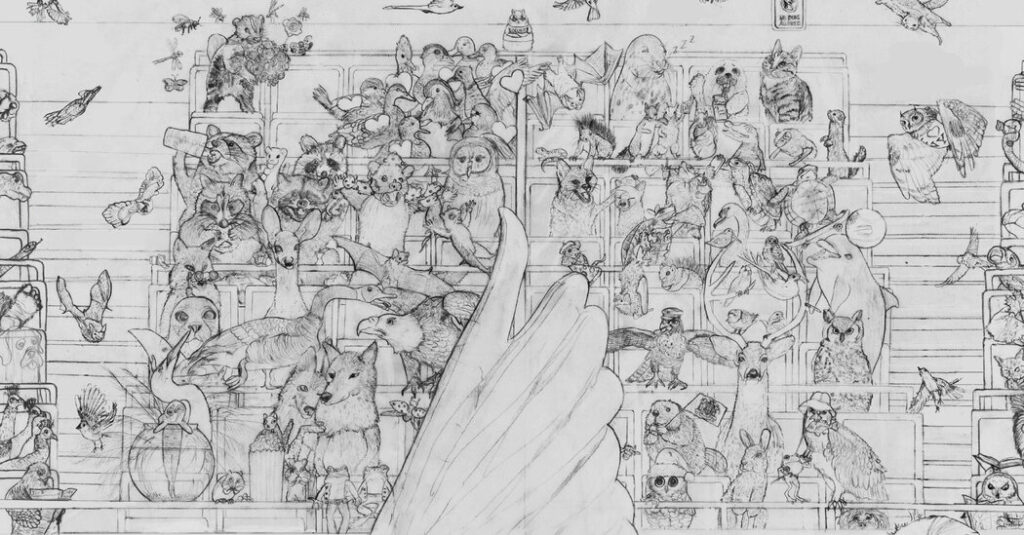
Dozens of unusual (and furry) faces fill Arthur Ashe Stadium in the cover illustration of this year’s preview, which appears as a special section in the newspaper on Sunday. Readers may spot a raccoon quaffing a Honey Deuce cocktail; a North American river otter juggling tennis balls; or Flaco, the Eurasian eagle-owl who escaped the Central Park Zoo, flying in the crowd.
It is a growling, chirping, barking illustration to match the wild child of Grand Slam tennis tournaments — and it is grounded in ecological rigor. Almost all of the animals on the cover can be found in New York State. Most are native.
This is Mr. Oliver’s fifth U.S. Open preview. Each year, for the cover, he and his colleagues have tried to capture the spirit of the tennis major that is noisier and more free-spirited than the others.
“It’s so engaging for New Yorkers that everybody can feel a part of it,” Mr. Oliver said.
In a sports year already busied by the Winter Olympics, a Knicks championship and the World Cup, Mr. Oliver, along with his collaborators on the sports pages Campbell Biemiller and Sara Ziegler, knew they wanted an illustration that could represent the unifying power that sports has on communities, but with a lighthearted touch.
Ms. Weldgen, a 23-year-old artist from Rochester, N.Y., had created a mural of animals on the campus of her alma mater, Monroe Community College. She said she often aims to emulate the playful nature of illustrations in children’s books. Naturally, animals are a common motif in her work.
“It feels like a lot of people can relate to animals more than humans,” she said of her mural. “Animals just bring a lot of joy to a lot of people.”
Research is central to Ms. Weldgen’s artistic process. As a New York native herself, she knew she wanted to locate animals specific to the state, and sought to pack Arthur Ashe Stadium, the U.S. Open’s center court, as a way to capture the cultural phenomenon of the tournament.
The general philosophy behind Ms. Weldgen’s selection process? The more the merrier.
“I ran out of animals in New York,” she said. “Which sounds silly, because there’s so much biodiversity.”
To locate many of the 179 critters and characters pictured in the cover, she spent weeks leafing through encyclopedias from her local library and browsing websites for the New York City Parks Department, the State Department of Environmental Conservation and the Cornell Lab of Ornithology.
The idea of adding mythological creatures, and animals of the inanimate sort, arrived later. She went down a rabbit hole of Google searches and news articles to bring in the likes of William the Hippo, the unofficial blue mascot of the Metropolitan Museum, and the “ghost dog” of Prospect Park.
Sketching hundreds of different animals required more than three months of preparation, a lead time Mr. Oliver estimated was the longest he had provided an illustrator.
Ms. Weldgen worked on the drafting table in her bedroom. A piece of tracing paper, 28 inches in height and 17 inches in length, soon became Ms. Weldgen’s best friend — and nemesis. On it, she had to “erase and repuzzle the pieces together based on our feedback,” Ms. Biemiller said.
And the feedback was very, very serious.
“I don’t know much about tennis, so they suggested small details like adding a ball boy. Now a little squirrel is perched on the railing dressed like a ball boy,” Ms. Weldgen said, later adding: “It’s been complete fun for me.”
Once Ms. Weldgen transitioned from tracing paper to the illustration’s final iteration, she conducted color studies to best capture the feeling of dawn inside the stadium. To be as precise as possible, she uploaded reference photos of Arthur Ashe Stadium into Photoshop to experiment with various color and lighting conditions. She finished with watercolor, acrylic paint and white gel pens for highlights.
Inside the tennis section, Mr. Oliver and his colleagues list every animal in Ms. Weldgen’s illustration.
For Mr. Oliver, readers under daily barrages of difficult news deserve a little respite to find joy in an image “everyone can see themselves in,” he said. Even as the pigeon serving on the court, or the eastern cottontail sitting in the stands.
The post How a Young Artist Went Wild for a U.S. Open Preview appeared first on New York Times.