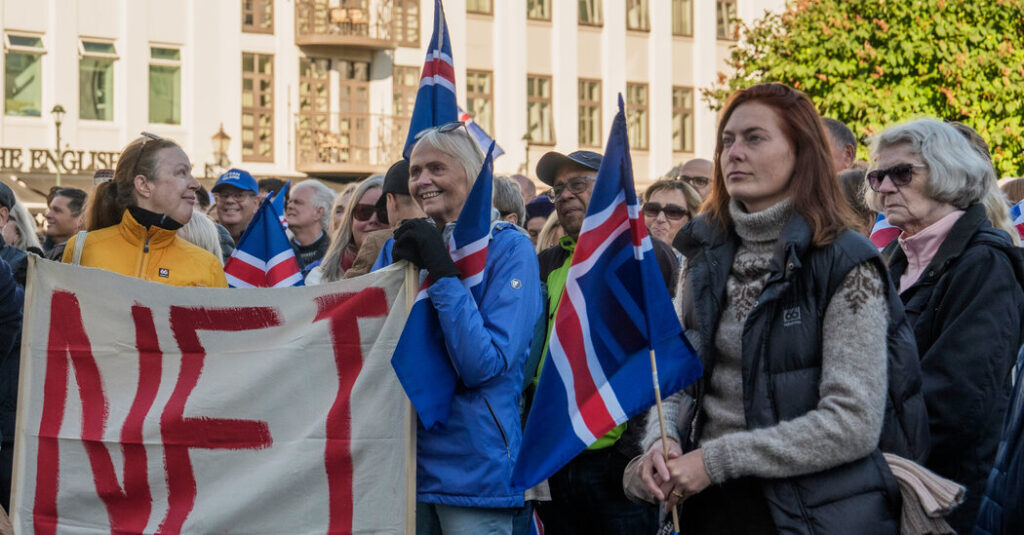
Icelanders are voting on Saturday in a national referendum on whether to restart negotiations to join the European Union, a contentious choice that some see as an essential question about their national future.
Iceland is already closely tied to the 27-nation bloc and follows many of its laws. But many in the island nation of 400,000 people see the referendum as deciding between maintaining Iceland’s independence and seeking the stability and security that the bloc could offer. Polls have shown a near-even split in public opinion.
If Icelanders vote to resume talks, negotiators will work to hammer out a deal, which could take years. Icelanders would then vote again on whether to join the bloc officially as a member state.
Why do some in Iceland want to join the European Union?
Some Icelanders feel that the European Union would offer security in numbers at a time of geopolitical upheaval. Iceland sits at the threshold of the Arctic, where superpowers are vying for dominance. President Trump’s pursuit of Greenland has rattled many in Iceland. (Mr. Trump repeatedly confused “Iceland” and “Greenland” in a speech this year.)
Iceland is the only NATO member that does not have a military. Though the European Union is not a military alliance, it does have a mutual defense clause.
The world is volatile, said Edda Kentish, a 42-year-old Icelandic copywriter, who is voting yes to talks: “We’re small, and that’s not going to cut it now.”
Some Icelanders worry about their financial situation — and their country’s — with inflation stubbornly high.
Many fear that the country’s economy is vulnerable to global shocks because of its small size and its dependence on tourism. Many “yes” voters think that joining one of the biggest economies in the world would bring stability.
Some say they want to see what could happen in negotiations and to keep their options open.
“I’m voting yes because I would like to see what the negotiations hold,” said Bjarki Eiriksson, a 42-year-old teacher. He added that he would vote against joining the European Union in a second referendum if he was not satisfied with a deal.
Negotiations would inevitably be complex and touch on many issues. Fishing would be a major one: It’s a large part of Iceland’s economy, and many Icelanders are unwilling to cede any control over the nation’s waters or its industry to the European Union.
Why are some Icelanders opposed?
“No” voters say they see the European Union as a potential threat to the country’s sovereignty.
Gudmundur Brynjolfsson, 62, a deacon in the town of Thorlakshofn, said he was voting no because he was worried about giving up power to the European Union and creating distance between Icelanders and their decision makers.
“Icelanders can today casually reach out to those in power,” he said. On Facebook, he said, “people even tag the prime minister personally when they are protesting something.”
Some farmers and fishermen are worried that they could suffer under E.U. rules, in part because of increased competition from within the bloc. People in the fishing industry, a major part of the Icelandic economy, are worried it could lose control of fishing rights in waters around the country.
Kolbeinn Helgi Kristjansson, 33, the chief executive of a northern lights tourism company, acknowledged that the European Union could bring economic benefits to some people. But he said Iceland could, overall, lose more from the bloc than it would gain, by giving away its powers.
“It’s like giving someone your lease and just hoping that they’ll treat you right,” he said.
What happens if ‘yes’ wins?
If the referendum passes, Iceland and the European Union will begin negotiations on membership, known as accession. (Technically, this would be a resumption of talks — Iceland started negotiations after the global financial crisis but stopped them over a decade ago.)
Negotiations would inevitably be complex and touch on many issues. Fishing would probably be a major sticking point, though some Icelanders have been heartened by signs that the European Union might be willing to compromise on fishing quotas if it meant bringing Iceland into the bloc.
Any talks could take years. If there is a deal, Icelanders will then vote in another referendum on whether to join the European Union as a member state. There would be other steps: Political leaders would need to approve the agreement, and the Icelandic Constitution would need to be amended before the country could join the bloc.
What happens if ‘no’ wins?
If the referendum fails, Iceland will not start talks with the bloc at this time. It is still possible that Iceland will try to join in the future, but experts say the result would most likely chill efforts to reopen the debate for many years.
When will Iceland have results?
Most polls close at 10 p.m. local time on Saturday (6 p.m. Eastern time).
The first numbers will probably start to come in as early as 10:30 p.m. local time (6:30 p.m. Eastern) on Saturday, according to RUV, Iceland’s national broadcaster.
Although the country’s six constituencies are expected to release their own results throughout the night, the National Electoral Commission plans to release the nationwide result around 12 p.m. local time on Sunday (8 a.m. Eastern).
Egill Bjarnason contributed reporting from Husavik, Iceland.
The post Icelanders Are Voting on E.U. Membership Talks. Here’s What to Know. appeared first on New York Times.