There are no actual dance steps in “Esplanade,” but it’s one of the most electrifying dances ever made. The audacity of its abandon, the ordinariness of its movement, the bliss of its structure — this isn’t just dancing, it’s flying.
At 50, “Esplanade” is a modern masterpiece.
Paul Taylor, the story goes, had the idea to choreograph the dance while watching a woman chase after a bus. Set to Bach — then, an audacious choice for a modern dance — “Esplanade” (1975) is a study of everyday movement: walking, running, jumping. And sliding: The World Series was on, and Taylor wanted to see if his dancers could slide into home. Bruises came. And blood. After “Esplanade” premiered, Lila York, an original cast member, said, “In every loft in New York City, everybody was throwing themselves on the floor.”
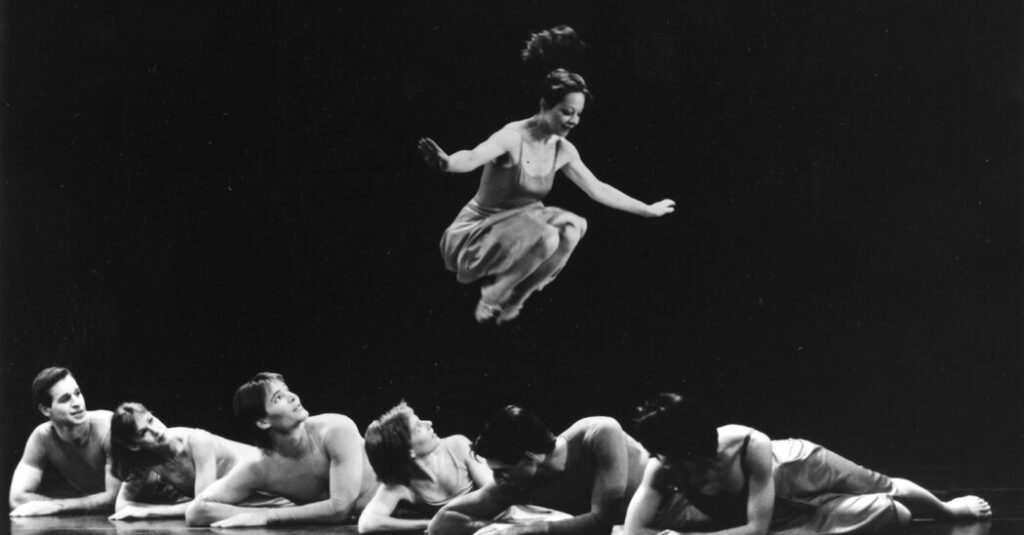
The main group of eight dancers — a ninth appears in the second movement — are a team of interlocking parts as they unite and splinter apart, amplifying the space just as the music amplifies them. As dancers carve and curl across the stage, they slip in and out of melodies, threading through one another like kids on a playground.
Taylor started choreographing “Esplanade” “on a mild afternoon in ’74, not all that long after I stopped dancing,” he wrote in his autobiography. He labored over it, which wasn’t always the case. “Usually he just spat out a piece in three weeks, but this was different,” York said. “He was breaking ground, and he had a lot of doubt about whether it was working.”
Floor-skimming walks and runs call for a deep plié and an uplifted torso that free the shoulders, the head, the neck. The first section, the longest, seems simple, but it’s the most complicated — an intricate labyrinth of walking patterns that Ruth Andrien, an original cast member, said “should baptize the space. We ran like our pants were on fire.”
Here, in the open space of a stage — the esplanade of a theater — Taylor takes a walk that springs into a jog and then a run and transforms it with angles and hops and changes of direction. Circle dances spool into formations like human fountains, and then back into circles — folk dance miniatures, seamlessly sprouting from one to the next.
Nothing is as simple as it looks. In “Esplanade,” Taylor introduced a new movement language, both sophisticated and homespun, related to his early experiments with natural poses. In 1957, he presented a concert, “7 New Dances,” which included “Duet.” In it, Taylor stood close to a seated dancer for several minutes. That was it. “Nothing taken to its ultimate,” Taylor wrote.
It inspired a critic to publish a review that was only blank space. But Taylor never stopped experimenting with stillness and natural postures. “With no dance steps for us to hide behind,” he wrote in his autobiography, “the sequences are revealing us as people. Undisguised, our individual traits are laid bare.”
This is the magic of “Esplanade.” We see human beings. And we see movement that is already in our bodies, movement that is part of us as people.
In the second section, referred to in Taylor company shorthand as “the conversation,” the mood is somber, hushed. (York has called it “a broken family.”) It unfolds slowly as Taylor explores states of stillness and everyday postures with dancers shifting their weight and focus like living sculptures. Taylor told Bettie de Jong, the original central woman (in pants), to think of it as a haunted house, that she shouldn’t look at the other dancers. She looks through them.
“The weight shifting, it’s not just stillness,” Carolyn Adams, an original cast member, said. “It’s what happens when you shift your weight from one foot to the other. The direction of your focus is huge. So it’s minimalist, but it’s also very complex.”
Momentum picks up in the third movement with dancers banking around corners and soaring into the air like they’re taking turns hopping over a fence.
Later, a soloist, originally Adams, swirls and glides, moving forward and back with birdlike, fluttering feet. At one point during the creation of “Esplanade,” the company was in residence at Lake Placid, N.Y. Adams took skating lessons in her spare time. Taylor told her to stop because she was going to get injured, but she wouldn’t. “You don’t have to stop and turn around,” Adams said of skating. “You’re in the curve, you just keep gliding through the change of direction.”
That became a solo of sheer delight in which a dancer curls and contracts as if she’s caught and pulled by a breeze, spinning from one direction to the next until, in the final moment, she stops, crosses her arms and one foot over the other.
She chases the men, the men chase her until she is alone, but instead of running into the wing, she leaps into the arms of a man, who catches her — like a baseball landing in a mitt.
The catch that ends the third section introduces slow walks in the fourth, as dancers are cradled and swung — tenderly, sweetly — until, gradually, they tip higher and higher.
As partners are exchanged, the stage is dusky until the last couple makes its way off the stage and a new dancer, a woman, leaps into the air, slides to the floor and rolls to her feet: She cracks the space open.
In the studio, the slides were brutal. But that was necessary: “The whole idea of making something impossible and turning it into a system, a completely doable system that still looks life-threatening, is fun,” Adams said.
In the fifth section, when the dancers spill onto the stage in slides that feel like waterfalls, something happens: Taylor eradicates the line between dancer and viewier. It no longer feels like you’re passively watching, but that you’re doing.
If you haven’t felt it yet, you’ll feel it now: One of the most thrilling moments in “Esplanade” is the solo originally created for the fearless Andrien. In rehearsal, Taylor instructed her on where to run, where to fall, where to twist, where to slide. She was new to the company; the other dancers hid behind the piano, and suddenly Andrien realized she was alone. Taylor, she said, paused and “like Humphrey Bogart, took a drag on his Carlton light and said, ‘Well, kid, looks like you got yourself a solo.’”
A bit later comes a section known as “the passion and the pain” that is loaded with dance history. Here, is a humorous nod to Martha Graham — to the angst and suffering of early modern dance. (Taylor danced in Graham’s company.) A woman falls to the floor, twists her torso and clasps her hands in front of her as she gazes up to the heavens: “It’s like if Pina Bausch and Martha Graham got really excited,” Michael Novak, the company’s artistic director, said. “That’s passion and the pain. It has this wildness to it.”
As “Esplanade” draws to an end with windswept falls to the floor, the dancers plant themselves on the stage, reinforcing their collective voice.
And then the circle returns. It changes direction and forms a line into the wing until one final dancer remains, turning this way and that as if still lost in motion until she stops, facing front. She steps forward, opening her arms, like a plane that has landed — at last! — on the runway. And that’s a wrap.
Video via American Dance Festival.
Dancers: Maria Ambrose, Michael Apuzzo, Lisa Borres Casey, Kristin Draucker, John Harnage, Madelyn Ho, Devon Louis, Christina Lynch Markham and Heather McGinley.
Gia Kourlas is the dance critic for The Times. She writes reviews, essays and feature articles and works on a range of stories.
The post Fall for Modern Dance With This Masterpiece appeared first on New York Times.