A chemical tank at a paper plant in Washington that imploded and killed 11 people in May was deemed at risk of failure nearly a year before the disaster, according to federal investigators.
In a preliminary report released on Friday, the investigators said that Nippon Dynawave Packaging, the owner of the plant, had hired a private firm to inspect the tank in July 2025.
Inspections that month found “significant thinning” in the walls of G Tank, which held a caustic mixture of sodium hydroxide and sodium sulfide.
The inspection firm, which also conducted follow-up inspections in October 2025 and February 2026, recommended that Nippon Dynawave conduct an internal inspection of the tank and make repairs.
But according to the new report from investigators with the U.S. Chemical Safety and Hazard Investigation Board, the company “did not internally inspect G Tank or make any repairs to the tank’s shell between the July 2025 inspection and the May 2026 incident.”
Instead, Nippon Dynawave continued using G tank and did not reduce the amount of liquid stored or the frequency with which the tank was used.
The liquid mixture is used in the process of turning wood chips into bleached paper pulp for packaging such as milk and juice cartons. The 1.2 million-gallon tank was installed in 1987 at the Longview, Wash., plant.
In a note sent to employees on Friday, Nippon Dynawave president’s, Matt Peerboom, said the federal report did not include important context and details about how the company handled plant safety before the disaster. He noted that investigations into workplace accidents like the Longview explosion can take several years and urged patience.
“We hope that all agencies share our commitment to allowing a full investigative process to proceed and establish a complete and accurate record before conclusions are reached,” he wrote. “We will continue to communicate transparently with the investigating regulatory agencies.”
Leaders of the union that represents Nippon Dynawave’s Longview employees said the preliminary report was “deeply troubling” and that the families of victims “deserve a complete accounting” of how and why the tank was still being used.
Kyle Findley, a lawyer representing the family of two brothers who died in the implosion, Tyler and Bradley Covington, promised “to work tirelessly to ensure those responsible for this horrific accident are held accountable and their families receive justice.”
Federal and state investigators are still trying to determine the precise cause of the May 26 implosion. A disruption elsewhere in the plant had driven the level of liquid in the tank to about 90 percent of its capacity when it imploded, according to the federal report.
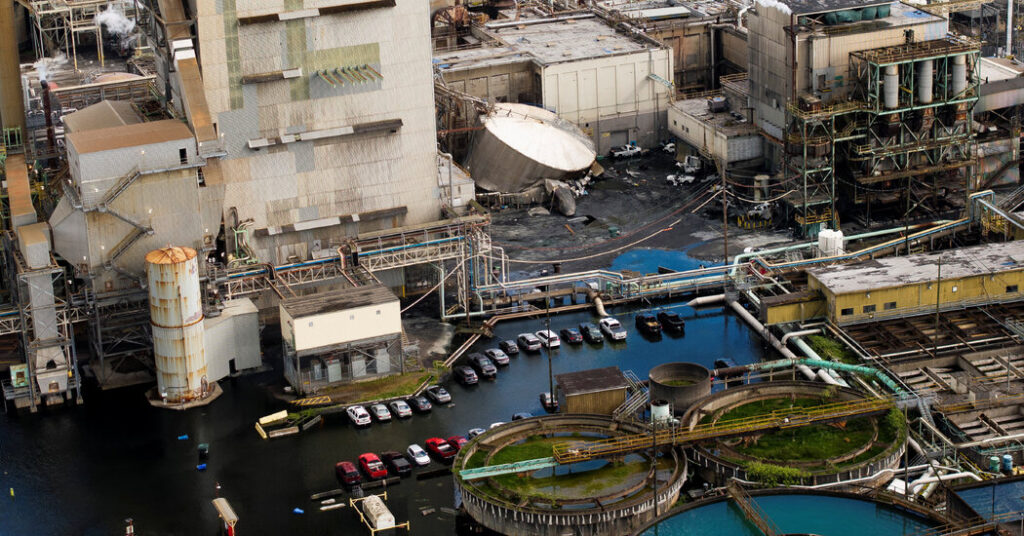
The tank stood in a courtyard near several maintenance shops, locker rooms and an employee break room. When its walls failed, a wave of white liquor heated to 200 degrees flooded the courtyard, crushing several vehicles and rolling into the lower floors of surrounding buildings.
All 11 workers who died suffered severe chemical burns; one also suffered blunt-force injuries and another died partly from asphyxia.
Federal investigators said Nippon Dynawave’s initial call for emergency assistance from the company’s internal medical team did not warn them that liquid had spilled. One person attempting to rescue a worker in the courtyard waded into the liquid, believing it was water, and suffered serious chemical burns.
Nippon Dynawave employs about 530 people at the plant in Longview, Wash., about 45 minutes north of Portland, Ore., along the Columbia River.
The spill also sent liquid into the plant’s storm water and wastewater systems and nearby drainage ditches of the small city. Some contaminated water bypassed treatment and flowed into the Columbia River, while larger amounts collected in nearby ditches, contributing to widespread fish deaths.
During the cleanup, the local public works department flushed the contaminated ditches with water and pumped the runoff into the river.
Earlier this week, Washington state environmental regulators made an initial determination that Nippon Dynawave Packaging had committed 35 environmental violations related to the spill and its aftermath. The company has 30 days to respond before the state decides whether to impose fines or take other enforcement action.
The post Tank That Imploded, Killing 11, Was Known to Be Unsafe, Report Says appeared first on New York Times.