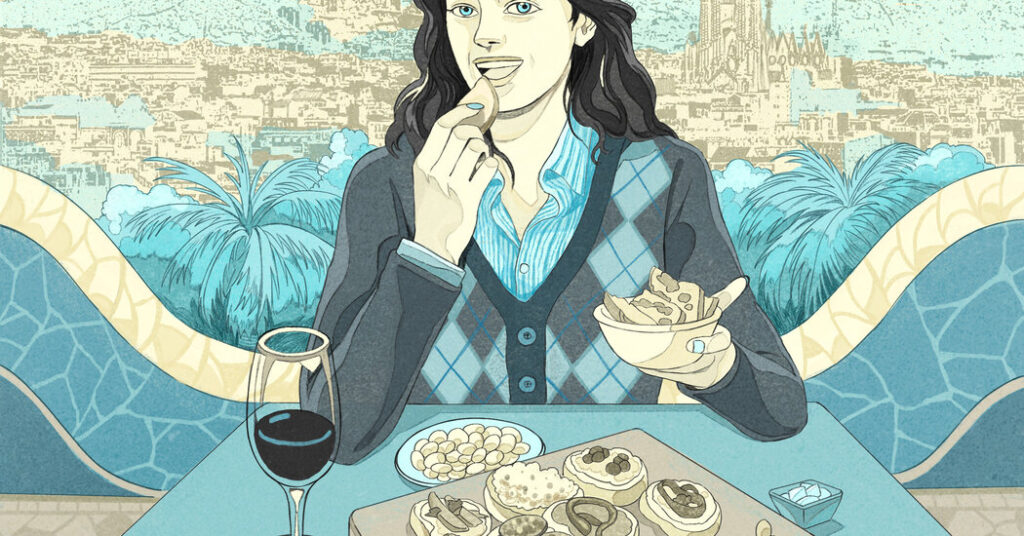
Everyone has different priorities when it comes to traveling: Some people just want to relax. Others want to spend a few hours in a museum or fill up their suitcase in the shopping district. And some of us care most about eating, and eating well.
Out of all of those options, figuring out where to dine can feel like a tougher task: There’s only one Prado Museum, but there are countless tapas spots across Madrid. The first step is to breathe — it’s impossible to visit every amazing restaurant, cafe or bar a city has to offer in a dozen visits, let alone one.
Instead, focus on what’s important to you. The food writer and recipe developer Carla Lalli Music once planned an entire vacation around the pursuit of great croissants. Anthony Bourdain would head straight to the central market of an unfamiliar city, calling it the best place to “get a sense of what a culture loves most dear” — and no doubt endearing himself to a vendor and gathering some choice recommendations.
I like to spend my first afternoon on the ground scrolling through the “Following” tab of a chic coffee shop’s social media account. As it turns out, cool coffee shops tend to follow cool restaurants and bars. Here are more tips from well-traveled food writers on how to track down great dining options, whether you’re the type to make reservations months in advance or play things a little more fast and loose.
Ask the locals
While its easy to make a snap judgment on a restaurant based on Google or Tripadvisor reviews, locals know the dining scene best — especially the beloved haunts where the service is great, the drinks are cold and a table is easy to come by.
Regan Stephens, a writer based in Philadelphia and a co-founder of the travel guide site Saltete, researches local experts before she hits the airport. She recommends restaurant critics, cookbook authors or food tour guides.
“I’m seeking out the people on the ground who’ve lived in the destination and know it better than anyone else,” Ms. Stephens said. She follows them wherever they write: their social media accounts, local publications, even Substack newsletters.
If you’re feeling particularly brave, you can even send an email or a direct message asking if they have a Google map or list that they share with friends and family — and more often than not the answer is yes, Ms. Stephens said.
This method also translates well to in-person interactions. Ms. Stephens will strike up a friendly conversation with a barista, a bartender or an employee at a small shop (“as long as they’re not in the weeds” and dealing with a barrage of customers, she said). Many are more than happy to share their favorite spots with a friendly tourist. But her personal preferred source for an accessible and delicious meal in a different city? Taxi drivers.
“If you were to drive somewhere right now on your lunch break, if you’re about to get off work and meet your friends,” she asks, “where are you going?”
Always be researching
For Lyndsay C. Green, the restaurant and dining critic for The Detroit Free Press, seeking out restaurants for her travels is her “first call of action anywhere I ever go,” she said.
She saves up recommendations year-round, using Instagram’s bookmark function to save posts into folders organized by city. “I really just try to find where real people are going.”
For instance, Ms. Green visits New York City a few times a year, so she keeps a running list of leads. “Then I can refer to it whenever I’m there,” she said. And as a self-identified “Last-Minute Charlie,” she said keeping a running list rather than starting from scratch makes the planning process less stressful. A week or two before she lands, Ms. Green goes through her list, makes reservations and creates a list or Google map of the more casual spots she wants to visit that won’t require a reservation.
Learn to spot a tourist trap
Not all touristy restaurants are bad: Many New Yorkers still heartily endorse the more than century-old Katz’s Deli, even with the line of out-of-towners snaking down the block at all hours of the day.
But not every restaurant is Katz’s. Ms. Stephens of Saltete, for instance, generally avoids restaurants that display pictures of what’s on the menu in the window. “They’re obviously just geared toward tourists,” she said, “to make it easier for them to come in and choose, especially if it’s a place that is outside of the U.S.”
Eric Asimov, a wine columnist for The New York Times Food section, is even more blunt: “This may seem obvious, but touristy restaurants are especially prevalent in touristy areas.” He suggests looking in “neighborhoods less overrun with tourists.” Avoid the areas around the Eiffel Tower in Paris; think the Montmartre neighborhood instead. “And to avoid waits, make reservations whenever possible.”
Susmita Baral, a senior travel editor for Travel + Leisure, agrees that standing in line to eat — which cuts into your time spent exploring — is not a fun activity.
“You have to be willing to wait, and more often than not, like, is a meal worth waiting in line for?” Ms. Baral said. “For me, no.”
Book a food tour
You don’t have to be an internet sleuth or a well-connected food writer to maximize your dining experience. Ms. Baral recommends booking a food tour as part of your trip, on a site like Airbnb Experiences. Guided tours with a local are a great way to learn in an informal setting: “You can ask about dishes that you should try or heritage cuisine or local cuisine that maybe isn’t as mainstream to travelers and tourists,” she said.
A food tour is also an excellent way to learn key phrases and local etiquette. On a recent food tour in Osaka, Japan, Ms. Baral not only got a taste of the city’s dining scene but also learned how to carry herself as a tourist. “She taught us how to order a beer at a bar,” she said of her guide. “She taught us how to yell and say, ‘Excuse me.’ And how to order for two versus one.”
Her only regret? That she didn’t book the tour on the first or second day of her trip.
Follow New York Times Travel on Instagram and sign up for our Travel Dispatch newsletter to get expert tips on traveling smarter and inspiration for your next vacation. Dreaming up a future getaway or just armchair traveling? Check out our 52 Places to Go in 2025.
Nikita Richardson is an editor in the Food section of The Times.
The post How to Choose a Restaurant When You’re Traveling appeared first on New York Times.