Robert Zaretsky teaches at the University of Houston and author most recently of “Chasing Happiness: Stendhal and the Art of Living.”
“Everyone is, was, or will be Gaullist.” Rarely has the famous quip by André Malraux, the French novelist, adventurer and France’s first minister of culture, been truer than it is today.
For the past few months, France has been gripped by what commentators are calling “gaullo-nostalgie” — a hankering for Charles de Gaulle, World War II hero and president. He was one of the rare individuals whose life, as Malraux also remarked, was equal to his myth.
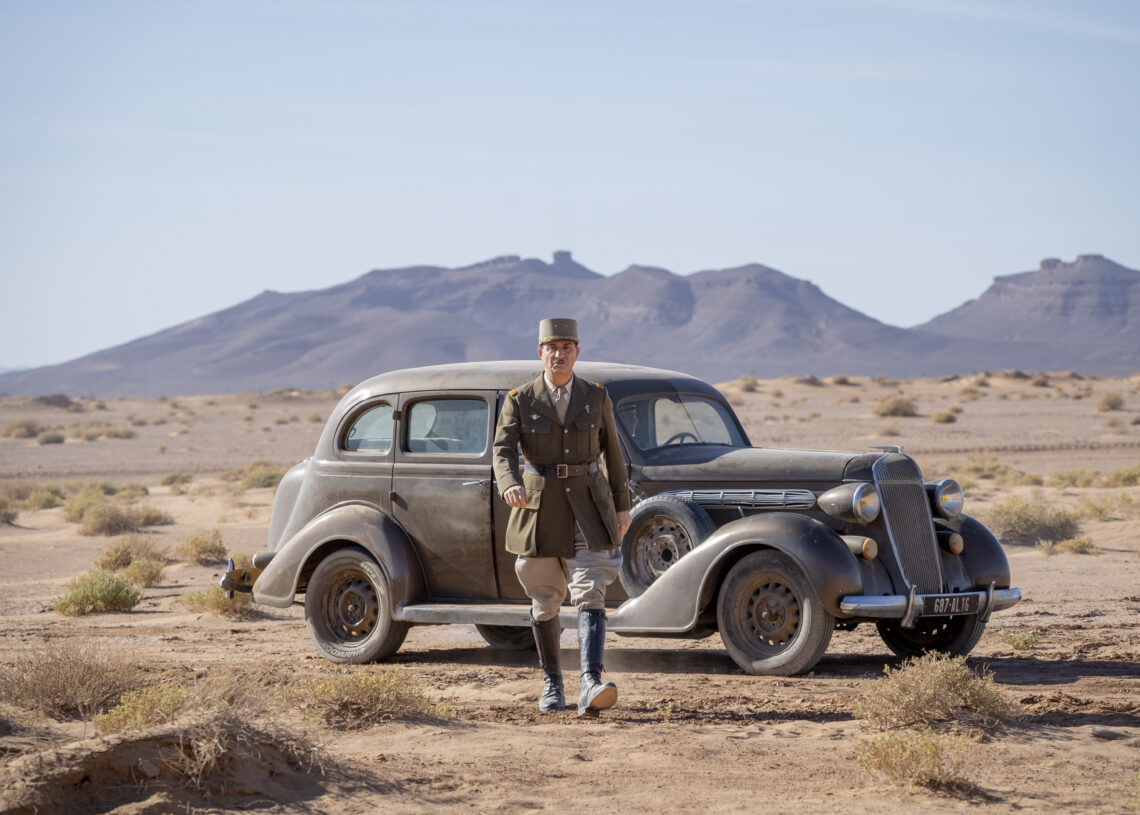
The release this summer of Antonin Baudry’s box-office smash two-part biopic, “La Bataille de Gaulle,” has helped to fuel this surge of nostalgia. (The first part, “L’Âge de fer,” was released a month before the second part, “J’écris ton nom.”)
Admittedly, the film — based on Julian Jackson’s magnificent biography of de Gaulle, “A Certain Idea of France” — has not drawn as many viewers in France this summer as Christopher Nolan’s blockbuster “The Odyssey,” which has already racked up nearly $70 million at French box offices.
Yet Baudry’s film can be seen as offering a fascinating riff on the Homeric epic, one that has resonated with more than 4 million viewers. After all, it tells the story of a man, de Gaulle, whose longing for home — the Greek “nostalgia” combines the words nostos, or “homecoming,” and algos, or “pain” — is realized only after a series of death-defying challenges that culminates in a bloody confrontation with barbarians occupying his land.
The film traces the arc of de Gaulle’s career from 1940, when, as a still largely unknown army general who has won one of the few battles against the Germans, he is flown by a prescient Winston Churchill to London, where he launches the Free French Forces. The film ends four years later with France’s liberation by Allied forces — which, critically, include de Gaulle’s troops as well as the interior resistance movement. (The resistance hero Jean Moulin, whose remains were interred at the Panthéon in 1964 under the watchful eyes of de Gaulle and Malraux, also has a prominent role in both films.)
During his lifetime, the obdurate and outspoken de Gaulle was an intensely divisive figure, inspiring as much distrust and dislike as he did conviction and admiration. Since his death in 1970, though, his reputation has remained consistently positive with the French public.
Earlier this month, an Ipsos-BVA poll revealed that 87 percent of respondents in France agreed that de Gaulle embodies the ideal of a political leader, with roughly 40 percent agreeing that the political values he best represented are “the spirit of resistance” and “ability to forge a unified people.” In a 2025 poll that asked which former president of the 5th Republic they wished could return to office, 55 percent of respondents chose de Gaulle, nearly double of the runner-up, the Gaullist Jacques Chirac.
It is not a coincidence that this swell of Gaullist nostalgia among the French is happening while waves of record-shattering temperatures and forest fires ravage vast swaths of the country. The prospect of spending five hours — the combined length of the two films — in an air-conditioned cinema was, perhaps, as welcomed by Parisians as was the sight of de Gaulle striding down the Champs-Élysées in 1944.
Moreover, the menace of intense heat wave and firestorms evokes the existential threat of the Nazi invasion and occupation in 1940. It is no accident that, during a visit to Bormes-les-Mimosas, one of the southern towns devastated by the fires, Macron invoked the Gaullist spirit. After denouncing the pessimism of “our so-called intellectual, political and financial elites today whose defeatist spirit resembles that in 1940 and led to France’s subsequent military defeat,” Macron hailed the “resistance” displayed by the French in their struggle against the fires.
Just as much of France’s physical landscape has been rendered unrecognizable by the fires, its political landscape has also been reshaped in recent years. In fact, the latter has changed so dramatically that one of the parties now claiming the Gaullist legacy, the Rassemblement National (National Rally), is the same one that, at its birth 50 years ago as the National Front, was virulently anti-Gaullist, as well as antisemitic and anti-Muslim. Though its former leader, Marine Le Pen, had rid the party of its worst elements, she retained the deep xenophobia of the party’s founder — her father, Jean-Marie Le Pen.
While half of respondents in the Ipsos-BVA poll believe there are no political figures today who can legitimately claim to be de Gaulle’s heir, the other half are split: The two political figures who rank highest as his inheritors are Le Pen, with 13 percent, and her second-in-command, Jordan Bardella, with 14 percent. Most other presidential pretenders — from the extreme-left’s Jean-Luc Mélenchon to the traditional left’s Raphaël Glucksmann to the traditional right’s Edouard Philippe — make claims for his legacy that do not resonate.
In “Fallen Oaks,” his account of a conversation he had with de Gaulle shortly before the latter’s death, Malraux declares, “You were alone on June 18” — the date in 1940 de Gaulle made his famous BBC address to the French — “and you are alone today. Perhaps that was the way it had to be.”
Of course, de Gaulle cannot again ride to France’s rescue. But the applause that often erupts in French theaters at the end of Baudry’s film suggests that de Gaulle is not alone. His countrymen still rally behind his example in these tumultuous times.
The post France has fallen in love with its most famous president again appeared first on Washington Post.