Big-time college football’s season begins on Saturday. Before the other professional league, the NFL, becomes a distraction, consider three propositions.
Football is a mistake. Bodies, and especially brains, are not built to withstand its repeated collisions. Culturally, college football scratches the human itch for tribalism, which America’s ethos of individualism fortunately discourages. And big-time football attached to higher education is, suddenly, educational.
It is teaching us two reasons the federal government grows: Many people demand this. And so, too, do society’s big battalions, when distressed. A discombobulated cartel — the college football industry — needs Congress’s help restoring order after the sudden emancipation of the working class: the players.
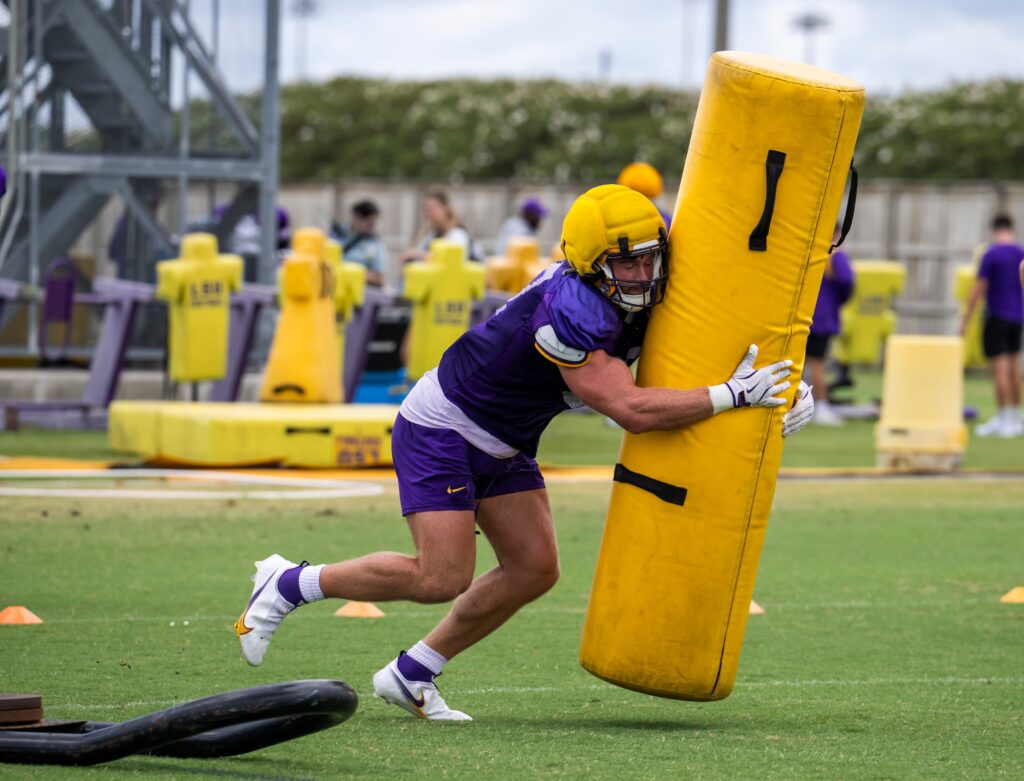
It is unlikely that fans’ enthusiasm for football will be dampened by this week’s New York Times report that at least 1 in 4 NFL players might expect to eventually suffer neurodegenerative brain disease (which can include impaired cognition, mood swings, erratic behavior, addiction, even suicide) as a result of the game’s kinetic energies. Up to five years of college football are now permitted for players by the NCAA’s new rules. That time is probably enough to put at risk even players who do not graduate to the NFL. This week, the Southeastern and Big Ten conferences discovered a limit to their permissiveness: They stopped LSU — a rogue football program, akin to North Korea — from recruiting two players who had suited up for NFL preseason training but wanted to return to college. There, the money is more certain, and sometimes better.
Eligibility rules can, however, be made ever more permissive by those who write them. The writers are universities and sports conferences who are in a financial arms race. But arms control might be coming, from Congress.
College athletic departments have become entwined with money-raising “collectives” through which donors finance on-field success. This, say some industry participants, can require $5 million (at least) annually for quarterbacks who direct $40 million rosters.
For elite football programs, success means surviving deep into the playoffs. These began in the 2014 season with four teams, then in 2024 expanded to 12. They might soon include 24 teams. Otherwise, fans of teams that lose, say, a third regular-season game will lose interest, the exercise having become pointless with the playoffs out of reach.
But even at just 12, there can be mismatches: Sports are meritocratic, and unless players’ freedom is circumscribed, merit will move toward the highest bidders. Such as Ohio State, which will receive about $17 million a year for putting Chase Bank logos on the uniforms of its players in 36 sports.
Under today’s almost-no-rules regime, the strongest few get stronger faster than their pursuers. Pity the University of Arkansas, a pursuer.
Arkansas is home to Tyson Foods and Walmart, but has the nation’s fourth-lowest median household income. The Athletic’s Seth Emerson reports that the school’s athletic director says: “We have per capita, I think, the greatest depth of billionaires of any state in the country, but per capita, we have kind of the shallowest pool of millionaires.”
Can Arkansas compete with, say, Georgia and Florida? It cannot, without help from Congress.
Athletes exercising free agency through the “transfer portal” is a recipe for the supremacy of the few financially fittest football programs. Congress might ride to the rescue of the many by mandating competitive balance in the form of a nationwide spending cap covering all sports at each school. This is part of the Protect College Sports Act drafted by Ted Cruz of Texas and Maria Cantwell of Washington, Republican chair and ranking Democrat, respectively, on the Senate Commerce Committee.
Before becoming finicky about Congress surely having bigger fish to fry — wars, deficits — acknowledge two things. College football certainly is interstate commerce. And more people care about it than about the Iran war.
If players are generating many millions for schools, are they employees of their institutions? If so, is collective bargaining next? One certainty is that the cloying vocabulary of “student-athletes” and “amateurism” has been retired.
The college sports cartel flourished for a century in what was, for it, an Edenic paradise: Profits from broadcasting soared; labor cost the cartel approximately nothing. Now, however, it is in the interest of a majority of schools, players and fans to limit the players’ pay and free agency in order to protect competitive balance.
Beneath the roar of stadium crowds, you might soon hear a sigh of contentment from the college football cartel as it is resuscitated by Congress. Take such satisfaction as can be had from this evidence that Congress can fix, sort of, something.
The post The addled college football cartel wants to huddle up with Congress appeared first on Washington Post.