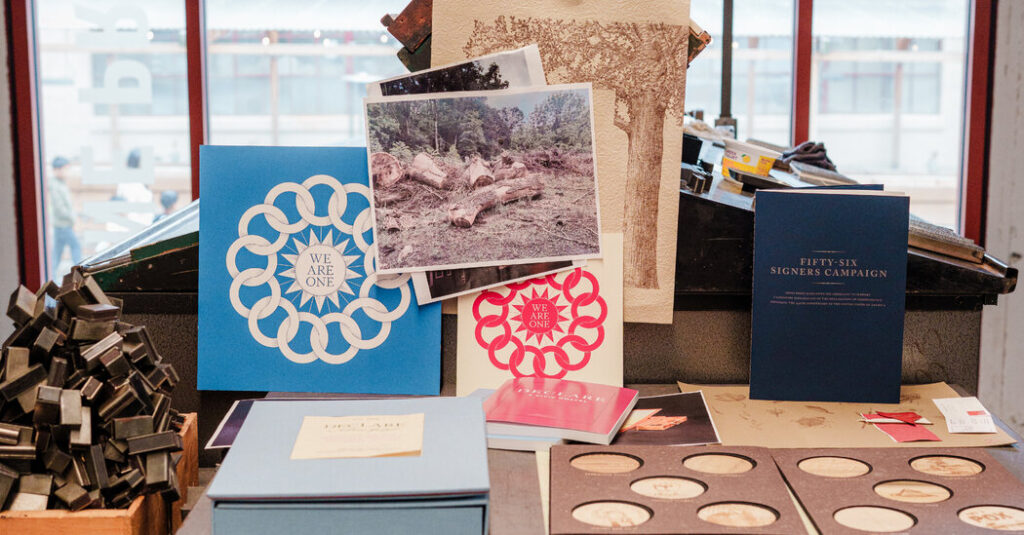
Arion Press, a fine-press publisher housed in a former military post turned arts hub in San Francisco, seems about as far as you can get from Ye Olde Colonial Print Shop. Upstairs is a robotics lab. Out the windows are sweeping views across the water toward the Golden Gate Bridge.
But earlier this year, as the country’s 250th birthday approached, its artisans were busy creating an elaborate tribute to the Declaration of Independence, using processes that would not have been unfamiliar to the printers who rushed to get the breaking news out to the world on July 4, 1776.
Arion bills itself as the only printer in the country that makes books entirely by hand under one roof, from casting metal type to printing pages to binding them together into exquisite volumes prized by collectors. Not that their latest product — titled “Declare: A Civic Gospel” — looks much like a book.
At first glance, it’s a simple blue box. Inside, reflections on the nation’s founding document are stacked like layers in a complex 250th birthday cake. On top is a bound collection of poems and essays. Underneath, there’s a broadside copy of the Declaration’s preamble and, in two pullout trays, a set of artist-designed medallions, made from the wood of trees that stood at Monticello in Jefferson’s lifetime.
All together, the project, available in a resonant 250 copies, involved the labor of more than 50 writers and artisans. Ted Gioia, Arion’s program and development director, called it “E Pluribus Unum in boxed-up form” — a rarefied product (priced at $3,000 a copy), but one grounded in a deep belief that democracy is the work of many hands.
“America was founded in an act of printing,” Gioia said during a tour of the press this spring, midway through production.
“Our independence wasn’t just declared,” he added, “it was crafted.
‘From Comma to Cover’
Recent years have seen a surge of interest in letterpress printing and other traditional book arts. But few places are as dedicated to making books the old-fashioned way as Arion, whose slogan is “from comma to cover.”
Its foundry arm, M&H Type, is one of a handful in the United States that still casts new metal type. Arion is also home to one of the country’s largest collections of antique metal type, second only to the Smithsonian’s.
Arion was founded in 1974 by Andrew Hoyem, a poet turned printer, at a moment when a renewed fine-press movement had begun marrying old-fashioned techniques to an artist-driven aesthetic that transcended fusty gentleman’s-library stereotypes.
If there’s a signature project (and a white whale for collectors), it’s still Arion’s 1979 edition of “Moby-Dick,” featuring 100 woodcut engravings by Barry Moser and 576 oversize pages of text set entirely by hand. More recent collaborators have included Kara Walker (illustrating “Porgy & Bess”), William Kentridge (“The Nose”) and Tim Hawkinson (“Frankenstein”).
Arion’s books — they typically do three titles a year, in editions of about 200 to 300 — may not come cheap. But even those prices don’t cover Arion’s $5 million annual budget, which is subsidized by donors.
“No one has made money doing this ever,” said Blake Riley, who started 25 years ago as an apprentice and is now Arion’s creative director. “And yet it persists.”
The collaboration with Monticello, as it happens, began with literal dead trees. In 2024, as they mulled a project relating to the 250th anniversary of the Declaration, Arion’s team heard about a stock of wood from two 200-year-old tulip poplars at Monticello that had stood near the house in Jefferson’s lifetime but had been taken down because of disease.
The press connected with Jane Kamensky, the president of Monticello. Initially, she recalled, Arion mostly “wanted the wood.” But as they traded ideas, the project expanded to include an ambitious book of reflections on the Declaration from writers of various backgrounds, disciplines and political perspectives.
Some of the artists and 16 participating writers (who include the historian Jill Lepore, the poets Rita Dove and Arthur Sze, and James Mattis, a retired Marine Corps general and former secretary of defense) traveled to Monticello for a study day, meeting with historians, archaeologists and arborists.
“I think they are the only group of dignitaries we’ve ever taken to our stump dump,” Kamensky said.
The Declaration, Kamensky writes in her introduction, is itself a kind of “national tree,” with roots in Enlightenment philosophy and branches that have grown in directions its signers did not imagine.
“There have been a lot of commemorative projects this year,” Kamensky said. “But this is a chance to think in both directions and ask: What content is lasting?”
The project also digs into the material history of the Declaration. The box, with its multiple drawers and compartments, is a riff on Jefferson’s portable writing desk. The red binding of the essay volume (also available from Monticello as an inexpensive paperback) was inspired by Jefferson’s personal Bible, and his preference for simple books “of a handy size” and free of “typographical luxury.”
For the broadside, Tré Seals, known for custom typefaces inspired by civil rights leaders and protest movements, went with Caslon, the same typeface used by John Dunlap, the Philadelphia printer who created the first printed copies of the Declaration on July 4, 1776.
The medallions were inspired by some 18th-century peace medals, used for exchange with Native American and other diplomats.
One designed by Chip Kidd includes the words “And a pox on King George!” (a homage to a slogan shouted every year in the Connecticut town where he used to spend July 4). One by Charles Gaines juxtaposes the words “Tree of Liberty” with “Fruit of the Poplar” — a reference to a lyric in the anti-lynching song “Strange Fruit.”
The project may seem to carry an edge of protest, particularly in this “No Kings” moment. Gioia said he sees the blend of voices in “Declare” as more of an “optimistic polyphony.”
Protest is “part of being a citizen,” he said. “But being a citizen is also about being in conversation with other perspectives and trying to find that more perfect union.”
Kissing the Page
Since moving to its current location in the Fort Mason Center for Arts and Culture in 2024, Arion has become more public facing, offering bimonthly tours as well as events across the country (including one at the New York Public Library on Sept. 23, where the audience can see a copy of “Declare”). On a beautiful day in May, the 10,000-square-foot space mixed a scruffy steampunk vibe with the quiet focus of a laboratory.
In the foundry, Brian Ferrett, the production manager, explained the intricate process of creating lines of type. In Dunlap’s day, type was pulled from drawers piece by piece by typesetters, who laid out pages one letter at a time. “Declare,” like most of Arion’s books, was cast using a Monotype system, a 19th-century technology that vastly sped things up, by casting the letters and laying them into full lines of type by machine.
In an original Monotype system, the text is typed into an oversized keyboard, which generates a paper strip punched with tiny holes the caster can read, player piano style. At Arion, the vintage caster is controlled by a digital interface.
Getting from the Tetris-like pattern on Ferrett’s computer to press-ready pages includes many adjustments. “It might look good digitally, but you don’t know until you get physical proof,” he said.
Next door in the press room, Joel Benson, the production manager, warmed up a vintage single-cylinder Heidelberg press and then pulled a few sheets of “Declare.”
Contemporary letterpress printing often features a notable “bite” into the page — a gesture that highlights its letterpress-ness, in contrast to offset or laser printing, which layer ink on top of the surface. But traditionally, letterpress printers, wary of eroding the type, have sought a lighter “kiss impression.”
“There’s a correct amount of ink where it just sings,” Benson said, holding a sheet up for inspection. “If there’s not enough, it can look a little sharp, a little weak. If there’s too much, it’s a little bolder. If you get it just right, you get that perfect letter form — perfect letters, the way they were designed.”
Incised type has “a shimmering quality, a bit of a dance to it,” Riley added. “Our bodies are tuned to respond to that.”
In the bindery, Megan Gibes and Jocelyn Lee were working amid stacks of carefully prepared materials lined up like ingredients in a restaurant kitchen. But “Declare,” like most projects, also involved some on-the-fly adjustments. Riley pointed to a pile of red-leather bits — some of the 700 goat-leather tabs created after it was decided there could be a more elegant way to pull out the trays of medallions than just gripping the sides.
“Notice I’m not laughing,” Gibes said, with a wry seen-it-all look, before demonstrating how to thin leather using a vintage skiving machine. “I thought this was most representative of the insanity of the whole project.”
Gibes had yet to read any of “Declare.” Often, the first time she reads a book is during proofreading, which involves one person reading the printed pages out loud, down to every punctuation mark, while a colleague checks it against the proof.
That’s probably how it was done in Dunlap’s print shop. Gibes, with apologies for “getting meta,” drew a connection between her work in the bindery and the many nameless people whose labors helped create the United States.
“My contribution to this is the skill, the craft,” she said. “That’s what this country was is built on — a bunch of people’s invisible hard labor.”
And typos?
“Oh, our books have typos for sure,” Gibes said. “As perfect as things look, they are not. It’s humans doing all of this — that’s the magic of it.”
The post A Fine Press Makes Beautiful Books the (Very) Old-Fashioned Way appeared first on New York Times.