Augustus Grissett spent three decades running the drug-abuse clinic at a hospital in Queens. His wife, Beverly, toured the world as a folk singer for 20 years. After raising a son and two children from Beverly’s first marriage, they moved in 2005 from New York City to Syracuse.
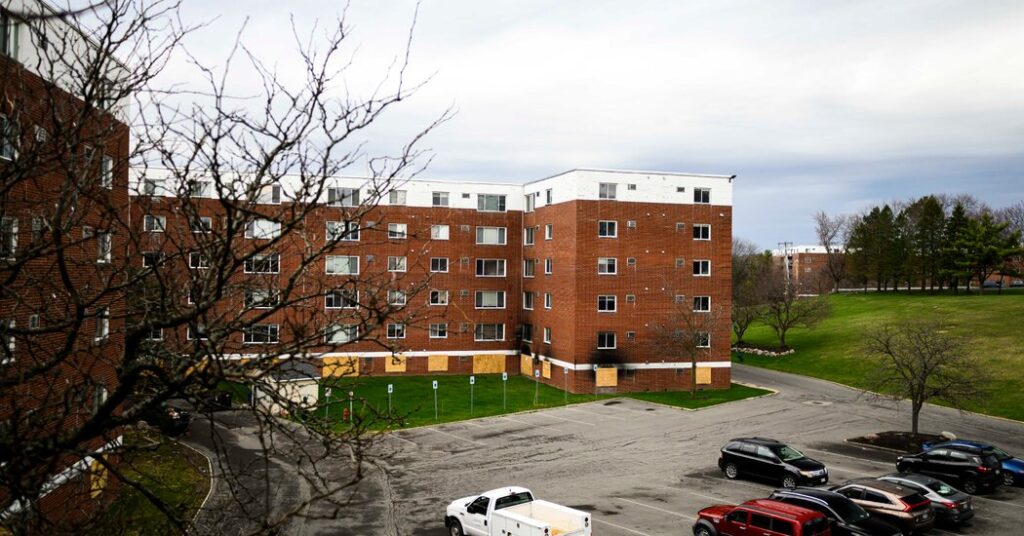
They were thrilled to move into Nob Hill, a sprawling rental complex along the southern edge of the city. With 761 apartments in four buildings spread across 28 acres, the property featured a swimming pool, a gym and well-kept lawns.
Their neighbors were politicians, lawyers, university professors and factory managers.
And around Syracuse, Nob Hill even had a nickname: Snob Hill.
“It was a fantastic spot,” said their son Gus Grissett Jr., who helped his parents move into a ground floor apartment in Building 3. “It was where the elite seemed to live.”
But after 15 years, things at Nob Hill started going downhill.
This January, Ms. Grissett entered the hospital. Her husband, at age 78, was still working full time for a nonprofit and spending the rest of his time at his wife’s bedside. They needed their son’s help, so Gus Jr. flew up from Queens.
He was shocked by what he found. The campus was choked with weeds. Reeking garbage overflowed from dumpsters outside, and trash bags and pizza boxes sat in piles down the hall from his parents’ door. Nearby units were supposed to be vacant, but Gus Jr. heard people inside them, bumping around. He assumed they were squatters, taking advantage of broken doors to seek refuge from Syracuse’s bitter winters.
In his parents’ apartment, the faucets emitted black and green ooze, and the radiators were cold. Building managers offered a space heater, but the elder Mr. Grissett refused, worried about the risk of fire. The apartment was so frigid that he slept in his clothes, including a winter hat.
“It was beyond disgraceful,” Gus Jr. said. “We might as well have been sleeping outside.”
Ms. Grissett died this Valentine’s Day. Her son stayed for another two weeks and then flew home to New York to prepare for her memorial service in Queens. His father would take the train to New York three days later, on Feb. 28.
Early that morning, after years of complaints from tenants about growing fire risks, a fire broke out inside Nob Hill’s Building 3. In the apartment where the fire started, firefighters found a body.
How did one of the largest and most desirable apartment complexes in New York State deteriorate so precipitously?
To nearly everyone who witnessed its decline, there was a clear answer: A private equity company bought it in 2018 and ran it into the ground.
Everything started to change, tenants and city officials said, when Nob Hill was purchased by an investment group based in Santa Monica, Calif.
At first, tenants said, it was small things: The grass went uncut and the pool was often closed. Then in 2022, conditions declined significantly. Uncollected garbage overflowed from dumpsters and trash chutes, and the elevators failed. Broken locks were never fixed, inviting squatters to occupy vacant apartments and do drugs in the lobbies.
Nob Hill acquired a new nickname: Slob Hill.
Meanwhile, maintenance was performed by five different management companies over four years. Every time a new manager took over, tenants said, their long-neglected maintenance requests seemed to disappear.
“Things there fell apart,” said Syracuse’s mayor, Sharon F. Owens, who visited relatives who lived at Nob Hill in the 1990s.
The situation became untenable in 2025. Tenants sued Nob Hill’s owners for uninhabitable conditions, and the city of Syracuse sued for code violations. This July, Letitia James, the attorney general of New York, weighed in with another lawsuit, citing “rampant negligence and violations of tenants’ rights.”
The owners responded with a countersuit, accusing one of the property managers of allowing Nob Hill to spiral out of control, and accusing the city of hampering efforts to fix it up.
“My son and I are serious, thoughtful real estate owners, investors and operators,” Patrick Nesbitt, Nob Hill’s largest shareholder and leader of the private equity company that purchased the complex in 2018, said in an email. In court filings, he stressed that the ownership group was kept in the dark about the state of the property. “Unfortunately, Nob Hill has been an unmitigated disaster from almost the beginning of our ownership.”
In court, tenants expressed fear that the combination of squatters, faulty electrical wiring and failed fire safety systems could lead to disaster.
At one hearing, Sean Stanyon, a tenant who lived in the same building as the Grissetts, testified that the fire alarms and smoke detectors were regularly out of order.
“I’m afraid to sleep at night in case there’s a fire,” he told the judge.
Weeks later, a fire broke out in Mr. Stanyon’s building as he slept.
Skin in the Game
Nob Hill was completed in the early 1970s. By 2018, the longtime owners were looking to sell. Nicholas Sinatra, a real estate developer based in Buffalo, learned of the opportunity through a local real estate company, he said. An investment broker introduced him to Mr. Nesbitt, a hard-charging real estate developer whose company, Windsor Capital Group, owned shopping centers, hotels, apartments and office buildings around the country. He lived on a 43,000-square-foot estate in Montecito, Calif., with stables for 17 horses and a regulation polo field.
After hearing Mr. Sinatra’s pitch about Nob Hill, Mr. Nesbitt recruited two of his friends to invest. Teodoro Calle, whose family owns an Ecuadorean construction company, came to own 13 percent. Fred Fellows, an investor in West Palm Beach, Fla., bought 8 percent. Mr. Sinatra also became a minority investor, taking a 4 percent stake. His firm, Sinatra & Co., assumed the role of overseeing the property.
The purchase of Nob Hill was part of a flood of similar deals in 2018 in which private equity firms bought apartment complexes across the country, said Jim Baker, executive director of the Private Equity Stakeholder Project, a Chicago-based nonprofit that tracks private equity apartment deals.
Nob Hill’s sale price of $58.5 million made it one of the most expensive sales in Syracuse history. But because 90 percent of the money came from a $51 million loan backed by Fannie Mae, the government-controlled mortgage finance company, Mr. Nesbitt and his fellow investors faced little financial risk if the investment failed.
“Why this is emblematic of private equity ownership of housing is that, from the beginning, the ownership group had limited skin in the game,” Mr. Baker said. “They never had much to lose. Most of the risk falls on residents and the broader public.”
The business plan was common among private equity firms: make some improvements, then sell at a profit in five to seven years, according to one of the investors. “The goal was not to cut costs,” Mr. Calle said in a recent phone interview. “It was to invest a substantial amount to make it better, and try to improve the occupancy and the tenants.”
Soon, however, Nob Hill fell apart.
“This is not good.”
Bruce Hare always had fond memories of Nob Hill. He moved there in 2001, into a one-bedroom apartment with two bathrooms and a terrace, for $1,200. The place was well kept and close to Syracuse University, where he was a sociology professor.
“The pool was beautiful,” Mr. Hare recalled recently.
He left Nob Hill when he married in 2020, then moved back in 2022, after his divorce. Soon after he returned, he realized things had changed. One of the two elevators in his building wasn’t working. The lawns were overgrown, and the pool was rarely open.
“I thought, ‘This is not good,’” he said.
Also in 2022, the Nesbitts removed Mr. Sinatra as the property’s manager, though he remained a minority investor. Nob Hill’s owners would cycle through four more management companies in less than four years.
“I was no longer in charge of operations,” Mr. Sinatra said, “and that’s when the property went south.”
In interviews and in court, tenants agreed that conditions worsened after Mr. Sinatra was no longer involved. As garbage went uncollected for months, pests invaded. Common areas were rarely cleaned, and elevators reeked of cat urine.
More seriously, fire safety systems failed. Some fire doors were nearly impossible to open, tenants said, while others rarely stayed closed. Smoke detectors, fire alarms and emergency lights broke across the campus. The Fire Department grew accustomed to frequent false alarms at Nob Hill. Michael Monds, the Syracuse fire chief, ordered special emergency response plans drawn up for each of Nob Hill’s four buildings.
“We knew it was going to be challenging if there ever was a fire,” Mr. Monds said.
The first lawsuit against Nob Hill’s owners was filed by the City of Syracuse in April 2025, followed the next month by a raft of suits brought by tenants.
Nob Hill’s owners stopped making mortgage payments in June 2025, and Fannie Mae sought to foreclose. In February 2026, Judge Shadia Tadros of Syracuse City Court ordered the owners to make repairs, and ruled that tenants could withhold rent until the problems were solved.
“For many of the tenants, Nob Hill was more of a nightmare than a home,” Judge Tadros wrote. “Some of the conditions noted are the worst this court has seen. The complete disregard of tenants’ living conditions would be deemed criminal if not for corporate protections.”
Judge Tadros signed her order on Feb. 27. Before the sun rose the next morning, Nob Hill’s Building 3 would erupt in flames.
Scared, cold, vindicated
The smoke detectors in Sean Stanyon’s apartment were broken. So when the fire started, he slept right through it.
He realized there was a problem only a half-hour later when Jack, his Pomeranian, wouldn’t stop barking. When Mr. Stanyon got out of bed, his apartment was thick with smoke.
“We’ve got to get out of here!” he said to his roommate before placing Jack in a bag and heading for the exit. The hallway was dark and silent. No fire alarms, no emergency lights. He slowly felt his way down three flights of darkened stairs and escaped to the parking lot.
He felt scared, cold and vindicated — his warning in court about the risk of fire now seemed unnervingly accurate.
When firefighters arrived, at around 4 a.m. on Feb. 28, they searched the perimeter of Building 3 and found flames leaping from the windows of a first-floor apartment. Nob Hill’s managers had provided a list of tenants, but fire officials quickly realized the list was wrong — many of the residents who had fled the building and were huddled in the parking lot did not appear on it.
The night before his mother’s memorial service, Gus Jr. called his father and reviewed the plan for his trip to New York. His father’s dark suit was laid out; he would pack his laptop and charger in the morning. He would drive to the train station, where a friend from work would see him off. He was still in mourning, his son knew, but he was looking forward to seeing relatives and old friends in New York.
“Everything seemed to be fine,” he said.
Gus Jr. called his father at 7 a.m. to make sure he was awake and ready. Mr. Grissett did not answer. A couple of hours later, Gus Jr. received a call from Syracuse. It was his father’s co-worker, calling from Nob Hill. There had been a fire. She stood in the parking lot surrounded by fire trucks.
Inside Apartment 128, where the fire started, firefighters had found a body. Nob Hill’s manifest described the apartment as unoccupied, so fire officials presumed the body was that of a squatter.
Gus Jr. knew: It was his father.
Mr. Grissett died in his apartment of smoke inhalation and thermal injuries, according to fire department investigators. Gus and Beverly were buried together on March 31, their 57th wedding anniversary.
The post How a Private Equity Group Drove an Apartment Complex Into the Ground appeared first on New York Times.