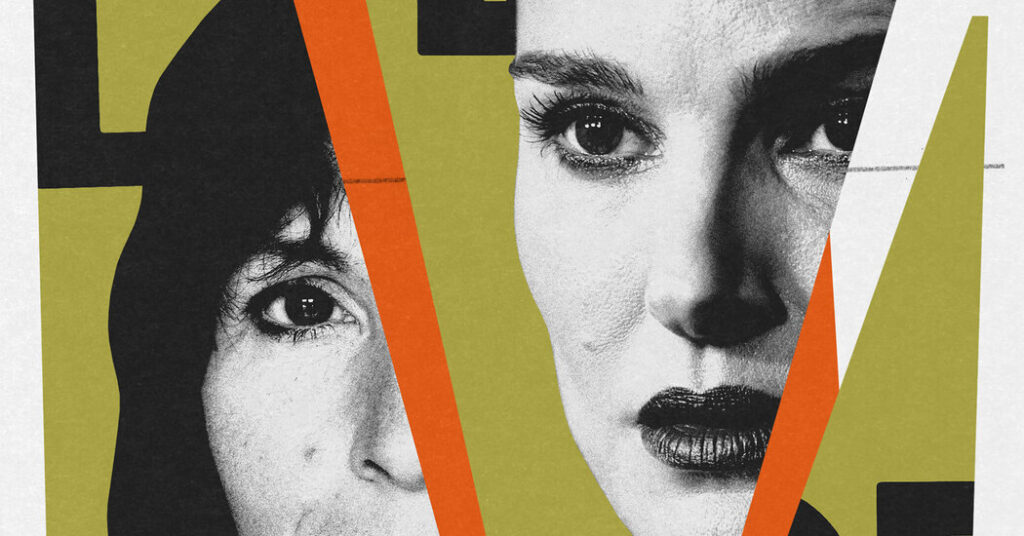
To accompany the startling news of this summer — the freakish weather; the apparent confirmation of the existence of “diamond rain” swirling inside Neptune — a slight, minimalist novel has become unlikely tabloid fodder.
The writer Rachel Cusk’s supposed portrayal of the actress Natalie Portman in “Life of M” has been called “a literary assassination” and the “literary scandal of the year.” In the novel, an A-list actress known only as M invites a novelist to write her autobiography, which becomes the book we are reading. (Portman and Cusk both live in Paris, where they are acquainted.) The details closely mirror Portman’s life and public statements — the frightening sexualization she experienced as a child actor, the pain of a public divorce — and are arranged, in a careful, somber style, to produce a portrait of the actress as big, dumb doll; pampered and pretentious; wholly incapable of love, originality, moral consideration, even real feeling. Sealed away in her comfort and privilege, M possesses no relationship with reality or semblance of interior life. Her existence is a form of walking death.
Cusk is well known for her sharp pen and slashing style, and no stranger to this very sort of scandal. She is a writer who can work up a fine fit of scorn for a pizza: “It is like a smiling face: It assuages the fear of complexity by showing everything on its surface,” she wrote in her memoir “The Last Supper” (2009). The initial run of that book was pulped when Cusk was sued for libel after a character in it recognized himself in an unflattering portrayal. (The publisher settled the suit.) Still, “Life of M” has given some readers pause. The impression the novel leaves, according to The Telegraph, “is of an author pulling the limbs off a person one by one, as a child might do to an insect, with no regard whatsoever for the creature’s suffering or sense of self.”
Cusk has pointed out, in response, that artists frequently portray public figures without inciting such outrage. Fair enough: The Todd Haynes film “May December,” which Portman starred in and co-produced, was criticized for the liberties it took in its interpretation of the relationship between Mary Kay Letourneau and Vili Fualaau. Furthermore, in the annals of literary treachery, Cusk’s offenses seem relatively minor. Take any Saul Bellow novel, any Robert Lowell poem. Philip Roth caricatured his ex-wife, the actress Claire Bloom, in not one but two novels, with details that were bagged and tagged from life.
Cusk has said that she felt entitled to a story like Portman’s because when “famous people enter the public imagination,” they become a kind of public property — it is part of the contract of fame. But if the author believes she is subject to special scrutiny among her contemporaries, it might be for the simple reason that fiction inspired by real-life figures has often been written in the service of adding complexity, depth and humanity — see Curtis Sittenfeld’s “American Wife” (2008) on Laura Bush or Gabrielle Zevin’s “Young Jane Young” (2017) on Monica Lewinsky.
By now, the roman à clef, as a genre, tends to provoke a set of familiar, slightly stale debates: Who owns the facts of a life? What is the relationship between artifice and reality, license and theft? What immunities does the artist possess, what does she claim? And my own question, plaintively: Must we? Yet again? Can we agree that there are no definitive answers (but we promise to settle the issue once and for all the next time this debate rolls around)?
One doesn’t want to trade in generalities, not when it comes to this case; it is Cusk one wants to talk about, the particular and thorny ire she inspires, and the spirited defense. She keeps finding herself here, struggling to defend her work and eliciting such articles. In a recent interview with The New York Times, Cusk insisted that she hadn’t expected any controversy, as blankly as Buster Keaton might mug for the camera before stepping on a rake. How, then, are we to understand her particular talent for trouble?
I once heard Cusk speak in Paris, at the sort of literary event she is famous for skewering — those parades of authorly self-commodification. She spoke haltingly, weighing her words, and then suddenly veered off, into an odd tangent. She envied those who perform menial work. Bus drivers, for example. Imagine the simplicity of those lives, I recall her saying — “to go home and be done with work for the day.”
I copied down her words, marveling at the condescension. She had lost the room and seemed to know it. She vaped discreetly and slumped a little in her chair. “Life hasn’t been very fun for me.”
The unheralded martyrdom of the novelist! To understand Cusk and her relationship with criticism requires little in the way of literary detective work. She is one of those writers invested in her own mythology, and often truthful about her motivations. For Cusk, a writer is someone trapped in childhood, trying to see its truth. In her essay collection, “Coventry” (2019), she describes being punished for her outspokenness by her parents, who would stop speaking to her. She was sent to boarding school, which she seemed to interpret as exile. Banishment and silencing are her great themes and patterns.
From the start, even her admirers could not deny her “mix of scorn and compassion,” as Hilary Mantel put it. Cusk’s work has been repeatedly criticized for its snobbery and insistent, almost obsessive cruelty about other people’s appearances, and fat and fleshy bodies specifically. Her memoirs — “A Life’s Work” (2001) and “Aftermath” (2012) — now regarded as feminist texts and praised for their honesty, had her branded as a sadist and narcissist; she was pilloried for admitting to the loneliness and difficulty of early motherhood, for exposing the private lives of her children, for being unfair to her ex-husband. “My mode of autobiography had come to an end,” she said in a 2014 interview with The Guardian. “I could not do it without being misunderstood and making people angry.”
She performed a vanishing act of sorts, returning with an entirely new style in her influential “Outline” trilogy, writing from an “annihilated perspective,” through a narrator who seems to passively collect and report other people’s stories. “‘Outline’ is the essentially defensive position of saying, Well, you can’t hurt me, because I don’t exist anymore,” Cusk said. The novels were praised for their innovation, for forging a form of storytelling without the contrivance of traditional character and plot. The novels were darkly funny, too, full of caricatures of other well-known novelists — reportedly Jonathan Franzen, Karl Ove Knausgaard, Damian Barr — gassing away with self-importance.
In comparison, “Life of M” is a lost little book — undisciplined, unfocused and instantly forgettable. The New Yorker deemed it Cusk’s “weakest novel.” The true faults with the book turn out to be less ethical than technical. Cusk may have jettisoned the conventional narrative lumber of character and scene, but she replaced them with a series of pieties and poses all her own that, with time, have started to feel strained, the characters who sound the same and speak in portentous tones about fate and chance, the fetishistic descriptions of interiors, the inexplicable shifts in point of view.
Stripped of the scandal, the book has little life of its own. It will fade. But some of the questions it raises about harm ought to linger. Cusk’s champions insist “Life of M” isn’t cruel or exploitative but an exploration of cruelty, an invitation to consider, in complicated ways, the nature of exploitation. In this view, it is not Cusk but the callow reader who is guilty of harm by projecting upon Portman her own feelings of affront, who is too stupid to see that it is not Cusk but the narrator who is responsible for this cruel portrait. To the critic Molly Young, “It seems impossible that a person of functional literacy could take ‘The Life of M’ as an act of Cusk-on-Portman violence.”
Challenge accepted! Writing wounds. Why pretend otherwise? And why would the author render the subject of her novel so identifiable if, on some level, the attempt to wound wasn’t meant to provide a spectacle, a frisson, of its own?
As for Cusk’s claim that anyone in public life is fair game, let’s see how she has set the terms when she was the vulnerable party. For she has written and spoken extensively of seeing a version of herself she didn’t recognize in the public imagination, seeing her words twisted, the facts of her family life distorted, and her work misrepresented to suit a writer’s ends. What words does she use? It is “careless, self-congratulatory brutality,” she has said. It is “violence.”
Across much of Cusk’s work, the artist is valorized as the person who dares to say what others cannot or will not. The artist is upsetting. She causes a scene.
There is a totemic, recurring episode in the “Outline” trilogy in which a strained moment between adults that seethes with unspoken tensions is suddenly interrupted by a child who, for reasons unknown even to herself, commits a magnificent and senseless act of destruction. The child rips her mother’s dress, strikes a sibling, sends a glass shelf crashing to the floor. She makes visible what the adults would like to keep concealed; her body and mind cannot hold the hypocrisy.
The child who felt banished for her outspokenness now, by virtue of her vocation, considers it her obligation to stand apart. “There are so many writers who I, rather unkindly, think of as luvvies, who all hang out together,” Cusk once said in an interview. “And you can see that some writers’ talents are fed by great exposure to society and then there are others — D.H. Lawrence is a good example — who think they want acceptance but actually they can’t stand it and they’ve got to annoy people by pointing out uncomfortable things, and that’s more me.”
Can we point out something uncomfortable in turn? Cusk is curiously invested in portraying herself as an outcast and controversial figure. As the critic Clair Wills noted in a review of “Coventry”: “There is so much in these essays about being disliked — by her parents, by her readers, by her ex-husband, by her friends — that this performance of being shunned itself calls out for interrogation. We could interpret her insistence on her own unpopularity as proof of her worth. The more people complain about her, the more ‘true’ she is being.” To such an artist, any scandal becomes proof that she has struck gold, illuminated an unarticulated conflict and paid the valiant price. Persecution becomes proof of integrity.
Cusk’s method has been to metabolize outrage into the energy required to create a new form. A character in “Transit,” her angriest novel, and the one I love best, could be commenting on these cycles of creative repetition: “We examine least what has formed us the most, and instead find ourselves driven blindly to re-enact it. Maybe it’s only in our injuries, he said, that the future can take root.” Can it still? “Life of M” suggests that this cycle, this impulse to destructiveness, is no longer as generative as it once was.
Portman, currently expecting her third child, has remained notably silent regarding “Life of M.” The only person directly involved in this affair to publicly express any distress or outrage has been, in fact, Cusk herself. An author justly acclaimed for her inventiveness has produced a scandal like no other. She is its perpetrator, victim and beneficiary.
Source images for illustration above: Christopher Polk/WWD, via Getty Images; Ulf Andersen/Getty Images.
The post Rachel Cusk Tried to Caricature Natalie Portman. She Only Caricatured Herself. appeared first on New York Times.