It’s easy to think that there was nothing vibrant about Black New York until the Harlem Renaissance came around.
A captivating new book sets us straight on that: “A Moment in the Sun: Black Manhattan Before the Civil War,” by the historian Shane White (who is Australian, as it happens). He captures Black life in Manhattan from the 1820s through the 1850s, and pays particular attention to the copious court records of the period.
It was a brief, shining moment. After the 1850s, significant immigration from Europe reduced the Black population to only 1.5 in 100 New Yorkers, and the real estate crunch segregated Black people into poor, isolated neighborhoods. To be Black was to struggle for work with legions of foreign but white competitors, with anti-Black bigotry increasingly implacable.
Of course, even in the time White writes about, racism was deeply a part of Black life. Eligibility rules made it all but impossible for Black people to vote. An ever-looming threat, for one, was slave catchers trying to recover escaped slaves or even capture free Blacks. But to a Black person alive then, life was more than that, and the sheer and shining strut of the culture at the time should speak to us as well.
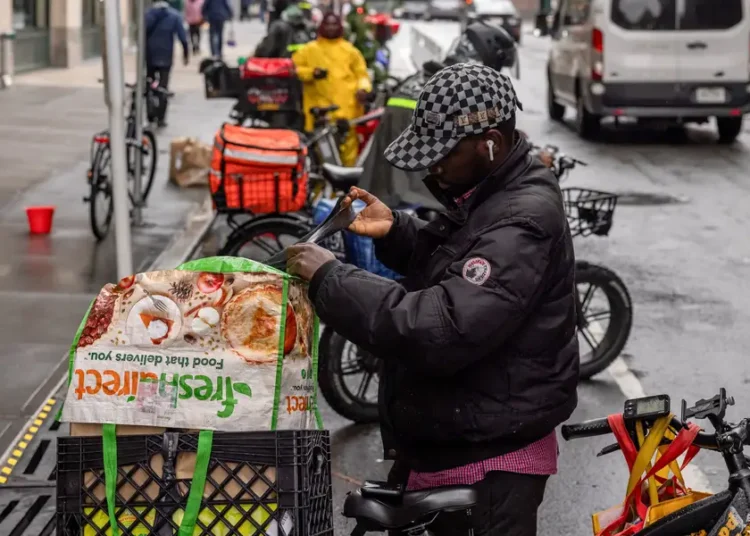
Slavery ended in 1827 in New York, and it became what White calls an “amalgamated city.” Outsiders were often struck by the prominence of Black New Yorkers, who made up about 5 percent of the city at the time. Between white and Black, interaction was constant (and romances were hardly unheard-of). With the exception of Seneca Village, far uptown where today’s Central Park is, Black people did not yet live in separate neighborhoods from white people. At a time when oysters were central to the American menu to an extent so counterintuitive today, over half of New York’s oyster sellers were Black. Newly free Black people often tended toward the boisterous, refusing to make way for white people on the street any longer. Nightlife was on fire, with dressy, rambunctious balls and underground dance dives all about noise and courtship, often mixing white and Black.
On July 5 each year, Black people had a parade to celebrate their freedom, a day after the national independence celebration. To be a Black New Yorker meant knowing that every Sunday morning, you might gather with a big Black crowd at Catherine Market in Lower Manhattan to watch Black men developing tap dancing while competing for a good string of eels, and that after church you would join the grand promenade on Broadway where le tout Black New York would amble about in resplendently colorful attire, regardless of social station.
“A Moment in the Sun” is a potato-chip book; I could barely put it down. This was indeed an early Harlem Renaissance — just less about the page, and happening without recording technology.
And as such, we can’t hear New Yorkers of that era speak, which of course I was thinking about, especially as I have spent the summer doing some research on earlier Black English. The book gave me one of two swell findings I’d like to share.
Today, most Black New Yorkers have Black English as part of their speech repertoire. But Black English was a Southern creation, and Black people brought it north during the Great Migration from the South starting in the 1910s. Before the Civil War, Black New Yorkers born there sounded pretty much like white people. White notes that an Englishwoman was surprised to hear that Black New York women “express themselves in good language, and with an enunciation, as bold and clear as any Englishman,” as opposed to the minstrelese parodies of Black speech she had seen based on the dialect in the South.
But then, this “bold and clear” — i.e., mainstream — speech that Black people used as well as white people was not what is familiar to us. As I have written here, the British accent we know now had only just come to exist in the 1820s, an ocean away from New York. Until around this time, Americans and Brits sounded pretty much the same. But vowels are always changing, and those of American English in 1820 were not quite ours.
Benjamin Franklin once proposed a new alphabet to indicate the sounds we actually make (there are 26 letters for about 43 sounds). Describing how words were pronounced, he accidentally gave us a listen into how he, and many Americans, actually spoke. What he describes is not the British accent we know today — but then, in some ways, not ours, either. One of the oddities is that where today we say “ah,” what Franklin shows is that back then, they said something more like “aw.” For “pot,” not “paht,” but more like “pawt.” And this explains why Black women selling hot corn on New York streets in the 1820s were described as calling out “h-a-u-t corn.” That is: “hawt.” We would wonder just what accent this was — Caribbean? African? Nope — just ordinary Northeastern American in 1820.
Also, this summer I found proof of something about early Black English I have been chasing forever. In the 1930s, writers under the Works Progress Administration were sent to interview ex-slaves. There survive hundreds of interview transcripts, and they are full of people using “am” not only with “I” but with “you,” “he,” “she,” “we” and “they.” You am; they am.
This usage of “am” was seized upon by minstrel performers as an indication of stupidity. Between this, the fact that seemingly no Black person is even depicted as using it after the 1920s and how plain bizarre it sounds today, experts on the dialect have supposed that no actual Black people used “am” this way, especially as none other than Zora Neale Hurston wrote that they didn’t.
God bless Hurston, but I have noticed so much evidence that some Black people actually did use “am” that way that I have kept digging. One ex-slave recorded in 1940 gave us one peep of someone saying, “That sure am a pretty dress.” But she was telling a story, performing. It could be that this was what linguists call ludic speech, only used in fictitious language, just as “Is You Is or Is You Ain’t My Baby?” is a ludic take on how an actual Black man would address a woman.
An academic needs more, and I ran across it. We live for this sort of thing. You feel in your bones that something is true, but there is no explicit proof, and your fellow academics — appropriately — hold that against you until you have really brought the goods.
The goods here are that it turns out that white Southerners used “am” in that way. The relationship between white and Black Southern English is as “amalgamated” as the New Yorkers jamming in those cellars before the Civil War. The overlap is huge, with Black influencing white and white influencing Black. (I recommend the historian Melvin Patrick Ely’s “A Terrible Intimacy,” where this linguistic “amalgamation” is illustrated.) Black people would have heard whites using “am” and internalized it themselves, and this is why the ex-slave used it.
In the early 1800s, Anne Royall, a witty woman of Southern origin, traveled the country and described the speech patterns she had heard in each place. She recalled a Virginia lawyer saying, “I ar ready for trial.” Then, “The opposite counsel, whom I believe was Mr. Wirt, rose up, and bowing, replied, ‘Am you, Sir?’” Eureka! I knew of Royall’s account from references to it, but had never bothered to read the actual thing.
And then there is a newsreel from 1929 of a white Southerner born in 1835, Rebecca Latimer Felton. This was someone who learned to speak when the president was Andrew Jackson. She was a politician (by formal appointment, briefly the first woman in the Senate), an ardent first-wave feminist and … a dedicated fan of slavery and lynching.
But honestly, she’s hopelessly dead, and what I want to know is how she talked! And of all things, in the newsreel she says, casually, “Our boys am pleased to see ya.”
Ah, the sense of release. Academia is about searching, revealing the counterintuitive and facing serious critique. It’s what you sign up for, and it keeps you going.
The post As Darkness Approached, Black New Yorkers Found Some Light appeared first on New York Times.