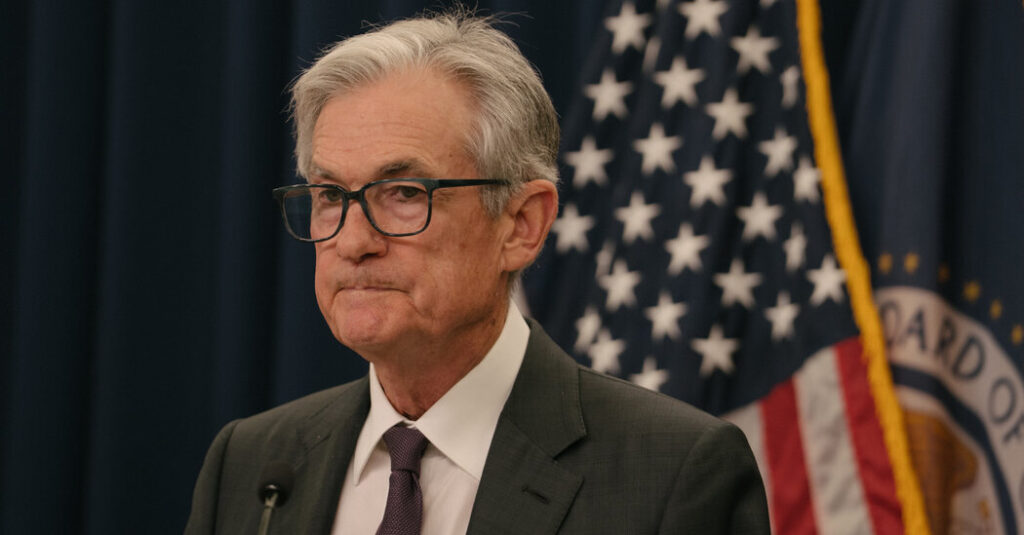
At a congressional hearing in June, Jerome H. Powell touched briefly on his goals for his final year at the helm of the Federal Reserve.
“All I want to do in what’s left of my time at the Fed is to have the economy be strong, have inflation be under control and have a solid labor market,” Mr. Powell told members of the House Financial Services Committee. “I want to turn it over to my successor in that condition.”
Six months later, Mr. Powell is facing a host of economic threats, including resurgent price pressures and stalling jobs growth. That has created a rift inside the central bank about what threat to focus on, shattering the consensus that Mr. Powell had been able to cultivate around interest rate decisions through his eight years as chair.
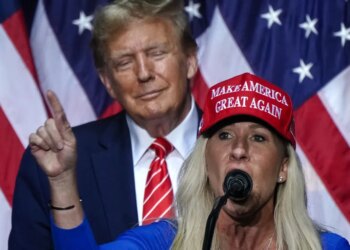
Mr. Powell is also under attack by people outside the central bank — chiefly President Trump, who has spent months browbeating the chair for not slashing borrowing costs. Other broadsides have come from the contenders to replace Mr. Powell when his term ends in May, a list that Mr. Trump said had been whittled down to one front-runner broadly assumed to be Kevin A. Hassett, the White House’s top economic adviser.
It is against this backdrop that Mr. Powell is expected to steer the central bank toward a third-straight interest rate reduction this week at the Fed’s final gathering of the year. What on the surface appears to be a routine decision, however, has been anything but, underscoring the acute challenge that Mr. Powell is up against in his remaining months as chair.
“You can make a perfectly good case for cutting at this point, and you could also make a reasonable case for not,” said Jon Faust, a fellow at the Center for Financial Economics at Johns Hopkins University and a former senior adviser to Mr. Powell.
Such an unusually close call suggests that the Fed could struggle to provide much more relief to borrowers if the economy holds steady, an uncomfortable spot for the politically independent central bank.
“If there aren’t sequential cuts forthcoming, the heat from the president will very quickly ratchet back up,” Mr. Faust said.
A Fractured Fed
Mr. Powell started to sound unnerved around the time that Mr. Trump unveiled sky-high tariffs on nearly all of the country’s trading partners in April. The Fed chair had been relatively sanguine about the economic outlook before that point, refuting worries that stagflation — a combination of higher inflation and slower growth — was at risk of taking root.
Even after the president backtracked on his initial round of tariffs, Mr. Powell started to articulate how the Fed would confront a situation in which its goals of low, stable prices and a healthy labor market were in tension with one another. It would force the Fed to make “what will no doubt be a very difficult judgment” about which to make a priority, he conceded.
The economy has so far avoided outright stagflation, but the Fed appears further from its goals than at the start of the year. Inflation has edged up, and it is unclear if the full effects of Mr. Trump’s tariffs on consumer prices have materialized. Monthly jobs growth has sharply slowed and the unemployment rate has ticked up, even as consumers continue to spend.
That has prompted a fierce debate among officials about where the biggest risk lies and how to set interest rates accordingly. For those more worried about the labor market, an interest rate reduction is necessary to avoid causing undue economic pain. For those concerned about inflation, standing pat is seen as more prudent to avoid inadvertently stoking price pressures and causing inflation to remain stuck above the Fed’s 2 percent target.
Once-unanimous policy decisions have since been replaced by much more fractured votes that have featured dissents in opposite directions. December’s decision is expected to be no different.
Officials have seemingly become more entrenched in their respective positions in part because of the lack of government data caused by the government shutdown, which has limited their ability to get a comprehensive read on the state of the economy.
The balance only tipped in favor of another quarter-point reduction recently, after John C. Williams, president of the Federal Reserve Bank of New York and a close ally of Mr. Powell, signaled support for one. Mr. Williams, who has a permanent vote on the policy-setting committee, joined a powerful group of officials backing a cut, including multiple members of the board of governors based in Washington. Those officials vote at every meeting.
In the other camp sit many of the officials who lead the 12 regional reserve banks across the country and vote on policy decisions on a rotating basis. One of those is Jeffrey K. Schmid, the president of the Kansas City Fed, who cast an official dissent against October’s cut.
Dissents in both directions are once again likely this week. While some officials want the Fed to pause, Stephen I. Miran, Mr. Trump’s pick to join the Fed’s board, has said consistently that he wants larger, half-point reductions.
Opting for a quarter-point cut is likely to prevent an even bigger fight from breaking out, said Ajay Rajadhyaksha, global chair of research at Barclays, who warned that there was a risk of “even more strident dissents” without one.
Such an intense degree of division has prompted some concern that Mr. Powell has lost control of the policy-setting committee. But Richard Clarida, a former Fed vice chair who is now at the investment giant, Pimco, sees it differently.
“The division does not really indicate any sort of discord,” he said. “It just represents a tricky juncture for policy given that the two sides of the mandate are moving in different places.”
Regardless, Mr. Powell will be under pressure to strike the right balance in his messaging about the Fed’s next steps. Mr. Clarida said he expected the chair to make clear this week that further cuts were by no means guaranteed.
“It is important to provide a signal that the committee takes the price stability mandate seriously, which is important to remind people of when you’re cutting rates with inflation around 3 percent,” he said.
Succession Planning
Any suggestion that the Fed is done cutting interest rates will not be well received by the president, who as recently as last month said of Mr. Powell, “I’d love to fire his ass.”
It is a threat that Mr. Trump has wielded many times but is likely to become obsolete as the end of Mr. Powell’s term draws nearer. The Supreme Court will also weigh in next month on the president’s ability to oust Fed officials when it hears a case raised by Lisa D. Cook, a governor whom Mr. Trump tried to fire in August. She has been allowed to stay on in her role as the case is being litigated.
Mr. Trump is expected to name Mr. Powell’s successor early next year. Mr. Hassett, a longtime loyalist of the president, is widely seen as his preferred pick. Since returning to the White House as director of the White House’s National Economic Council, Mr. Hassett has become a mainstay on cable TV promoting the need for substantially lower interest rates despite forecasting strong growth next year.
Mr. Hassett has also amplified his criticism of the central bank, faulting the staff and accusing officials of injecting politics into their policy decision-making. He also questioned at one point if Mr. Powell should be fired over his handling of renovations to the Fed’s Washington headquarters after the costs attracted the president’s ire.
Whoever is selected to lead the Fed will inherit many of the challenges that Mr. Powell is dealing with. For one, the next chair may struggle to deliver the interest rate cuts that Mr. Trump so desperately wants given the split among voting members.
Even Scott Bessent, the Treasury secretary who is also leading the search, acknowledged recently the limitations of the chair’s influence.
“At end of the day, he or she is one vote,” he said last week at The New York Times’s DealBook Conference. Next year, many of the regional presidents who are most vocally opposed to further interest rate cuts will also be voting members of the policy committee, suggesting that the bar for reducing borrowing costs further is likely to shift higher.
Financial markets may also act as a counterweight if investors start to question the Fed’s willingness to control inflation, resulting in exactly the higher borrowing costs that the president dislikes.
“If the data is coming in in a very definitive direction under a new chair, it’s not going to be hard for them to get consensus,” said Ellen Zentner, chief economic strategist at Morgan Stanley Wealth Management. “Where it does become difficult is if chair wants to do something that is clearly not supported by the data.”
Colby Smith covers the Federal Reserve and the U.S. economy for The Times.
The post Powell Faces Pressure From Multiple Fronts as Fed Prepares to Cut Rates appeared first on New York Times.