COLUMBIA, S.C. — The late Lindsey Graham must be giddy in paradise.
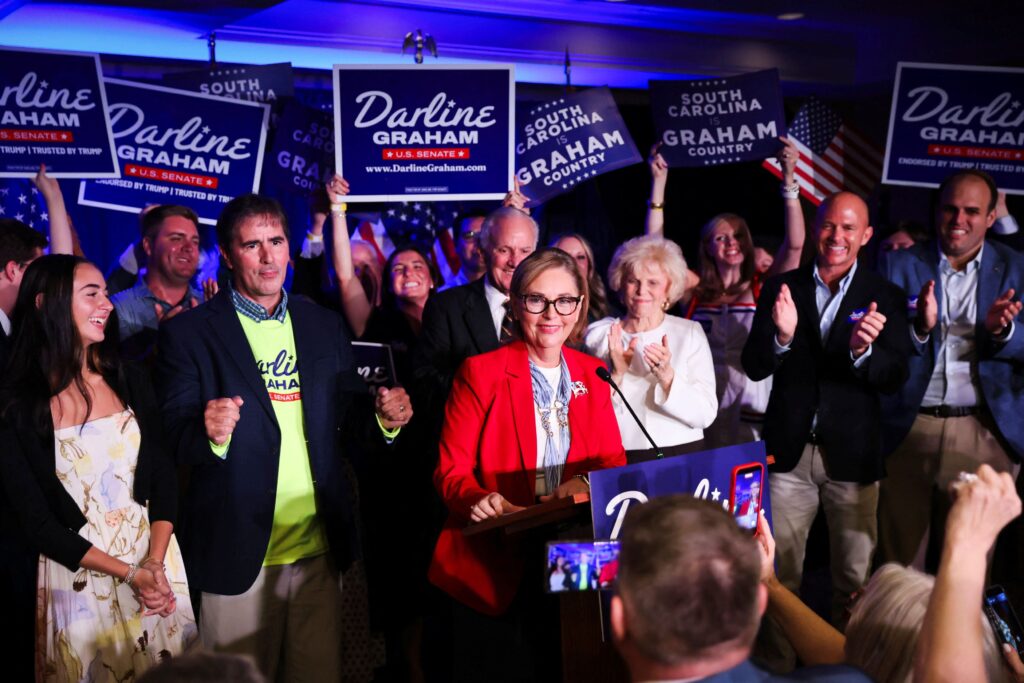
His beloved sister, Darline Graham, won a Republican primary runoff Tuesday for his soon-to-expire Senate seat, defeating U.S. Rep. Ralph Norman, whose noteworthy liability was supporting former South Carolina governor Nikki Haley in the 2024 primary against then-presidential candidate Donald Trump.
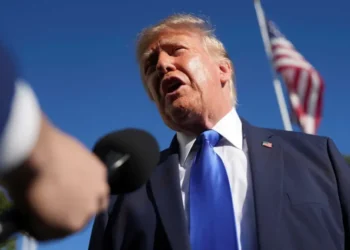
Trump is an elephant when it comes to politics. He remembers his enemies, nurses grudges for long periods and seeks retaliation. Trump’s loyalty calculus apparently doesn’t allow credit for Norman’s willingness to overturn the 2020 presidential election results. (Lindsey Graham voted to certify the election while his sister demurred when asked Monday if she would have.)
Trump’s reinvention of Darline Graham from a relatively unknown state employee into an overnight U.S. Senate candidate is the stuff of political legend. Not only did the president support Gov. Henry McMaster’s (R) decision to appoint her as a placeholder through the remainder of her brother’s term, he also lobbied her to run for the six-year seat. Lo and behold, she accepted his challenge and was camera-ready in no time.
She immediately brought to mind the erstwhile Republican governor of Alaska, Sarah Palin, who was plucked from the moose-hunting fields and dramatically injected into then-Sen. John McCain’s 2008 presidential campaign as his running mate.
Like Palin, Graham has an authentic down-home appeal and relates to people at the kitchen table. But also like Palin, she wasn’t ready for the national stage. When she flubbed the much-discussed question about whether Taiwan and the South China Sea were important to national security, saying that she wasn’t well versed on the subject, the political commentariat probably thought she was doomed. Obviously, not so.
Not surprisingly, Trump has accepted credit for Graham’s victory. A Trump-affiliated super PAC spent almost $800,000 on her campaign. And last Friday he swept into Myrtle Beach, South Carolina, for a rally, telling the crowd: “Pretend, please, that I’m on the ballot.”
Even so, I wouldn’t give Trump all the applause. Keep in mind that Norman had recently been rejected by Republican voters when he sought the nomination for governor. And Graham won narrowly, with 52.5 percent of the vote in the primary runoff against Norman.
Most of the credit goes to the candidate. Perhaps counterintuitively, if you’re not from around here, the smartest thing Graham did was to answer that foreign policy question with candor and without apology. Her simple, direct response was sincere and rang true to her audience.
“I’m just going to be honest,” she said, but then she continued by saying national security “is not my thing.” But, really, why would it be at this point? Graham had barely buried the brother who helped raise her and was rushed to her swearing-in ceremony before she’d had time to grieve. Her mere presence under such pressure is a marvel.
Many, if not most, people recognized themselves in her response to the South China Sea question. Sometimes admitting that you don’t know the answer to a question can earn a candidate as much credit as a pitch-perfect response would. One can learn. What matters more to everyday folks trying to make ends meet is character and honesty, a truth that only magnifies the mystery of Trump’s grip on South Carolina.
No doubt, Lindsey Graham could explain it. He also could have delivered a dissertation on the Taiwan matter, while possibly making us laugh. We shall miss that. His death was a blow to MAGA world and to Trump, who could count on his golfing pal to carry the torch in most cases. Lindsey Graham’s friends also attest to the times he tried to steer the president away from some of his more dangerous impulses. The newly appointed senator probably won’t be much help in this regard.
Finally, from the department of buried leads, South Carolina now has two women vying for a Senate seat. By November, Darline Graham might be more familiar with the issues and, indeed, ready for prime time when she faces Democratic challenger Annie Andrews, a pediatrician who also has never held elective office. Graham is already putting up her dukes, saying that Andrews is “the most radical liberal ever nominated for a statewide office by the South Carolina Democratic Party.”
Democrats, meanwhile, tell me they’re celebrating Graham’s win against Norman, saying they believe Andrews will destroy her in a debate. Andrews’s internal polling before the longtime senator’s death found her lagging him by just three points.
Whatever happens, South Carolina voters will elect a woman to the Senate for the first time in its history — an overdue correction Lindsey Graham likely would applaud.
The post South Carolina turns into a historic Senate race appeared first on Washington Post.