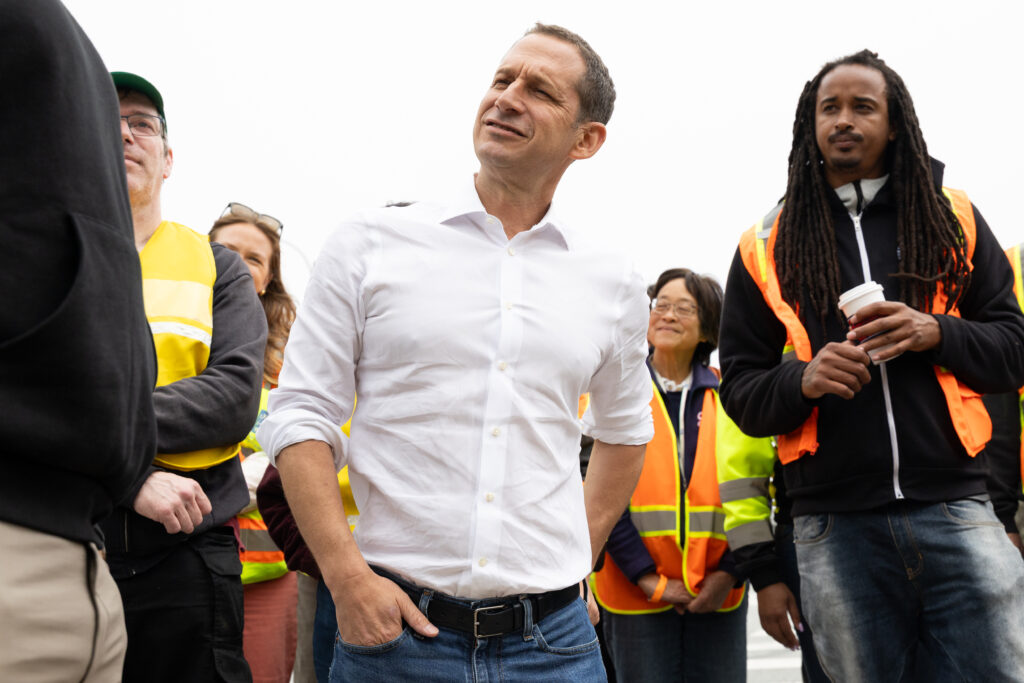
The Democratic Party is becoming a tale of two grocery stores. In New York, Mayor Zohran Mamdani has launched a pilot program for the city to own and subsidize them. In San Francisco, Mayor Daniel Lurie is cutting the ribbon at a locally owned Grocery Outlet in North Beach, a neighborhood that has been without a full-service store since the Safeway closed in 2023.
The former is part of a national story, as the progressive wing of the party pushes its way into the spotlight. The latter is part of a quieter revolution, but it’s no less transformative.
“I think it is radical for an elected official to think about his or her city and just stay focused on that,” Lurie, 49, tells me a few hours after the shop’s opening. “I think there is something that is resonating with the people of San Francisco, where they see me focus on them.”
Something is working. As of early May, Lurie boasted a 74 percent approval rating among San Franciscans. They elected him in 2024 — in a 10-point upset over incumbent Democratic Mayor London Breed — no doubt in part because he was laser-focused on reducing crime and resolving the city’s homelessness crisis. “We lost our way in San Francisco, and we didn’t keep our eye on the ball,” he tells me. “If we do that, if we do the basics of government for the people of San Francisco, they’re going to do the rest.”
Lurie, an heir to the Levi Strauss fortune, has had a few moments in the national spotlight, including last autumn when he asked Donald Trump not to send the National Guard into the city. The president agreed, after several tech executives made the case, too. “It’s an easier process if we do it, faster, stronger, and safer but, let’s see how you do?,” Trump reportedly said to Lurie. But the newcomer to politics — Lurie’s mayoral bid was his first campaign — hasn’t spent much time looking beyond the Bay.
One of the most notable differences in the city is the reduction of street encampments. Based on a preliminary count this year, the number of people living in tents has fallen by 85 percent since 2024. Homelessness still rankles the city, but the government is succeeding in getting people into temporary accommodations. The unsheltered population decreased 22 percent between 2024 and 2026, its lowest level in 15 years, and bed capacity in emergency shelters and transitional housing facilities was reported in June to be at an “all-time high.”
“We have actually more housing units per capita — permanent supportive housing units — than any place in the state. And yet we still have our crisis,” Lurie says. “That’s because we were sort of treating the issue of homelessness as just one issue, but it’s really a drug crisis on our streets.” He wants the city to get more people into treatment and recovery, “whether that be voluntary or involuntary.”
Lurie elaborates by telling me about the city’s new RESET Center. The facility, short for “rapid enforcement, support, evaluation, and triage,” is intended to serve as an alternative to jail cells and hospitals. It’s designed to help connect the homeless with treatment, and it assists the police with transferring custody of intoxicated people.
“Thirty percent of the people who have been brought into the RESET Center in the first couple months are being connected to care,” Lurie tells me. “Officers can do it in 20 minutes or less, and they’re back out on the street.”
This isn’t the mayor’s first foray into the issue. Before running for office, Lurie founded Tipping Point Community, a San Francisco-based foundation that works with local organizations to reduce poverty while increasing access to college education and higher-paying jobs. Its grants have helped provide housing for more than 9,500 people.
The way Lurie talks about progressivism is very different from how his peers invoke the ideology. “We are always going to remain true to our San Francisco values, which means taking care of each other, looking out for each other. But some of those progressive values that we pride ourselves on meant continuing to walk by somebody who was struggling with addiction on the street,” he says. “Three years ago, we had over 800 people die of overdose on our streets. Last year that number got down to 625. Still not acceptable.”
He’s hoping to reestablish deterrence. “My message from day one is: If you come to San Francisco to use drugs or to deal drugs, we’re going to arrest you, we’re going to prosecute you and we’re going to hold you accountable. … There is nothing progressive about walking by somebody who is in the throes of addiction and doing nothing,” Lurie adds.
His attitude toward crime puts him at odds with the “defund the police” and “abolish prisons” wings of his party. Yet it’s also prompted other city and state leaders to call him for advice. San Francisco homicides dropped 20 percent last year, reaching their lowest level since the 1950s. Robberies and motor-vehicle theft were down 24 percent and 44 percent, respectively, too. All three were improving before Lurie took office and have continued to fall. How’d he do it?
“Public safety is my number one priority. It’s actually my number two and three priority as well,” he says. We are sitting in the Real Time Investigation Center of the San Francisco Police Department, which uses drones and cameras to track crimes in progress. Lurie seems to know everyone on staff, and they appear delighted that he’s stopped by.
“It’s gotten better on just about every one of those numbers, again, here in 2026. We are a safe American city. We focus on it. … We were short-staffed by over 500 officers. We just graduated our largest police academy in nearly 10 years,” Lurie says. He emphasizes that there is no one fix to crime and homelessness, but if he had to sum it up: “I would just encourage anyone across the country to stay focused and not be pulled in lots of different directions.”
Yet there is another national debate that San Francisco can’t escape: the looming showdown over the use and regulation of artificial intelligence, which will center on some of the city’s most famous companies. What’s Lurie’s advice to D.C.?
“We need guardrails for this technology,” he says, but adds, “I don’t think it should be done city by city.” He hints at supporting federal preemption. “It should be done at the very least at the state level. And it would be best, I would imagine, at the federal level.”
What must be tackled at the local level is the city’s spending problem. Lurie in May 2025 said that he was ending the “era of soaring city budgets,” and he’s made good on that promise. He signed off on San Francisco’s annual budget last month, closing a near-$650 million two-year deficit. When asked whether he plans to rely on the AI boom to make up revenue, he’s keen to stress fiscal responsibility: “Whatever happens, I want to make sure that we live within our means.”
Lurie describes how the city was “caught flat-footed” after the pandemic-era gusher of federal funds stopped flowing. He’s had to make difficult cuts to balance the budget — none of which, contra his critics, has destroyed the city’s safety net. “I’m really proud of the work that we did last year when Washington and the federal government shut down and they cut access to SNAP food benefits,” Lurie says. “We, as a city, stepped up and covered a month’s worth of it for 112,000 San Franciscans.” That money, some $18 million, was found through a combination of public and private funding.
While Lurie isn’t relying on the valuation of any particular company to keep the city’s finances afloat, he is keen to play host. “The future starts in San Francisco, and we’re proud of that. And we want these companies here, and we want them doing well, and we want them paying their fair share in terms of taxes.” He adds that he wants CEOs to “be part of our city” and “help us build a broad and durable recovery.”
There is nothing us-versus-them about Lurie’s rhetoric. It’s a sharp break from that of, say, Seattle Democratic Mayor Katie Wilson, who in April waved “bye” to Washingtonians leaving the state to avoid a 9.9 percent tax on income exceeding $1 million a year. Lurie, meanwhile, was campaigning against Proposition D, a union-backed proposal that would’ve hiked taxes on San Francisco companies that pay their CEO more than 100 times the median salary of their staff. The city’s residents voted against the tax increase in June.
The mayor is having a moment in America, in large part because of attitudes like Wilson’s and grocery store stunts like Mamdani’s. Such politicking has captured the nation’s attention, but Lurie isn’t interested in weighing in on any of it. “I don’t really think about parties and ideology,” he says. “I think about getting results for the people of San Francisco. That is what I wake up in the morning thinking about. It’s what I go to bed at night thinking about.”
The foil to the rising socialists might be found in a red state with conservative values. But perhaps he’s a Democrat in San Francisco, quietly and determinedly cleaning up his city.
The post Daniel Lurie, San Francisco’s quiet radical appeared first on Washington Post.